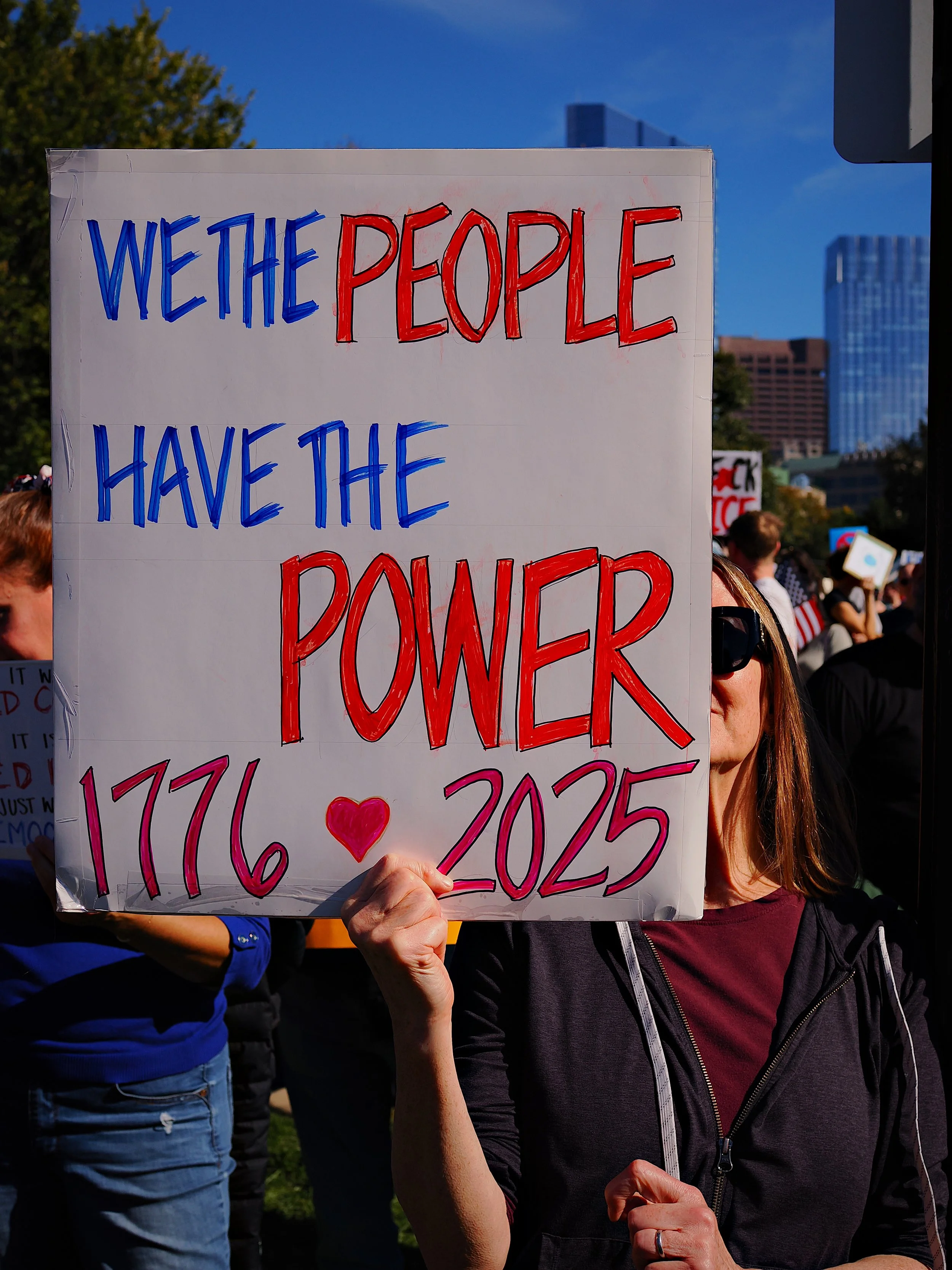
An activist’s sign from No Kings 2 in Boston on October 18, 2025. Photo from a Mass 50501 volunteer.
Preamble
For the last 10 or more years, the people's ability to feel they have a real impact on how they are governed seems to have drifted further out of reach. Here we'll explore how we came to that situation, what we've been able to do to move the needle, and what we need to do going forward.
How did we get here?
The last two years have been a real eye-opener for many Americans who took for granted the “general” humming of our government. As a result of the New Deal, we saw significant growth of the middle class and infrastructure in this country during the 1950s, 1960s, and 1970s. We could rely on clean water, support for science, weather, and the environment. We could rely on upkeep and support for infrastructure throughout this country. And we could (generally) rely on the ability to get a decent education. As a country, though not perfect, we at least strived for equality under the law and the desire to be a better version of ourselves.
Since the election of Ronald Reagan in 1980, the policies put in place that worked for the people have been slowly eroded. Between scapegoating others for “corrupt spending” (remember the “welfare mothers”?), propaganda supporting “trickle down economics”, and the biggest cuts to taxes on the wealthy in history, the American people have been squeezed by a diminished standard of living for most, challenges to our civil rights, and the skyrocketing cost of healthcare. The infrastructure we’ve relied on (and, perhaps, have taken for granted) is decaying and needs support, the deficit is climbing, all while climate change is happening at an alarming rate.
Perhaps, because people have generally felt relatively safe for the last 40+ years, even with declining standards of living and corruption behind the scenes, they weren’t paying as much attention to governance as they probably should have been. Civics classes have been removed from many school curriculums, which means not everyone really understands how our government works. Add to that, it’s difficult to pay attention and understand what the government is doing and how to use what power one might have to change things, especially when trying to raise a family and/or work one or more jobs to make ends meet.
This systemic disconnection from our governance may be a significant part of what led to the vote for Trump in the first place. And the Covid pandemic reduced the people’s sense of safety even further due to the number of deaths, conflicting information, and poor management. While the disaster of the first Trump administration caused voters to flip to Democrats, the MAGA coalition and Project 2025 continued with propaganda. And the standard of living for most Americans did not improve enough to prevent a second Trump presidency. This time around, the damage inflicted on the people by those we elected is even worse, given the lack of guardrails that were in place during the 2016 administration, the slashing of agencies by DOGE, the violence of masked ICE agents in the streets, the existence of concentration camps in our country, the unlawful tariffs, a war that no-one wants, the weaponization of the DOJ, the obvious grifting, and so on.
We The People
So we organized, protested, used our voices (postcards, calls, emails, canvassing, etc.), and used our vote. And the whole country voted for change, using arguably the strongest voice we have, the power to remove and install candidates. The election results indicate the first major shift that I’ve seen since the activism of the 1960s and 1970s. The activism of 2025 and 2026 (historically-sized No Kings protests, Tesla takedowns, boycotts of Target, etc.) have historically been the biggest seen in this country in modern history. All of this has culminated in elections that had one of the biggest turnout (for a midterm election) in recent memory, with results that strongly indicate a mandate for change.
Our Role in Governance
This election doesn’t mark the end of our struggle for everyone to have a shot at a decent life with safety. Nor will the 2028 election or elections after that. If I’ve learned anything, it’s that we’ve been fighting these kinds of power grabs throughout history (think 1890 robber barons, 1920s leading to the depression, etc.). We the people need to stay vigilant and ensure that our government serves the people. This is our civic duty it turns out, as well as the only way we can ensure a free democracy, where each voice matters. Our role in our governance is to use our voice in the myriad of ways that we can. It’s much more than simply voting, it is also speaking out when we see injustices or when we see a need for change and improvement (there are multiple ways we can do this, which are explored below). Speaking out can also ensure that people are educated on what’s happening and also on how our government works.
Now that We the People created a blue wave that was more than “too big to rig” and that we’ve elected folks we think will work for the people, what should we do now? Do we go back to assuming Congress will do the right thing? Likely no, because it seems going back to the way things were before will only bring us back here again. Furthermore, we still have two more years with an administration that is hostile toward the people of this country. There will be more battles before we can elect a new president. If (and when!) we elect a president we think will serve the people, we must not be complacent. Every citizen has a duty and right to participate in government, beyond voting if possible. And it’s not easy. If we want true freedom it means participation at some level, always.
The first step to meaningful participation is being accurately informed about what is happening in our government. So how do we stay educated about what is happening and the issues we care about? The mainstream news media has failed to accurately cover what is actually happening (some have capitulated to the current regime, censoring certain types of coverage). Many have ignored the corruption and grift, some even going so far as to seemingly applaud it. The news media is changing and there are reputable and independent journalists that we can subscribe to (for free) to gain a better picture of what’s happening (Letters from an American by Heather Cox Richardson, Status Coup Independent Media, Bryan Tyler Cohen, The Guardian, and more). We can join local groups, such as Mass 50501, Indivisible, a local church, or town committee. This is also a way to build coalitions, which helps to combine voices to push back and fight for change.
What are the other ways we can use our voice? When we understand what is happening, we can advocate for what we want. We can do that through the local groups we join, on social media, and by contacting our federal, state, and local representatives telling them what we want. Repeatedly if necessary. We must keep doing this because if we don’t tell them what we want, then we can’t sway their behavior (and if that doesn’t work, we can vote them out). There are other ways we can use our voice through targeted boycotts, protests, and organizing lobby meetings with representatives and senators.
Remember, this is OUR government. And we have the power to ensure it works for us by using our voice.
Enjoyed this article? Get updates on the movement, volunteer opportunities, and more by clicking below.