How To Engage Your Local Government
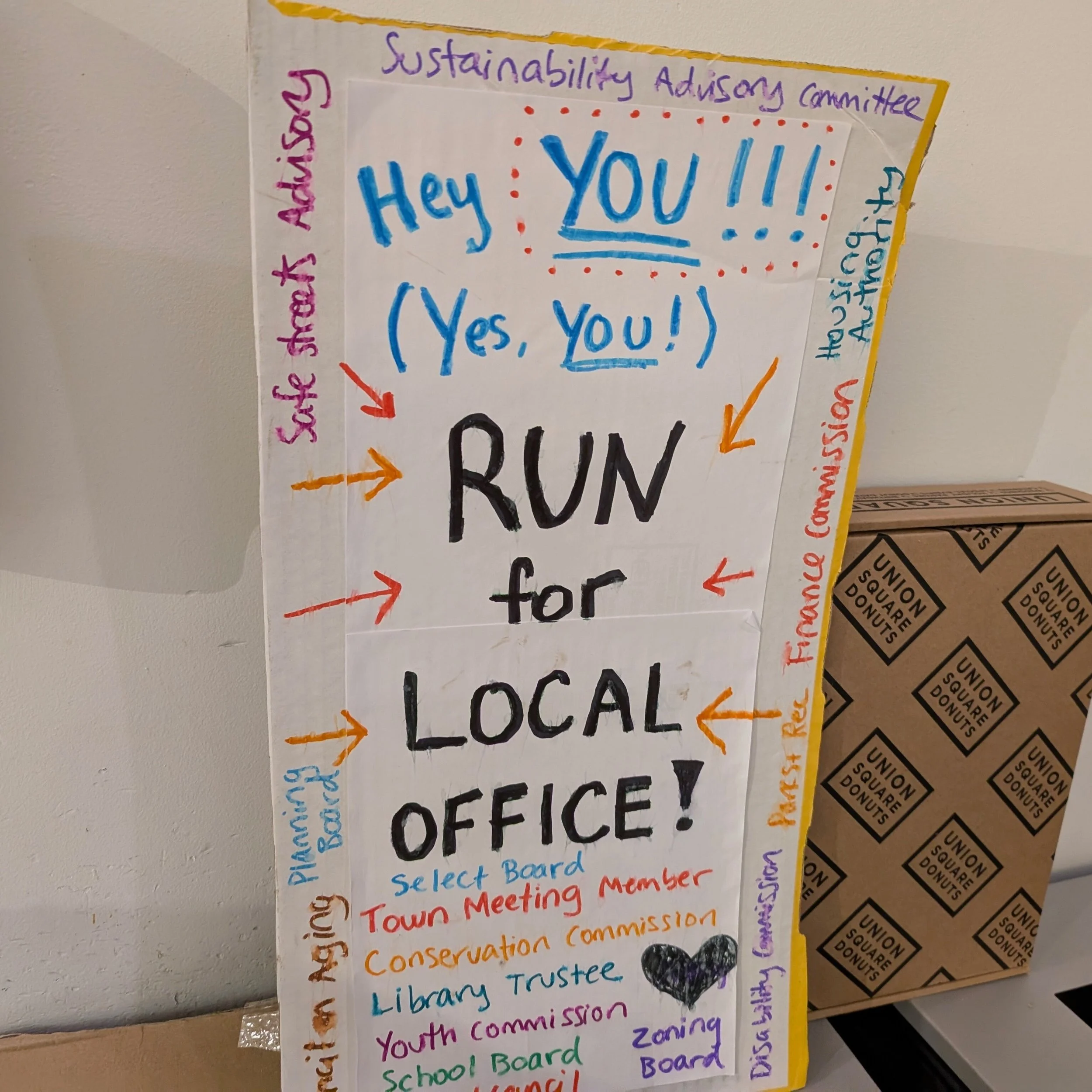
At this point in Trump’s second presidency, readers like you will be well aware of the travesties happening at the national level. However, you may not be aware of what is happening in your backyard—literally. While national issues get the most media attention, local issues can be just as important, if not more so. In this article, we hope to answer some questions you might have about municipal politics, starting with…
Why Should I Get Involved In My Town Politics?
There are two very good reasons to get involved in your local politics. First, municipal officials are fundamentally the ones responsible for deciding how schools are run, where utilities are serviced, and what the local property tax rate is. Through zoning, these officials also have great influence over what gets built. These policies may seem less demanding of our attention, but ultimately have a profound impact on our daily lives. If you want to see a change in any of these areas, that is a great reason to engage with your local government.
Secondly, municipal issues are, by definition, decided by a smaller group of people than state or national issues. These issues often don’t neatly overlap with the charged, partisan topics which collect the most media attention. As a result, getting active in your town politics is often the easiest way to effect change. As an added bonus, it can also be a great way to meet new people in your community.
How Is My Town/City Governed?
When getting to know your local government, it is important to first learn if your municipality has a city- or town-style government. Knowing this is not always easy, because some towns call themself the “Town of ___,” despite having a city-style government. However, there is an easy way to resolve any confusion; Just look at your town on this map here.
If the options on this map appear overly complicated—you’re right! Massachusetts’s municipal structures are notoriously confusing, but it’s for good reason. Unlike most of the country, where counties are the fundamental building block of local governance, in Massachusetts, municipalities reign supreme, with most county governments in the state having been abolished in the late 1990s. This ultimately gives Massachusetts’s 7 million residents, spread out across 351 towns and cities, more power than those in either Texas, with its 32 million residents spread out across only 254 counties, or those in Rhode Island, which has 1 million people and 39 municipalities (like Massachusetts, Rhode Island also lacks county governments). The diversity among our municipal government structures is the price we pay for this greater representation. There are historical reasons for the complexity, too. Several towns predate both the creation of the Province of Massachusetts Bay, which politically unified most of the modern-day territory of Massachusetts, and the creation of the United States. Because New Englanders tend to cling tightly to their local traditions, some historical legacies were unavoidable.
How Does Town-Style Government Work?
Most municipalities in Massachusetts (83%) have a town-style of government. Town-style government is set apart from city-style government by the hosting of a Town Meeting at least once per year, something cities lack. Town Meetings are where all the legislation for local laws, known as town by-laws, is passed.
The exact process and rules of a town meeting vary significantly by town, but a few practices are standard. For instance, all town meetings will be announced well beforehand, and prior to the meeting, the town will release a “warrant” listing the articles to be voted on at the meeting. This warrant can be viewed on your town website, or picked up at the town clerk’s office. The meeting is then typically held at night at a school auditorium. Volunteers will check IDs at the door to verify residence (nonresidents can still attend, but their participation is limited). Once the meeting starts, the town moderator will announce each article (it will also likely be displayed on a projector screen), and voters will have a chance to debate the article before a vote takes place to see if the article passes or not. This process continues until all articles are voted on and the meeting is closed.
Town Meetings can be “Open” or “Representative,” with the difference between these types of meeting being who gets to vote. In an Open Town Meeting, all town residents are allowed to vote and debate. This practice is historically how most towns in Massachusetts, including all of the oldest towns, were governed. However, due to the challenge of fitting large numbers of people into auditoriums, some larger towns—mostly those with populations over 25,000—have switched to holding Representative Town Meetings. In these meetings, only certain elected residents known as “Town Meeting Members” can vote. For a given town, the number of Town Meeting Members is typically in the hundreds, and so members are often elected by very small margins, and candidates sometimes win through write-in campaigns. Out of the whole state, 11% of towns, representing 13% of the state population, have Representative Town Meetings.
In addition to being “Open” or “Representative”, meetings can also be “Annual” or “Special.” However, the differences between Annual and Special meetings are not as extreme. Effectively, Annual Town Meeting refers to the meeting where voters approve the budget for the next fiscal year, and Special Town Meeting is the generic term for any other Town Meeting. As the name suggests, Annual meetings are required to happen every year. By contrast, there is no statewide rule for when Special Town Meetings happen. Depending on the town, they may be recurring (happening annually in the fall, for instance), or may only be called if a time-sensitive vote is needed. Due to rules about what issues can be voted on at what meeting, a Special Town Meeting may be held immediately following the close of the Annual Town Meeting.
Of course, it is not possible for whole towns, even small podunk ones, to be run by once-per-annum meetings. This is where the town Select Board, historically referred to as the Board of Selectmen, comes in. The members of the Select Board are residents elected to three-year terms who oversee the town functions part-time, often unpaid. Because Select Board members usually have full-time jobs aside from their town service, the Select Board hires a town administrator (some towns call them a town manager) to deal with the day-to-day management of the town. This administrator is typically the highest-paid official in town, but is not necessarily a resident, and their job is to coordinate between all the different town departments. They report to the Select Board, while other municipal employees (police and fire departments, the department of public works, etc.) report to them. They are the person to talk to if a government department is not performing their function (e.g., road clearing). By virtue of their position, they are often the most educated person on town matters, and can be a useful resource if you can get a hold of them.
While the Select Board members are the chief executives of the town, they are not the only elected officials. There are elected committees which oversee specific town departments. Each town has a school committee, which oversees the schools, and a budget committee which helps draft the town budget. Towns may also have additional bodies for overseeing utilities, parks, or funding supporting cultural initiatives, for instance. Both the Select Board and committees hold public meetings on a regular basis which the public can attend and listen to what is being discussed (meetings may be attended in person or, especially since the pandemic, online). People may provide comments at these meetings; however, if there is a topic you wish to address at the meeting which is not on the agenda, and the agenda does not list an “open session,” it is best to reach out to the committee more than 48 hours beforehand so that the item can be placed on the agenda. If you do not obey this principle, officials may not respond to the comment.
How Do I Get Involved With My Town?
What this means is that if you live in a town, there are two upcoming dates you need to know: The date of the Town Meeting, and the date of the town election. If you are reading this article on March 27, its publication day, these dates are likely coming up soon. State law requires towns to schedule both their Annual Town Meeting and their Town Election between February and June, with the vast majority not happening until April, when the weather warms up. You can check the dates of these events by looking your town up here.
Voting in town elections is a good idea, but requires voter registration (you can check your registration status here). However, if you don’t know where to start, the best thing you can do is go to your Town Meeting. Attending is the most direct way to learn about the most important issues in your town, as well as where your local tax dollars are being spent. It will also introduce you to all the important town officials, who should all be there, allowing you to put faces to the names you might read in your local paper. If you are the kind of person who appreciates hearing different perspectives, going to Town Meetings may even be fun! As you become more active in town politics, you can then consider attending hearings of the committees you are most interested in. Eventually, you may choose to run for a seat, or present your own article at town meeting; it only takes as few as ten valid signatures to get an article onto the town warrant.
How Does City-Style Government Work?
While most municipalities are towns, the majority of state residents (55%) live in cities. Due to the size and added complexity of cities, cities have different structures which make them more effective at delivering their services at scale. There is significant variation in the structure of the state’s 59 cities—state law recognizes six different forms of city government. To keep things simple, I will only discuss general properties of two forms of city government: Mayor-Council and Council-Manager.
The chief difference between a town and a city is that legislation is not done by a large group of town residents, but rather by a small group of 9 to 13 officials elected to the city council. Unlike Select Board Members, city councilors are full-time, paid officials. City councils serve very similar roles in both Mayor-Council and Council-Manager systems; the difference between these systems is who oversees the city’s executive functions. In a Mayor-Council system, which about three-fourths of cities follow, a democratically elected mayor oversees city departments. In a Council-Manager system, the council hires a manager similarly to how towns hire town administrators. The specific powers of these managers and mayors varies from city to city. (Note: The cities of Cambridge, Lowell, and Worcester have unique systems involving both a mayor and a city manager.)
How Do I Get Involved With My City?
If there is an issue that is important to you, the first thing you should do is go to your city’s website and determine who your councilors are. Next, you should reach out to your local or at-large councillor (a councillor representing the entire city), who should help you with your request or refer you to the appropriate committee or department. Do NOT reach out to the entire council with your issue. Voting in elections is another way to get involved. However, unlike towns, which set their own election dates, elections for cities happen on the same date reserved for federal elections (the first Tuesday after the first Monday in November), but on odd-numbered years. This means that the next city elections will not take place until November 1, 2027, so you have to wait a while to vote.
Conclusion
Confusion is the first obstacle to engagement. We hope this article makes you better equipped to deal with issues in your local community. Not sure where to start? If this article has excited you to become engaged in your town or city, but you don’t know what issue to get involved in, consider talking to your elected officials about the dangers presented by Flock Safety. Flock Safety is the company behind surveillance tools, including AI-powered Automatic License Plate Readers, which track people, often without their knowledge. Because Flock often partners with local police departments, much can be done at the local level to stop Flock from taking over our privacy. See here for advice on how to pass Flock-restricting bylaws at your Town Meeting, here for a call script to talk to your local elected officials about Flock, or click here to read answers to frequently asked questions about Flock.
Enjoyed this article? Get updates on the movement, volunteer opportunities, and more by clicking below.