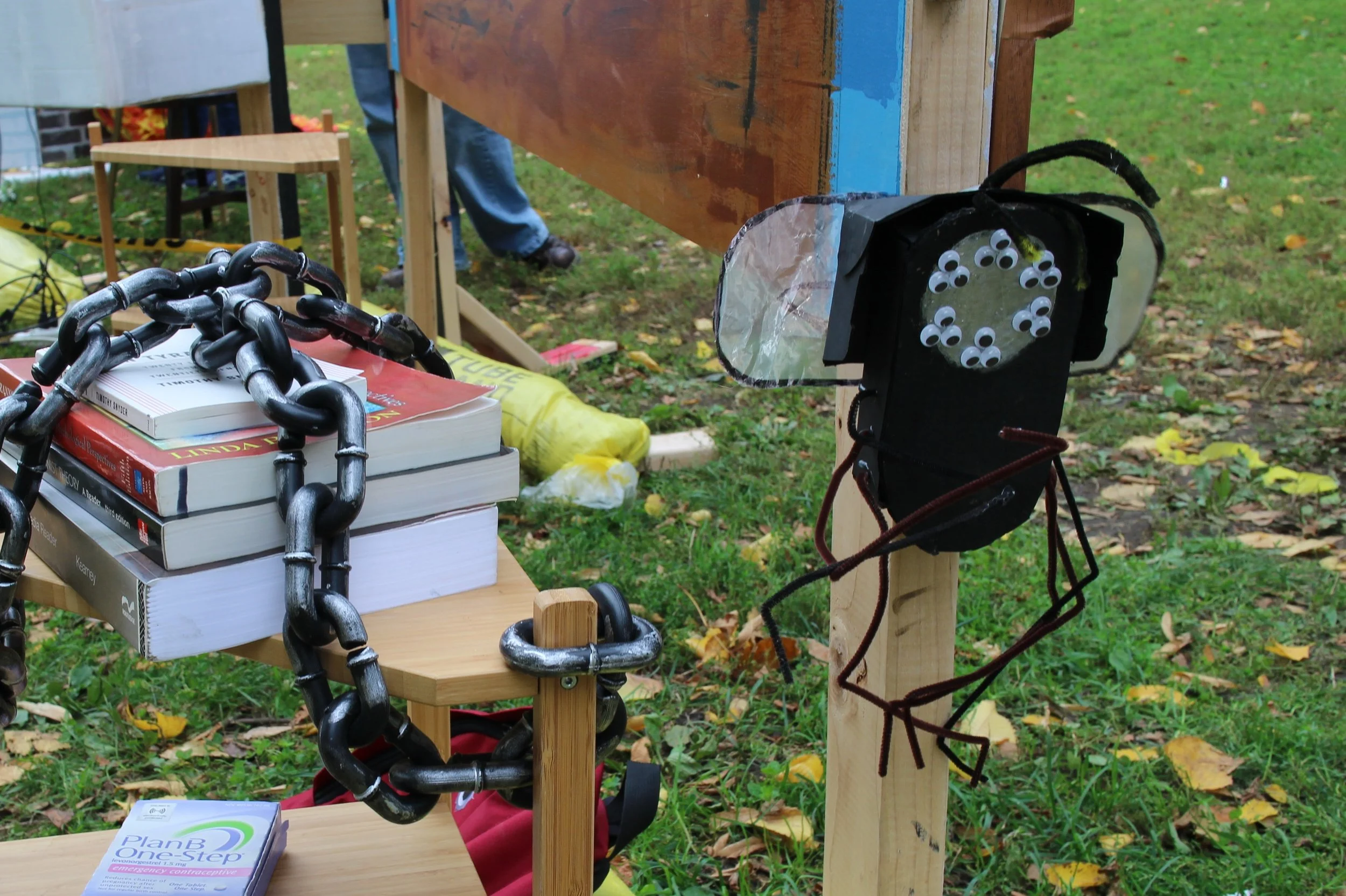
An artistic rendition of a Flock camera at Mass 50501’s Authoritarian House of Horrors at No Kings 4 in Boston. Photo from a Mass 50501 volunteer.
When talking about making massive, sweeping changes to the way something is happening in society, it’s a lot easier to say “no” than it is to say “yes.” It’s easy to say things like “Flock Off.” The slogans are simple and unifying, and the victories are concrete. Whenever a city or town shuts off their Flock cameras, it’s a victory, whether they’re doing it because they’re focused on civil rights or because they just woke up feeling cute that day. Anything that results in fewer cameras in a dystopian nationwide dragnet AI surveillance network is a win. However, now that more towns and cities have shut their cameras off, and many of them are looking at next steps, it has become critical that we articulate what we want a better world to look like. As solutions are being put forward, we need to be clear about what we can—and can’t—say “yes” to.
A wide range of responses to the public outcry against ALPRs (Automatic License Plate Readers) are being considered across the region. Some municipalities, such as Provincetown and Middleboro, have voted to ban use of the technology. Some have passed or considered a range of local legislation to regulate use of the technology, including CCOPs from the ACLU of Massachusetts and Articles 21 and 22 that were referred to a subcommittee at the recent Special Town Meeting in Tewksbury. Some municipalities, such as Boston, are piloting Flock competitors. Some are trying to negotiate Master Service Agreements (MSAs) with Flock, or are simply updating their privacy settings in the Flock portal. The Massachusetts Public Safety Chief recently suggested giving Flock a “PR makeover.” New Hampshire has passed strict statewide legislation for ALPR use, including a 3-minute data retention limit unless a plate is matched to a hot list.
I’m sure some of these responses sound more palatable than others. Let’s talk about why:
The movement against Flock has been widespread and nonpartisan, largely because many of the concerns with Flock are rooted in common sense. Some concerns that have come up repeatedly are very, very basic; it almost feels silly to have to say them out loud. Other concerns are rooted in fundamental American values. These are the things we grew up learning about in civics class as the foundation of American democracy. This makes it very easy to unify behind some shared principles as we move away from being an opposition movement and towards a movement articulating concrete plans that we can support.
Below are five suggested requirements for any proposed solution to the concerns with Flock, ALPRs generally, and mass surveillance technology more broadly. These should be the absolute minimum standards when evaluating next steps; these are principles that can unite groups around the country and across the aisle. Many solutions do a lot more! Some communities don’t want ALPR technology at all; a ban would meet and exceed these minimum requirements. If your town or city is proposing next steps that don’t meet all of these criteria, though, feel free to pull ideas from this list for ways to articulate what your concerns are.
Common Sense Principles:
1. No one can effectively audit themselves; accountability needs to come through regular, independent oversight.
Problem: Many police departments either have no auditing procedures or conduct all audits internally. We have seen many examples in the news of why that can be a problem. Concerned citizens submitting FOIA requests at random intervals has resulted in some accountability and oversight, but should not be the default means of uncovering misuse.
Solution: If a government system is collecting data that could be used to build a profile on any person or group of people, there must be a regular, independent review of training and access procedures, data security, civil rights impacts of data access, and established disciplinary measures for failure to follow established procedures.
2. Once the data leaves your control, you’re no longer in control. A local data storage option with strict controls on sharing should be mandatory in any contract with a provider.
Problem: Many police departments developed strong training, access controls, and civil rights protections. Then they connected to a local, regional, or even national automatic sharing network and discovered that their data was being queried millions of times by outside entities. Those aforementioned protections were dwarfed by the overwhelming percentage of inquiries coming from outside sources instead of from the department’s own trained employees. The data security became as good as the combined failures of the weakest links in that entire network. If you have one person in that network sharing their credentials with their spouse who works for ICE, your data is now accessible to ICE whether or not your department is prohibited by law from sharing it with ICE.
Storing the data on Flock’s servers also means that, ultimately, Flock controls a large portion of what happens with your data. You get to experience exciting moments like this accidental release of private law enforcement searches to the general public without any ability to control the practices that caused it. You get to be surprised by fun new types of undisclosed data tracking when Flock tries to sell you that data later. While some people like surprises, when civil rights are on the line you might want to retain local control.
Solution: Data should be controlled locally. Refuse automatic sharing agreements and select a provider with the architecture to support local data storage. Local storage and control provide a pathway for local accountability and enforcement when access controls are violated.
American Values:
1. Fourth Amendment: Americans are protected from unreasonable search and seizure.
Problem: As the Flock network expanded rapidly, what was actually being tracked shifted. Capturing an image of a vehicle in plain view at a single point in time isn’t unreasonable search and seizure. When the cameras proliferate, though, a single search could reveal a detailed profile of movement. In Commonwealth v. McCarthy (2020), a Massachusetts court held that if ALPR technology produces a detailed enough picture to reveal a mosaic of one’s daily life, it may constitute a Fourth Amendment search. At the time, there weren’t enough cameras to reveal that mosaic for that specific case. In United States v. Kyle (2026), though, an ALPR search revealed over 50 records in a month and a federal judge ruled that the search triggered Fourth Amendment protections.
Solution: If a government system is collecting enough personal data that it could be used to build a profile on an individual or group, a judicial warrant should be required to store or access that data.
2. Presumption of innocence.
Problem: Flock has been in the news for illustrating many of the problems with the phrase, “if you aren’t doing anything wrong, you don’t have anything to worry about.” The ACLU tracked a pattern of pulling people over because their driving patterns are deemed “suspicious.” These encounters can be extremely dangerous. A man was shot in San Diego over a false ALPR identification.
Solution: Automated systems should not be monitoring the general population to proactively find reasons for a traffic stop. If any kind of passive alerts are allowed, they should come exclusively from lists which require a judicial warrant for vehicles to be added for tracking. We don’t police pre-crime in the United States, and an AI alert that someone might be driving suspiciously should not be sufficient to track down a vehicle and prompt a traffic stop.
3. Authority derives from the consent of the governed.
Problem: Many Flock cameras popped up across the country without public disclosure or feedback. If a contract could be located at all, there were often extremely concerning provisions. In some cases, the contract couldn’t be located at all.
Solution: Require new surveillance technologies to go through a publicly-accessible review and approval process.
As of this writing, over 40 municipalities in Massachusetts have shut off their Flock cameras. Strong grassroots movements have risen up across the state, from Cambridge to Framingham to Haverhill to New Bedford. Those 40 cities and towns are on the forefront of shaping what a future looks like where this technology exists AND we decide that we are in control of shaping the ways we interact with it. As different paths are explored, it is critical that we maintain our values and goals in clear view. Placation isn’t progress: a “PR makeover” or replacement with a substantially similar competitor doesn’t solve the underlying problems. This is a critical moment in the movement when we collectively decide what our progress means.
No matter where you are in Massachusetts, I encourage you to reach out to your state legislators to ask them to cosponsor legislation in the upcoming legislative cycle that meets at least the five criteria listed above. If your municipality is considering removing and/or regulating ALPR cameras, I encourage you to reach out to your local officials as well!
If you are getting started with new organizing efforts in your town or city and want support, please feel free to reach out at flockoff@mass50501.org.
For more background information about Flock Safety and AI-powered License Plate Readers, visit our action page.
Enjoyed this article? Get updates on the movement, volunteer opportunities, and more by clicking below.