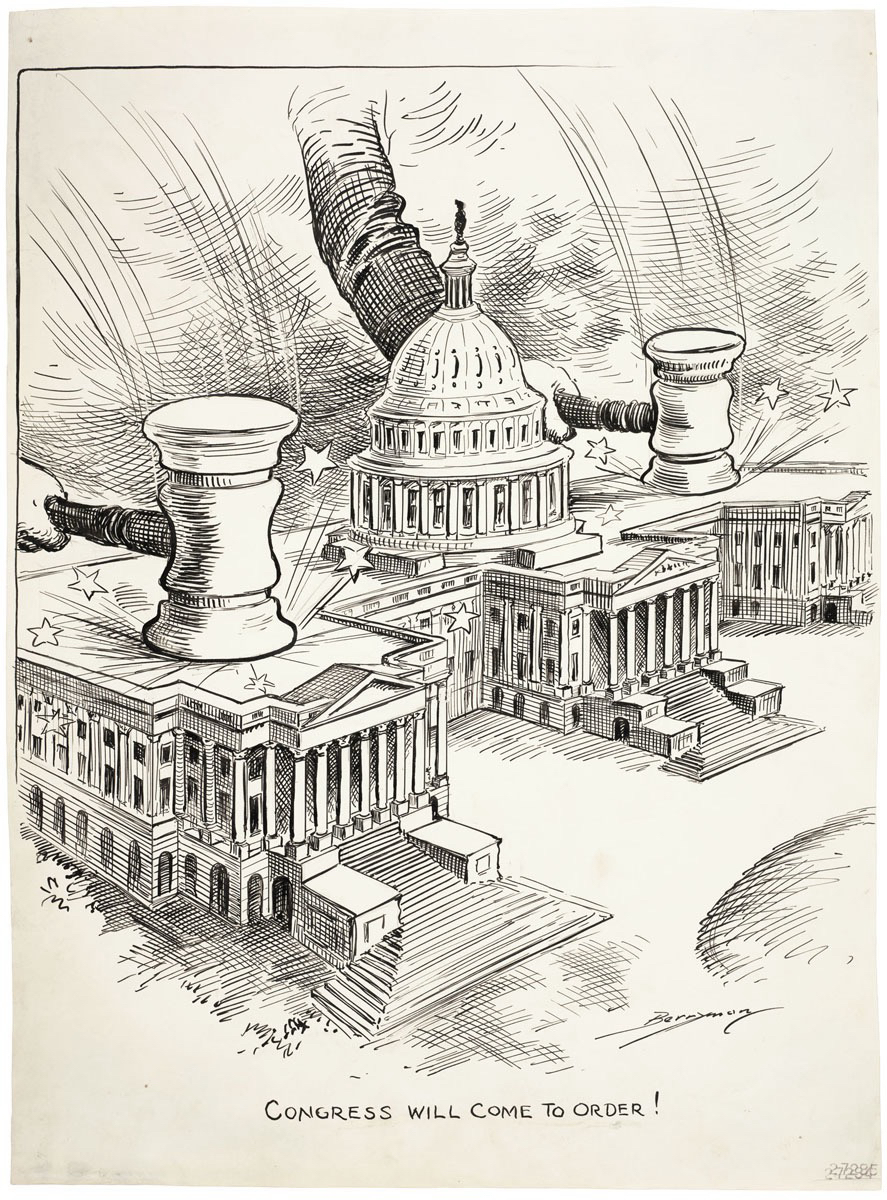
“Congress Will Come to Order!” Cartoon by Clifford Kennedy Berryman, December 2, 1912, depicting the 62nd Congress. It memorializes the 1912 election in which Democrats won the Presidency and control of both the U.S. House of Representatives and the U.S. Senate. Image via The Library of Congress https://catalog.archives.gov/id/306178
The people have voted, and now the Democrats are set to take over Congress when the newly-elected members are sworn in on January 3. With the new Congress will come new leaders to be selected by the incoming senators and representatives.
Whoever the leaders are will have their hands full. The country is in the midst of a cost of living crisis spurred by Trump’s tariffs and his war with Iran. Making things worse, it appears that the economy is in an AI-inflated bubble which could pop anytime, assuming rogue, unregulated AI doesn’t wreak havoc on us first. This would be a lot to deal with in any congressional term. However, next year, with the authority of Congress under assault, congressional leadership will also need to answer key questions about how to deal with the executive branch under Trump’s leadership: How will Democrats wield their oversight powers to investigate the strong evidence of corruption? Will Congress investigate the apparent lawbreakers in the administration? Will the Democratic Senate rubber-stamp Trump appointees as the Republicans had, or will they ensure only experienced public servants take up these roles? Looming over all this is the prospect of impeachment of Trump and/or his Cabinet members. A motion was already made to impeach Defense Secretary Pete Hegseth this week. Will these sorts of actions continue when Democrats gain control of the House?
Accomplishing both these objectives—solving everyday issues faced by Americans and holding the Trump administration accountable—should be possible. However, it is also true that Congress has a finite capacity to get things done. As such, it will be the job of the next speaker of the House and the next Senate majority leader—the top jobs of Congress’s two chambers—to balance them, and whoever holds those key positions will have an outsize role in determining the trajectory of the next two years.
In the rest of this article, I hope to answer some questions you have about these roles, starting with
What are the responsibilities of the House speaker and Senate majority leader?
In their respective chambers, the speaker and majority leader each get one vote on any legislation, the same as every other voting member of Congress. Despite this, they have more power than other members. In Congress, legislation gets voted on by a committee before proceeding to a floor vote by the whole chamber. The leaders pick both who will serve as chair of each of the committees and schedule the floor votes. These two powers give them incredible influence over what legislation actually gets voted on.
In addition to these procedural duties, the leaders also serve a key political role as well. Because their job depends on having their party control a majority in their chamber, they have a natural interest in how many of their party get elected. To this end, these officers spend time recruiting candidates across the country to run and fundraising for their campaigns.
Lastly, because of their influence, many reporters rely on their statements to predict what will happen next in Congress. As such, they play a key role in communicating key priorities to the American people as well.
How are the speaker and majority leader selected?
The Senate party leader and the majority party’s candidate for speaker are selected by the incoming Congress by a secret ballot, prior to being sworn in. The decision making for majority and minority party leaders ends here—whoever wins the party vote is the party leader. The speaker is officially chosen by a full House vote when the new Congress starts its session in January. However, because Congress always votes for this on a party line basis, the election for the democratic candidate for speaker is almost certain to decide who the next speaker will be.
This year, House Democrats will caucus to select their speaker nominee and their party leadership on November 18 or 19. The Senate Democrats haven’t scheduled their caucus yet, but it is expected to take place in early December.
Who will be the next speaker and majority leader?
While the selection process is still ongoing, it is typical for the former party minority leaders to ascend to these offices when a new party takes control in Congress. The current minority leader in the House is Hakeem Jeffries of New York, and the current Senate minority leader is Chuck Schumer, also from New York. These two are the only ones so far to step up for the positions to lead each chamber next year. Here is how they are likely to govern their respective chambers.
How would Chuck Schumer lead?
Chuck Schumer has led the Democrats in the Senate since 2017. He has been the minority leader during the Trump years (both Trump’s second term so far as well as the entirety of his first term). He was also previously the majority leader throughout the Biden administration.
Schumer’s recent history as minority leader provides an indication of how he will lead a majority. When DOGE began its hostile takeover of the government in early 2025, illegally cutting funds appropriated by Congress, Schumer did little more than make mild statements denouncing the matter. Later in 2025, Senate Democrats under Schumer’s leadership forced a government shutdown to negotiate for an extension of healthcare subsidies for 24 million Americans. While Schumer held firm, enough Democrats ultimately broke rank after 43 days to end the shutdown and restore pay to government workers without a healthcare concession. These episodes show that Schumer is unlikely to be a vocal advocate for Congressional authority and unlikely to hold a unified front in the face of opposition. Since Schumer voted against nearly all of Trump’s second-term Cabinet appointments and all of his recent judicial appointments, a recoronation of Schumer would probably lead to a change to who sits in these positions, provided that vacancies emerge.
If Schumer becomes majority leader again, he is likely to prioritize collaboration with the Trump administration on certain issues over pursuing full-on conflict. He has already indicated that his top priority is to pass small-bore, targeted legislation related to improving the cost of living. Schumer’s motivating idea behind this strategy appears to be that either Republicans (possibly including the president) will work with him to the benefit of Americans’ finances, or they won’t and the resulting partisan split in the vote record will give Democrats a political edge going into the 2028 elections.
On accountability, Schumer has signalled openness to it, expressing approval of impeaching and removing of Hegseth specifically, but has made clear that accountability comes second to cost issues. There is no need to take my word for this analysis. Following the election, Schumer told the New York Times, “We have to look into the most egregious examples of corruption. And of going against his bad people. I would be for him kicking Hegseth out tomorrow. [...] But number one is costs, meaning focus on reducing the cost for the American people. If we just did corruption, we’d be a loser. If we didn’t do any corruption—you got to do some but not let it overshadow and take away what we can do on costs.”
How would Hakeem Jeffries lead?
Hakeem Jeffries has been the topmost House Democrat since 2023. If Jeffries is voted in as speaker of the House, he would become the first Black speaker in American history.
Having only been the House Democratic leader for two years, Jeffries has less of a track record to examine than Schumer does. Like Schumer, he was slow to forcefully respond to the DOGE actions of 2025. However, in July 2025, in the run-up to the passage of the One Big Beautiful Bill, which eliminated the healthcare subsidies and allocated $170 billion in funding for ICE, Jeffries spoke for a record 8 hours and 44 minutes in opposition. Jeffries has also kept his party mostly unified in the face of government shutdowns; only six of the 212 House Democrats voted to fund the government at the end of the Fall 2025 government shutdown. After the shutdown was over, Jeffries succeeded in getting the House to pass an extension of the healthcare subsidies over House speaker Mike Johnson’s objections. (The bill died in the Senate.)
Jeffries has provided mixed statements on how he would lead his caucus in the next two years. He has alarmed those who wish to see accountability by meeting with Jared Kushner, Trump’s son-in-law, before the election to find areas of “common ground.” Likewise, in a post-election interview on MS NOW, Jeffries said, “the American people don’t want us to get even, they want us to get things done on their behalf.” These actions could suggest that holding hearings on Trump officials would not be a priority. However, other statements he has made suggest a more aggressive agenda. Just this week, perhaps in response to public pressure, he has said that he wants to “hold crooks to account.” Prior to the election, he stayed quiet on the subject of impeaching Trump officials, although he did say that Democrats would “run Pete Hegseth out of town” if they won a majority. This week, Jeffries voted to proceed with a procedure to impeach Pete Hegseth. All Democrats who were present voted with him.

An activist’s sign from Mass 50501’s Show Pride for Democracy Rally in Boston, March 15, 2025. Photo from a Mass 50501 volunteer.
I have an opinion on who should be the next House speaker and Senate majority leader. What should I do?
If you want to have a voice on picking who the next Senate majority leader should be, call your senator. Elizabeth Warren’s office can be contacted here, and Ed Markey’s office can be contacted here. If you are not in Massachusetts, call the U.S. Capitol Switchboard directly at (202) 224-3121 to be transferred to your senator.
If you want to have a voice on picking the next Democratic candidate for speaker of the House, contact your representative. You can find out who your representative is here.
Call soon! House Democrats are voting in less than a week, and Senate Democrats are likely voting in less than a month.
Enjoyed this article? Get updates on the movement, volunteer opportunities, and more by clicking below.