The Story of Sonny V.
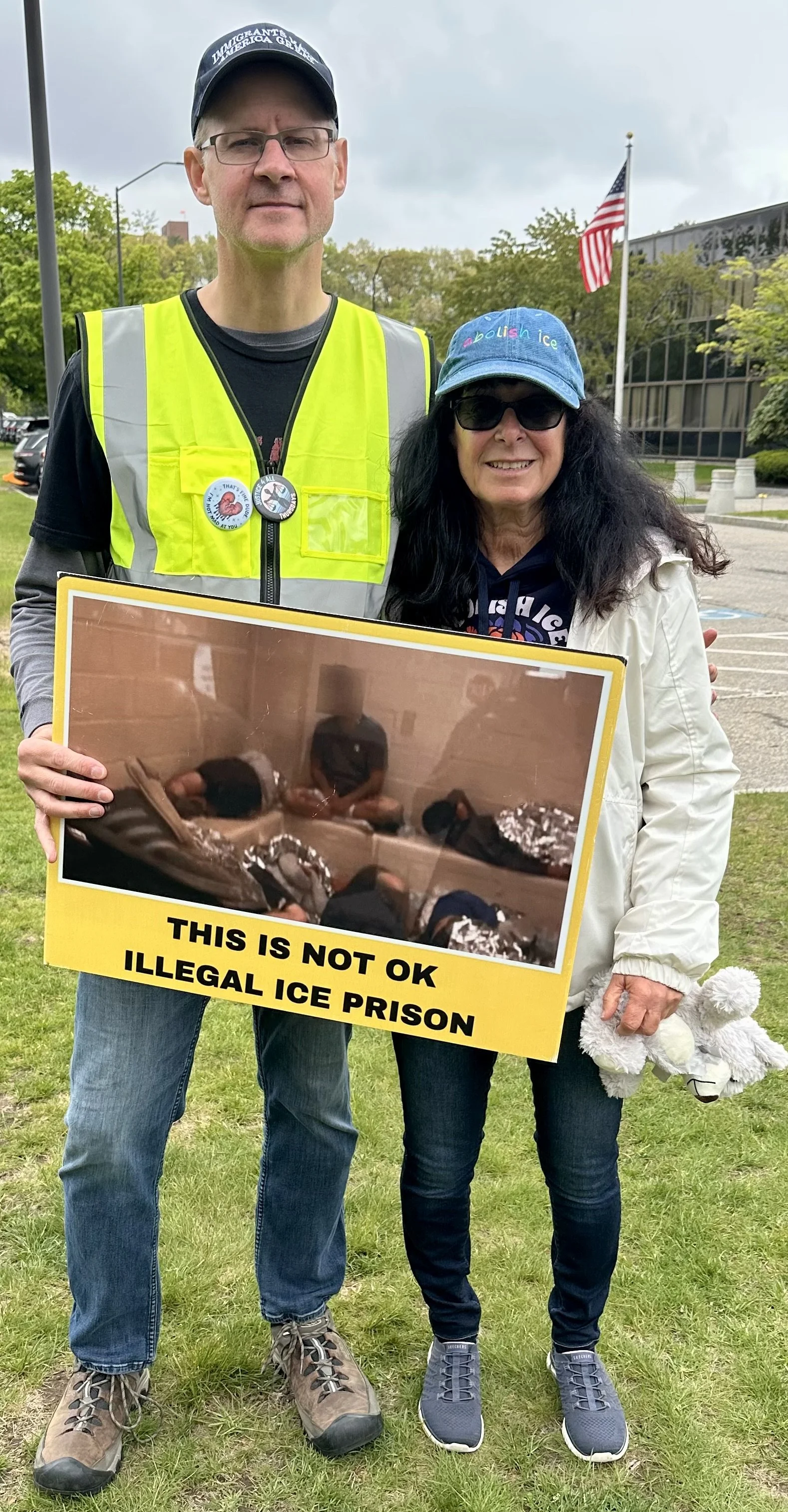
Todd Palmer and a fellow volunteer protesting the conditions under which Sonny and other immigrants have been detained at the ICE Facility in Burlington. Photo by Rabbi Susan Abramson.
Todd Palmer is a retired engineering manager turned immigration activist. Over the course of Trump 2.0, he has spoken at No Kings, joined Greater Assabet Indivisible Network, become a Substack author, launched a weekly protest at the ICE Facility in Burlington called Justice 4 All Thursdays, joined the De-ICE Hanscom Coalition, and is a co-lead on the Indivisible Mass Coalition’s Immigration Justice Action Team. Central to everything he does is his belief that America should live up to its stated ideals, as expressed in the Pledge of Allegiance and “The New Colossus.”
Under this Trump administration through March 10, 2026, ICE has arrested 7,030 people in Massachusetts. Of those arrested, 46 percent had no pending charges or convictions, 35 percent had pending criminal charges, and 19 percent had criminal convictions according to a WBUR analysis of data from the Deportation Data Project. There were 685 people convicted of serious crimes, classified by ICE as Case Threat Level 1, under 10% of the total. When asked whether people who have committed violent crimes should be deported, 87 percent of Americans say yes. I hope today’s story will convince you that the answer to that question should always be, “It depends.”
A friend said to me one day last fall, “I think you’d enjoy meeting my friend Sonny. He was detained for 90 days in Plymouth. He was in that photo,” she texted me. I didn’t know what picture she meant, so she sent it to me. And it was THAT PHOTO, the only known photo showing the inside of a Burlington hold room.
I visited Sonny and his girlfriend Katie at their home in December and January. The first time I went, I suggested a time of 2 PM; I was trying to avoid any possibility of them trying to serve me a meal. It didn’t work, and Katie prepared some salmon, ravioli, and a salad. I wasn’t hungry but I ate it anyway.
On May 30th, 2025, Sonny’s life was upended. Katie, his girlfriend of eight years, took the phone call from ICE. They said they needed to “update information.” ICE’s Operation Patriot was being covered in the news, so Sonny knew what this meant. He called them back and was told “we just need to update some paperwork.”
“Listen, I see what’s going on on TV, so don’t BS me,” Sonny told them. “Just give me 10 minutes, let me say goodbye to my family and you guys can come. But please, when you come […] don’t make a scene.”
Sonny was taken to Burlington. Sonny was put into one of the holding rooms with 30-40 other men, one of whom was Marcelo Gomes da Silva, the high school volleyball player from Milford detained by ICE on his way to practice.
Marcelo was released Thursday, June 6th, and Representatives Seth Moulton and Jake Auchincloss were in Burlington along with TV crews. Moulton described the facility as “obviously completely inappropriate—I would say, inhumane—for long term detention.”
Sonny spent four days and three nights in those conditions. The photo first emerged online, then appeared on Boston.com. Through a glass door or window, you can see six men: three lying on the floor, one of whom was Marcelo, and three more on the built-in bench. In the far corner of the room, a man is sitting and facing the camera; his face is blurred to protect his identity, but that man is Sonny.
That photo, along with the building’s floor plans, the statements by lawyers and members of Congress, and the statements of people who have been detained are the best proof of the blatant violations of the 8th Amendment to the Constitution that continue to this day in Burlington.
You can see there are no windows, no beds, the overcrowding, the absence of anything but a hard surface on which to sit or lie. Sonny says that if they had been able to see down the other end, it would have looked worse.
Sonny told me the guards were terrible. He asked one, “Why am I here?” and the guard replied, “You got in a fight, didn’t you? Well, let me tell you something. Vietnam is taking people back, and with this administration… yeah, bye bye.” That same guard also spoke to Katie, who said he was very definitive, saying, “You’ll have to wait three months to find out what’s going on […]. [He’s] gonna be sent back to a country, a different country and not home.”
From Burlington, Sonny was transferred to Plymouth County Correctional Facility. Plymouth was better. You have a bed and you can use the phone. After 30 days, you get a tablet which allows you to make calls home during allotted “rec time.”
Sonny was pressured to sign self-deportation orders. “These poor guys from El Salvador, Mexico, Brazil […] they would just sign their life away to be deported […] because they didn’t want to be there anymore […]. They tried that with me numerous times and I just refused.” Sonny showed me a paper where he was written up as “refused to sign.”
Sonny was held at Plymouth until August 28th, 90 days of detention. After 90 days in ICE custody, you are entitled to a review called a Post-Order Custody Review (POCR). After POCR, you may be held another 90 days or be released with monitoring.
Because Sonny had a final removal order, his only path forward was for a judge to re-open the case. His lawyer filed a motion to reopen (MTR), and the judge granted it. Sonny was lucky: in FY2025 judges approved just 10 percent of these motions.
Then, on January 12, the judge terminated Sonny’s case. I can only infer that, after reviewing a case rooted in a felony conviction from 19 years ago, the judge found ICE’s actions unjustified.
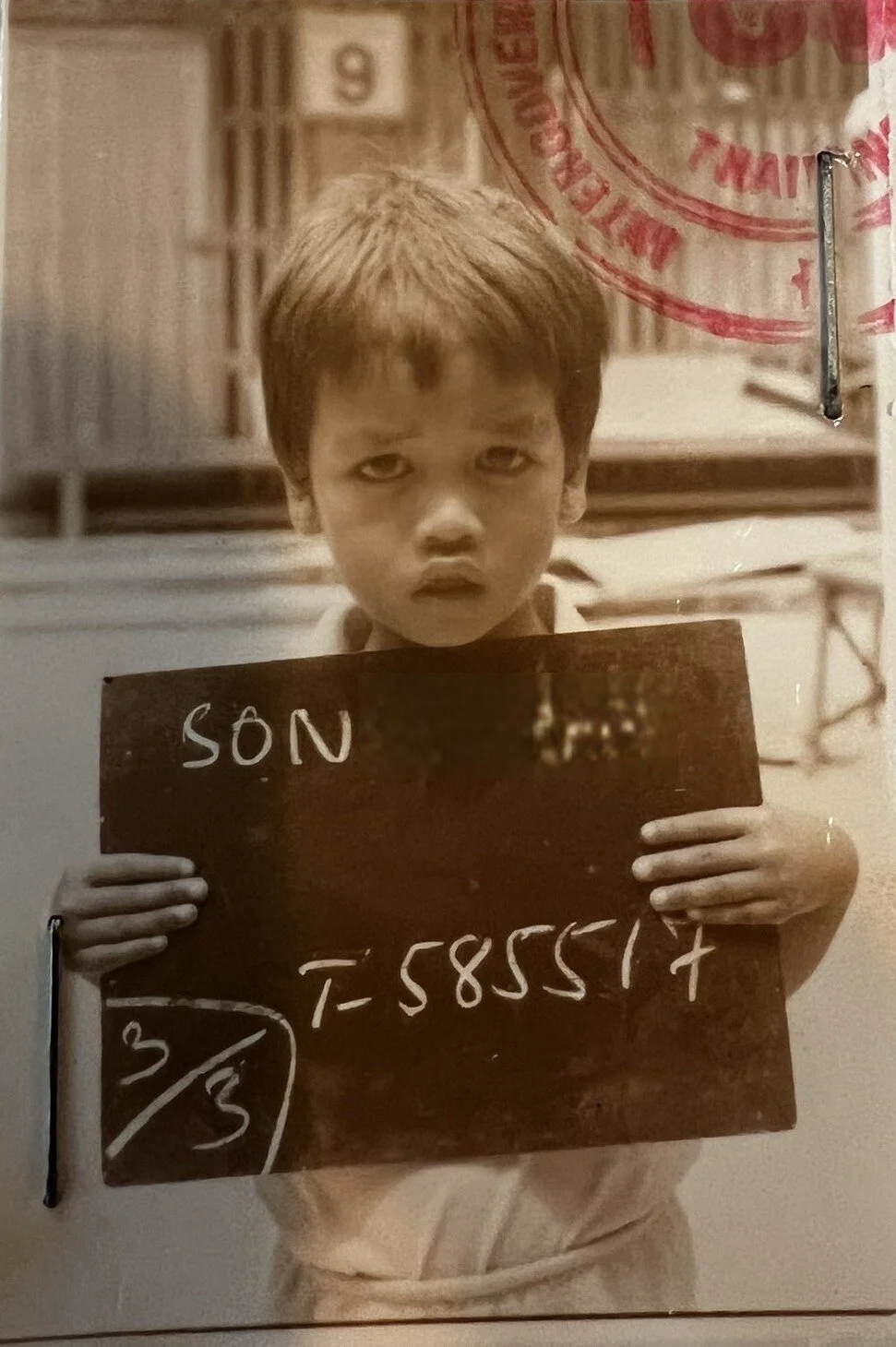
Sonny as a child in Thailand. Photo from Sonny’s sister, provided by Sonny, and used with his permission.
To understand how Sonny came to be in this situation, we must start at the beginning. Sonny was born in 1984 in the South of Vietnam or Cambodia. His father was Vietnamese and his mother was Khmer Krom (“Lower Cambodia”), an indigenous people of Vietnam and Cambodia (Kampuchea in Khmer). They are the earliest inhabitants of the Mekong Delta. There are about 2.5 million Khmer Krom, mostly in Vietnam and Cambodia, and about 30,000 in the U.S.
The history of the region is complicated and tragic. Cambodia was bombed by the U.S. during the Vietnam War, which helped destabilize the country leading to the rise of the Khmer Rouge, who ruled the country from 1975 to 1979 as Democratic Kampuchea. They committed the Cambodian genocide; as much as one quarter of the population was killed, 1.5-2 million people. The 1980s movie The Killing Fields is set during the genocide. Though the Khmer Rouge government fell in 1979, they continued hunting their enemies, amongst them the Khmer Krom and the Hmong people, who had been allies of the U.S.-backed South Vietnamese government, until the imprisonment of Pol Pot in 1997.
Sonny was born in 1984 amid that chaos. Once, while everyone was fleeing, his sister turned back and saw Sonny and his grandmother trapped in quicksand; had she not looked back, they would have been lost. Another time, they were crowded into a boat and one man said there were too many people and suggested throwing some overboard, including young Sonny. His sister and grandmother refused.
At the age of five, Sonny was flown to the U.S. from a refugee camp in Thailand with his older sister and grandmother. He showed me a picture of himself at the camp. He remembers being upset during the flight to the U.S. and that a nice flight attendant gave him his first taste of pudding, which calmed him down.
They were initially brought to Utica, NY, then to Springfield, MA, and finally to Lowell, which has the second largest Cambodian community in the U.S. after only Long Beach, CA. There, Sonny was raised by his older sister and his grandmother and remains fluent in Khmer.

Sonny and his sister during their second week in America. Photo from Sonny and used with his permission.
Sonny did not meet his mother until he was 12. They had been separated before he reached the refugee camp, and his sister later discovered that their mother was living just blocks away in Lowell. Sonny was introduced to his half-brother, then two years old, who had been given the same name because their mother believed Sonny was dead. About 10 years later, Sonny took in his younger brother after his mother died suddenly.
Much later, Sonny met his father on a Facebook call. His older relatives all recall his father as being a great, honorable man. Through Facebook, Sonny was able to talk to his father just once, when his father was on his death bed. Sonny’s father cried the whole time at the joy of seeing his only son for the first and only time. His father passed days after that call. Sonny’s sister made a composite photo of Sonny and his father.
As Sonny describes it, Lowell of the 1990s and early 2000s had large Asian and Hispanic populations, and they did not get along. In fact, he got beat up quite a bit near his grandmother’s house by Puerto Rican kids. “I was tall, but skinny and goofy,” Sonny said.
Fast forward a bit, Sonny graduated from high school in Lowell. He got married and had three children from that marriage. He moved to Westfield, MA for a while. In 2006, while visiting his sister and grandmother in Lowell, everything changed.
While coming out of a pet store in Lowell, he was approached for wearing the wrong color for the neighborhood. He didn’t want trouble, but as Sonny describes it, “it went to pushing and shoving, and then swinging.” No one was hurt in the fight, and people came and broke it up. As Sonny said, “hands were shook,” then the police came.
Police arrested Sonny and two bystanders and charged all three with assault and battery, but didn’t arrest the white man who started the fight. It is unclear how prosecutors expected to prove the charges, given that no one was injured and the other participant was neither arrested nor identified. Sonny was preparing for trial when he learned that the two bystanders had accepted plea deals.
Through his lawyer, the prosecutor offered a plea bargain with 18 months’ probation. Sonny just wanted it to be over. No more court. No more troubles for his grandma or his sister. And his lawyer advised, “let’s make this simple.” And it would have been simple, had Sonny been a citizen.
About a month before his probation ended, the immigration troubles started. Sonny’s guilty plea to assault and battery classified him as a VFO, a violent felony offender. He ended up spending four or five months in the Plymouth County Correctional Facility in 2008, which was worse back then as the immigration cases were mixed in with the regular inmates.
Sonny told me that they could not deport him at that time because there was a memorandum of some kind with Vietnam. Under the 2008 U.S.-Vietnam Repatriation Agreement, Vietnam refused to accept the deportation of individuals who arrived in the U.S. before 1995. ICE had to release him, but his legal resident status was gone and he had a final removal order as a VFO.
ICE put him on OSUP, an order of supervision. First, he had to call in monthly, then every six months, and then after years, it became an email check-in. Once you have that VFO label and a Final Removal Order, changing that is exceedingly difficult. Sonny explained, “You’re stuck in that status until a new administration comes […]. It doesn’t matter if you’ve been out of trouble. That don’t mean jack […] because you’re on that final order of removal. What you are eligible for is a work permit.”
Sonny got out and went to work. One place that gave him a shot was Petco and within a year, they made him a manager. He worked there for 12 years. Life went on, Sonny got divorced in 2014, and in 2017 met his current girlfriend, Katie. They now live in Worcester County with two kids and a dog.
“My dumbass should have fought the immigration case back then,” he explained. The check-in routine had become habit. Sometimes they would have to go to Burlington, and it was scary, because he would see other people getting detained. But it was routine, until 2025 and a new administration took over with an aggressive immigration enforcement policy, rhetoric about criminal illegal aliens, and a quota of 3,000 deportations per day.
And that brings us back where we began: May 30th, 2025, when Katie got that phone call. I can’t imagine what it was like for Katie. She said, “You’re aware that it can happen, but you never really expect it to. When it did happen, it’s just fight or flight. You call and get a lawyer and when that lawyer is asking you for every piece of information you have, so you do that. It’s really dark, when the kids are asking you where he is…”
Sonny said, “I didn’t think anyone was going to fight for me. That was the last of it. I won’t hear from nobody ever again. So, when they gave me a phone call and she said she got a frigging lawyer for me? I was like, whoa, because I never expect anything, because I’ve always been a survivor.”
It surprised me to find that Sonny’s story is not rare. I did some research and I’m going to quote an excerpt from the Vietnamese American Organization:
In 1975, the United States withdrew from Vietnam […]. Thousands fled, seeking safety and freedom. Many eventually reunited with their families in the U.S., only to face new hardships.
As refugees adapting to a new culture, language, and life with little […] institutional support, many Vietnamese struggled with poverty, discrimination, and trauma. Some […] made mistakes that led to involvement in the justice system. After serving their criminal sentences—often decades ago—they began to rebuild their lives, taking steps toward healing and integration.
Then came another blow: ICE arrest and detention. These individuals—many with legal permanent residency—were once again punished through deportation proceedings. However, under the 2008 U.S.-Vietnam Repatriation Agreement, Vietnam refused to accept the deportation of individuals who arrived in the U.S. before July 12, 1995, including those with criminal convictions. As a result, ICE had no choice but to release these individuals […].
And they did what America asks of all its citizens—they turned their lives around.
Over the years, they rehabilitated, pursued careers, married, raised U.S. citizen children, became homeowners and business owners, and contributed meaningfully to society. These individuals became stable, peaceful, and productive members of our communities.
Now, we are witnessing a harsh wave of ICE enforcement, targeting decades-old cases and ruthlessly disregarding the time, effort, and human dignity behind each individual’s transformation.
This is not double punishment—it is triple punishment. First, they were punished by the justice system. Then, by ICE detention and deportation efforts. And now, again, by tearing them away from their families after years—often decades—of rebuilding their lives with the belief that America had given them a second chance.
I first read those words back in January, and it struck me. That is exactly Sonny’s story. According to the VAO, there are 15,000 Vietnamese, Laotian, and Cambodian people living in the U.S. with removal orders.
The one point I would revise is that this is not triple punishment, but quadruple. We should not forget that the U.S. had a hand in making these people refugees in the first place. From 1967 to 1973, the U.S. heavily bombed Cambodia and Laos attempting to destroy the North Vietnamese supply lines, the Ho Chi Minh Trail. We created these refugees, and now after decades in the country, we want to send them back to a home that they haven’t known for 30 years or more.
I still remember Sonny’s closing words in our first text exchange: “remember to always be kind.” I do not know how he endured two months-long periods of detention, 15 years apart, and still emerged with his humanity intact, but I admire him greatly for it.
I am glad to inform you of good news in the months since I first met Sonny. His case was terminated on January 12th, 2026. His ankle monitor has been removed. He got his work permit back and he is back at work. And lastly, he got his green card back. There is only one step left. I hope to see Sonny become a citizen because he is an American. And he and Katie and his children should never have to worry about this again.
Should immigrants with criminal records be deported? My hope is that we can help educate our fellow Americans that the only reasonable answer is “it depends.”
Todd’s suggested calls to action to oppose ICE in Massachusetts:
To learn more about the impacts of ICE in New England, check out theJustice4All Substack and BearingWitnessatICE Substack
Consider joining Justice 4 All or the protests in Burlington; go to BearingWitnessNE.org to sign up for email updates.
Oppose ICE flights out of Hanscom? Head to deicehanscom.org
Concerned about digital surveillance? Go to mass50501.com/flockoff
Want Congressional oversight at Burlington? Email: immigration-justice-action-team@gmail.com
This is a guest article by our friend Todd Palmer, which was originally published on his Substack. He kindly adapted it to share with Mass 50501. Check out his calls to action and his Substack to learn more about his important work.
Enjoyed this article? Get updates on the movement, volunteer opportunities, and more by clicking below.