40 Years of Activism
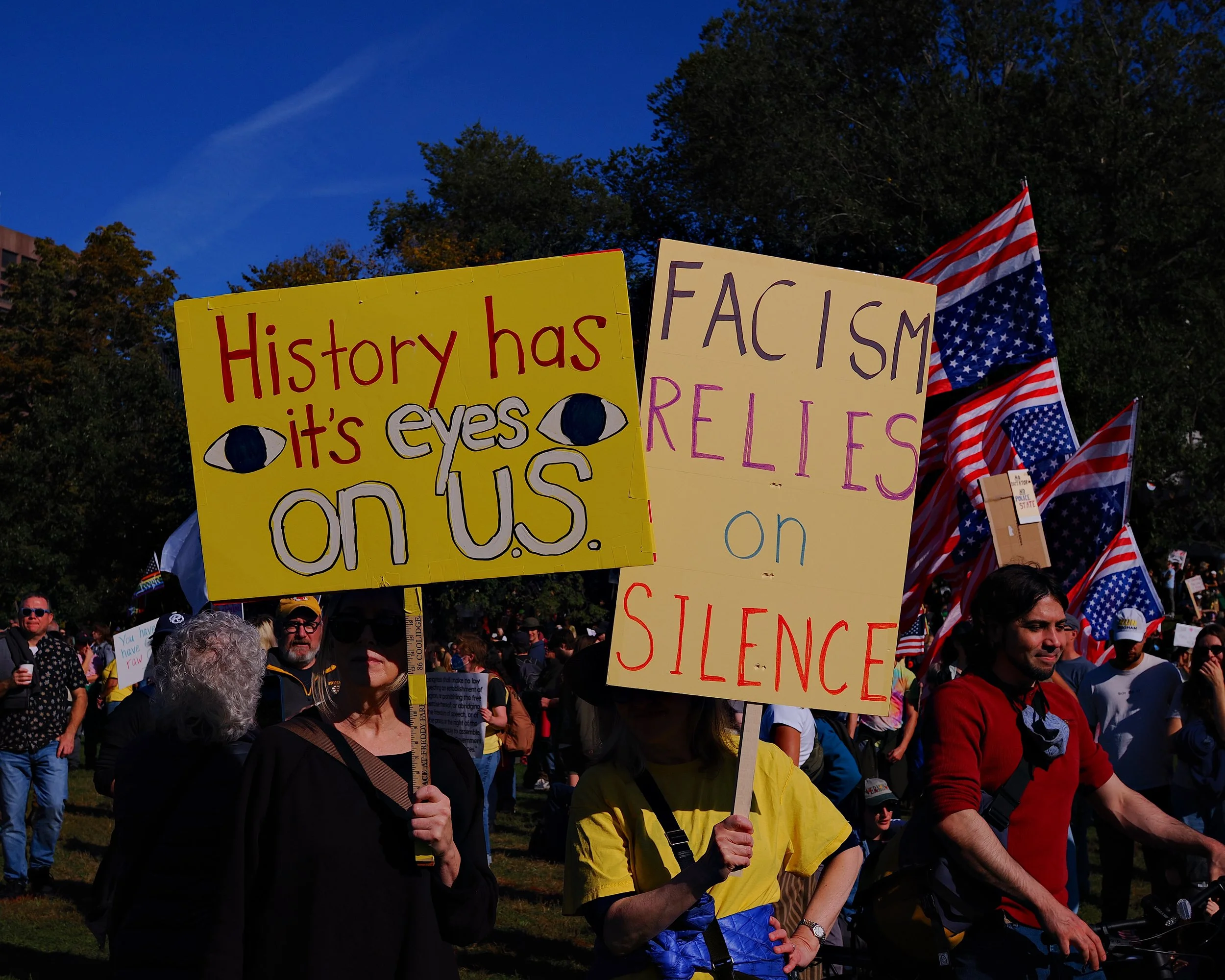
No Kings II in Boston. Photo by a Mass 50501 volunteer.
We’ve written in the past about the importance of self-care, community building, and talking to one another to strengthen our resolve on our path through this period of democratic backsliding. While each Mass 50501 volunteer has arrived at our shared values, the individual pathways toward this work are quite varied. There is an immense benefit gained when we share these stories with one another. Mass 50501’s Community Building team has created a new series of Panel Discussions meant to inspire all, educate people who are new to activism, and build stronger bonds in our community. Our first Panel Discussion will take place on Saturday, April 18th. We invite you to come listen and ask questions of our seasoned volunteers.
One of Mass 50501’s volunteers, who asked to be referred to as A Big, Black Bird, was a main creator of these new panel discussions. While organizing this panel series, they realized that they too had their own story to tell. Below are excerpts from Big Black Bird’s personal writing project Forty Years of Activism, in which they detail some of their life experiences that ultimately led them to pursue activism volunteering with Mass 50501.
Forty Years of Activism
I wrote about my life with the hope that people could glean some good advice. Maybe take some inspiration from the actions, and find hope and tools for the ongoing fight for our rights. It is my belief that the current administration is trying to kill anyone who isn’t white, straight, or male. They want to turn women back into chattel and human beings into slaves. What does this say about us as a species? Let’s end fascism and hatred. These are some of the stories of my life. I hope you find something of use here.
First Protests: Aerial Spraying of the Forests
The first things I remember hearing on the radio as a young child were about the Vietnam War and the impeachment of Richard Nixon. When I was five, my mom passed the baby Bar. She never did pass the big Bar. But that didn’t stop her from using her legal training in various capacities, like as a Legal Aide. And years later, she sat on the board of the local county ACLU.I didn’t find out until my mom’s memorial service in 2013 that she had been an activist since I was a young child, or probably before I was even born. My mom and I were both undiagnosed autistics for most of our lives. She identified as autistic when she passed away in 2013. I wasn’t diagnosed till 2021, at the age of 55. It shouldn’t have surprised me that my mom had been more of an activist than I had known.
When I was 17 in 1983, my mom took me to my first protests right in our little town. We were blockading the gate to Simpson Timber Company which was using herbicides like 2,4-D or 2,4,5-T to aerial spray the forests. Their reasoning was that this would cut down on “unwanted undergrowth” to make it easier to make the trees grow straight and tall and easier to harvest. The problem was that there were people living in those forests.
My mom decided to participate in the protest. She sat down with other protesters in the blockade. My mother looked a lot like Momma Cass. And she liked to sing. She had a handful of favorites, 500 Miles by Peter, Paul and Mary for example. But she always sang horribly off key. I was always embarrassed by it. But as she sat on the ground there, she started singing Amazing Grace to the cops. I don’t think I’ve ever been prouder of her than I was in that moment.
Not long after that mom and I drove out to a campground along Highway 299 where there was a weekend protest and teach-in happening. I heard a woman talk about having what is called a molar pregnancy, where the fetus is nothing more than a jellyfish and is dangerous to the life of the mother to carry to full term. The woman said it was from eating the wild blackberries in the forests that had been sprayed with the herbicides. The same thing had happened to the women on the Bikini Islands after the nuclear tests were performed there.
I learned that 2,4-D and 2,4,5-T are elements of Agent Orange. (Several decades later I learned that the company that made these chemicals got re-branded as Monsanto. And that Mitt Romney was their CEO.)
My attention to political causes extended beyond herbicide protests. I was furious when I figured out that I was going to turn 18 the day AFTER Reagan was re-elected! I hated the man because he had removed all of those lovely after-school work programs that my older siblings got to enjoy and that allowed us to get after-school jobs. He also wanted to throw “crazy” people out into the streets and stop financing mental health group homes for low-functioning adults. And I hated him for winning the day before I could legally vote against him. This was not, unfortunately, the worst election day/birthday that I would ever have.
The Great Peace March and the Anti-Missile Crisis.
In early ‘86 my father took me to the launch of the Great Peace March. We went down to L.A. City Hall to send off the marchers. I wanted so badly to be a part of it, but didn’t know how to get involved. Being at the launch with thousands of people, listening to Mr. Mister sing their famous song—it was a spiritual experience. This was an impetus to get me rolling towards my own values and actions, towards protests and nonviolent civil resistance. I kept thinking that maybe there was something that a single person alone could do. Around that time I learned of Katya Komisaruk, and the Plowshares movement. She was a huge inspiration to me, knowing that one single person could make such a big difference. Her actions set my values in stone. I resolved that I could make a difference. I would do anything for the cause of freedom, liberty and the American way, or I would die trying.
Lockheed and Nonviolent Civil Resistance
By late 1986 I had moved to Santa Cruz, CA. I was college-aged and most of my friends were college students at UCSC. There was a big push to protest against Lockheed Martin for their nuclear bomb production. This was the era when we were moving from Mutual Assured Destruction (MAD) to the insane idea that if we had a sword (the first intercontinental ballistic missiles [ICMB]) and shield (the Navstar computer) that they would protect us. From what? Certainly not nuclear winter. Lockheed claimed that they didn’t test nuclear weapons at the Santa Cruz installation, but they did test the rubber bullets that released the warheads from the casings. This was way before they started using rubber bullets on protesters.
It was during the planning of one such protest that I learned about things like nonviolent civil direct action (NVDA), Know Your Rights, what a peacekeeper does, what a legal observer does, what a police liaison does etc. I remember doing the practice hassle lines where we pretended to be getting hassled by the police. This is how we learned to resist, but not violently. We learned that we wanted change, but we weren’t going to let them provoke us. I learned about what affinity groups were, how to plan out what our strategies would be. How to set objectives and who to trust.
People were blockading the San Jose Lockheed installation, but we were going to the installation in the Santa Cruz Mountains, 20 miles from downtown, up a paved road. Only one way in. It was easy to blockade.
We picked a day and planned the blockade. There were over a hundred arrests that morning, and the sun hadn’t even come up yet. We had chosen the time when the workers would be just arriving for their day shifts.
I got arrested too, but not right away. Three guys and I decided to do a little back country action. We started making our way down the fire road while everyone else was at the front gate. Two of my friends decided to split off. My friend and I decided to keep going deeper onto the Lockheed property. We found ourselves at the company picnic grounds of Hewlett Packard, and then on an easement between Lockheed and Mormon land. When we ended up firmly back on Lockheed property, we wandered around for a little while. We hiked around for several hours, then we walked up to a building that had all sorts of yellow “Danger Zone” and “caution” signs all over it. We peeked inside an open door and I heard a worker say, “uh, oh, protesters.” We wandered over to a launch pad where they tested the rubber bullets, as I was told later. I was told that these were the bullets that released the warhead from the casing of the bombs. I wonder now if these are the same type of rubber bullets that they use on protesters. We saw a sticker our friends had left there that said “if the world goes away, where will the children play?”
We wandered around for about 45 minutes before we saw a truck driving toward us with a security guard inside. He asked if we just wanted an escort to the front gate or if we wanted to be arrested. We had just exhausted ourselves hiking around for hours, and the road back to town was 20 miles long. We had come all this way to get arrested, after all. These were the days when it was still safe to do so. The guard called the closest sheriff from one of the little nearby mountain towns. We got real handcuffs, not the cute little plastic ones most protesters get these days. I think the police officers were slightly annoyed that they had to come back out after they thought the protest was over.
We arrived in Santa Cruz and got booked into the jail. I remember being in a separate cell by myself for a while. I remember talking to some of the women about what was happening, being strip searched, then being offered a chance to cite out. That means that you can sign a citation saying you waive your right to a speedy trial and promise to come back for a court date some time in the near future.
The guy who hiked with me decided not to cite out. He stayed overnight and was arraigned the next morning. My friend asked that the charge of misdemeanor trespassing be dropped down to an infraction to match the charges everyone else was getting from blockading the front gate. He also asked that anyone else with the misdemeanor charge have theirs dropped down as well. That went for me, and the two other guys. When I went to answer my charges a month later, I couldn’t find my name on the court docket anywhere. I was told the charges had been dropped altogether.
Conclusion
My childhood and early experiences in activism shaped the way I see the world. Over the years, I have participated in various causes, including Move to Amend and of course volunteering with Mass 50501. I hope my story is helpful to my fellow resisters. There is so much we can learn from one another and so much we can achieve together.
I hope you join us for the panel discussion. If you’re interested in volunteering with us, please join us on Discord and set up an onboarding call. Your actions matter. Your voice matters. We’d love to hear the stories you have to tell.
Enjoyed this article? Get updates on the movement, volunteer opportunities, and more by clicking below.