The Power of Oaths
A column of ordinary people marched four abreast down the wide boulevards of Washington in November. The people's house above overshadowed us with its old arcs and majestic geometry. We were in a Place of Consequence, and we felt the weight of the building with every uncertain step. A friend and a Navy Pilot confessed to me, “I’ve never actually marched before.” A man to my right joked about his bad knees. The leaders of the march struggled a bit with their cadence; the rhythm and confidence was defiant but unsteady and confused.
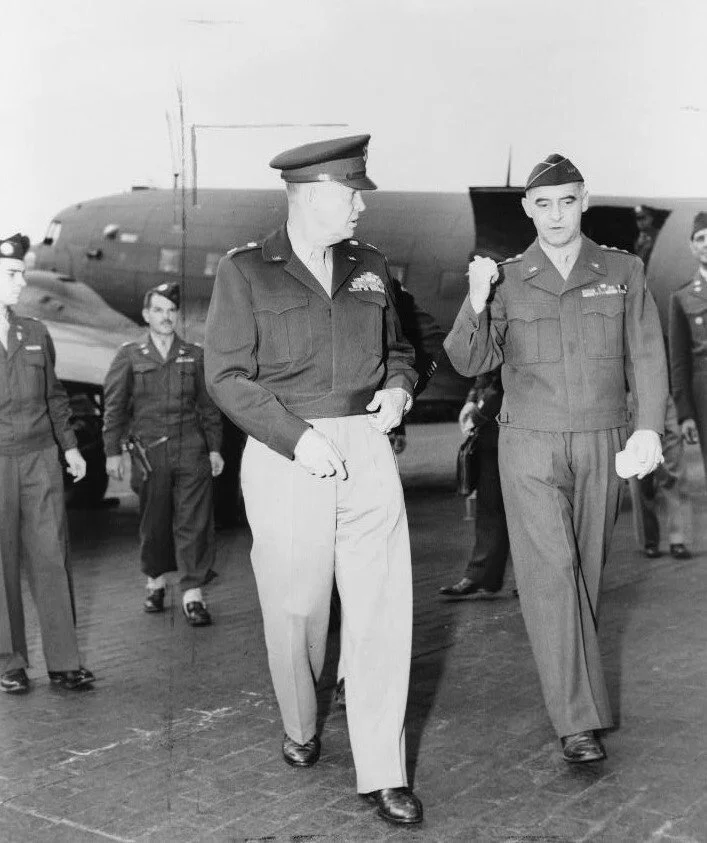
General Eisenhower with Lt. Gen. Lucius Clay after Eisenhower’s arrival for the Berlin Conference at Potsdam. From the Library of Congress (95502978).
As we marched, a sense of the gravity of the moment began to weigh on us. Our motion got heavy but more regular. The crowd got quiet as the cadence got louder. Our spines straightened as the Capitol Dome loomed closer. Our feet landed harder and with more rugged intent. Soon only the reverberating echoes of men and women in hard, synchronized advance could be heard. Cameras and silent crowds bore witness to our approach through groves of wind-rustled trees. By the time we reached the white steps and tall columns our procession was a crescendo that drowned out the sounds of the curious as well as the fearful who knew nothing of our purpose.
Each step was a declaration, a statement of conviction repeated as cadence. We became a unit bound in singular purpose, each subordinating our will to a collective entity servicing a higher ideal. It happened organically and without instruction. I knew scarcely a twentieth of the names of those with whom I stood defiant in this place of power. The crowd, silent and respectful, marched with us in spirit, with many asking themselves if they could do more in the wake of our demonstration of defiance.
Those women and men were driven to be there by a higher calling to something deep and profound. We can be pillars of courage when the nation itself is under fire. Veterans were all given great responsibility at a young age. We matured under the demands of defending the nation, and gained wisdom about the human condition. All the veterans of the No Kings movement have within them power to win hearts and minds. With patient effort and clear direction we can prepare the people for the demands of our time. Veterans represent something to people. We are already trained as servants and leaders, and bearers of quiet burdens. That habit of service does not atrophy.
We are also in a time of great troubles, with masked men roaming our streets, our faith in humanity eroded, and our certainty about everything dissolved. In such times people have an instinct to seek out leadership and guidance. The people are screaming for it. I have found myself a leader at times in this movement, and it is a profoundly uncomfortable position to be in. I still have doubts about my own capacity and capability. I have met great leaders and I honestly do not know if I am up to the task because I only know from second hand experience what it means to truly lead. The list of burdens is long, and it tests both physical and mental will if done correctly.
A leader never tells someone what to do that they themselves are not willing to do. I sometimes ask others for less because I am embarrassed that I cannot do more. Leaders do not shy from a fight, from risk, or from cost wisely spent. A leader is quiet, confident, fierce when confronted, stands on principles, and does the right thing by their own morals even if no one is watching. What real leaders understand is that they are not the important thing. Command isn’t domination—it’s service.
Dwight D. Eisenhower exemplified this quality of leadership. He was not a brilliant orator, strategist, or tactical leader. But he was a dynamic and effective coalition-builder. He navigated complex systems of interlocking relationships, penetrating the inner circles of potential allies amongst the population of the enemy as the Allied forces claimed the land. Those relationships with tradesmen, lawyers, and community leaders served him well when securing garrisons in hostile territory and later during German reconstruction. He persuaded a population propagandized by fascist media and brutalized by death and conflict that he was a man they could work with.
Service already gives us an advantage in the difficult art of building institutions because people will talk to us. They may forget a few of their prejudices. They might not know us, or they might disagree with us, but they will often be willing to give us a chance. The people recognize something of value in the Veteran community.
When I go to a bar wearing my Veterans hat, every 5th person will say to me, “Thank you for your service.” Every 10th will buy me a beer. Every 20th will want to be my friend, to tell some story about how they honored service in their own life. This is a common experience for American Veterans. It also tells us that when we say something important and with passion, people will listen.
As a movement Veteran you can freely talk to churches, communities, and to the crowds at the hundreds of protests every month in your region. As you build relationships, you can help knit together this complex human machine, every relationship becoming a neuron that can wire up the ends of the nation from small towns all the way into the halls of power. Movements thrive doing the hard work to unify many to common ends. Politics is about addition and assertion.
Veteran culture is also aggressive. We are earthy and loud. We are salty and we aren’t afraid to flex. It’s also accessible to the common man and woman and a wide spectrum of the American People, from all walks of life. War stories draw attention because they are told in the first person, about real people in real places doing unreal things. Many of them are funny and they are always interesting to the uninitiated. Embedded within the bravado is a steady confidence that we have earned for doing something very difficult and coming out better people for the experience. We are proof positive that history isn’t an abstract force but something organically created through the actions of mere people.
We learned discipline and how to discipline others. We understand hierarchy, orders, and the dispensation of power across complex systems that require both agility and a rigid focus on the mission. Our collective experience and the surrounding mythos can induce others to act when they would otherwise shy away from the muscular and sometimes vulgar activation of power.
A cause always requires its symbols and rituals, and military culture is replete with martial traditions; things like marches, ceremonies and flags have power because history imbues them with a motive force that endures for centuries. When we carry a symbol, we inherit that same animating principle that gave it strength the first time it was used. Embrace and reclaim those symbols fully and we can broadcast that enduring strength to others. We can give everyone a sense that we march with them and for them. This movement is part of a contest where every act of courage is of value because it can beget further acts. By demonstrating audacity we give others permission to dare greatly. Because of this, our valor does not deplete when it is used—it multiplies.
Despite this, there is still a skepticism in some parts of our society towards the military that we need to overcome. I’ve seen it among anti-war activists and in those who rightly distrust the security state. They see our military now committing war crimes in the name of a tyrant that whispers mad imperial dreams to the sick and the lost. I feel it myself. I remember as a young soldier sitting in a tent in Iraq arguing in a room full of my superior officers that while I would do my duty, I believed the war was a geopolitical and moral mistake. I was alone in that sand-blasted command tent, but history has proven me right and a few of those comrades have reached out to me since then to say so.
We are a symbol of both our successes and failures as a nation. Eisenhower was able to persuade the people of a defeated nation he was on their side after we had bombed their entire civilization into rubble through simple acts of kindness, attention, and competence. Certainly we can do the same with those uncertain as to our intentions.
That cold day in Washington was something far larger than a political rally. Our formation was a murmuration of will mustered into mass and tuned to a singular purpose—straight, precise, ruthless, and true. From California to Carolina, from Montana to Mississippi, from all the rusty and rural places between Minneapolis and Boston, we came. Then we returned home to all our corners to warn, to instruct, and to lead.
Sacramentum Tenemus, ( We keep the oath )
Bryan C. Winter
Enjoyed this article? Get updates on the movement, volunteer opportunities, and more by clicking below.