What the Flock?!
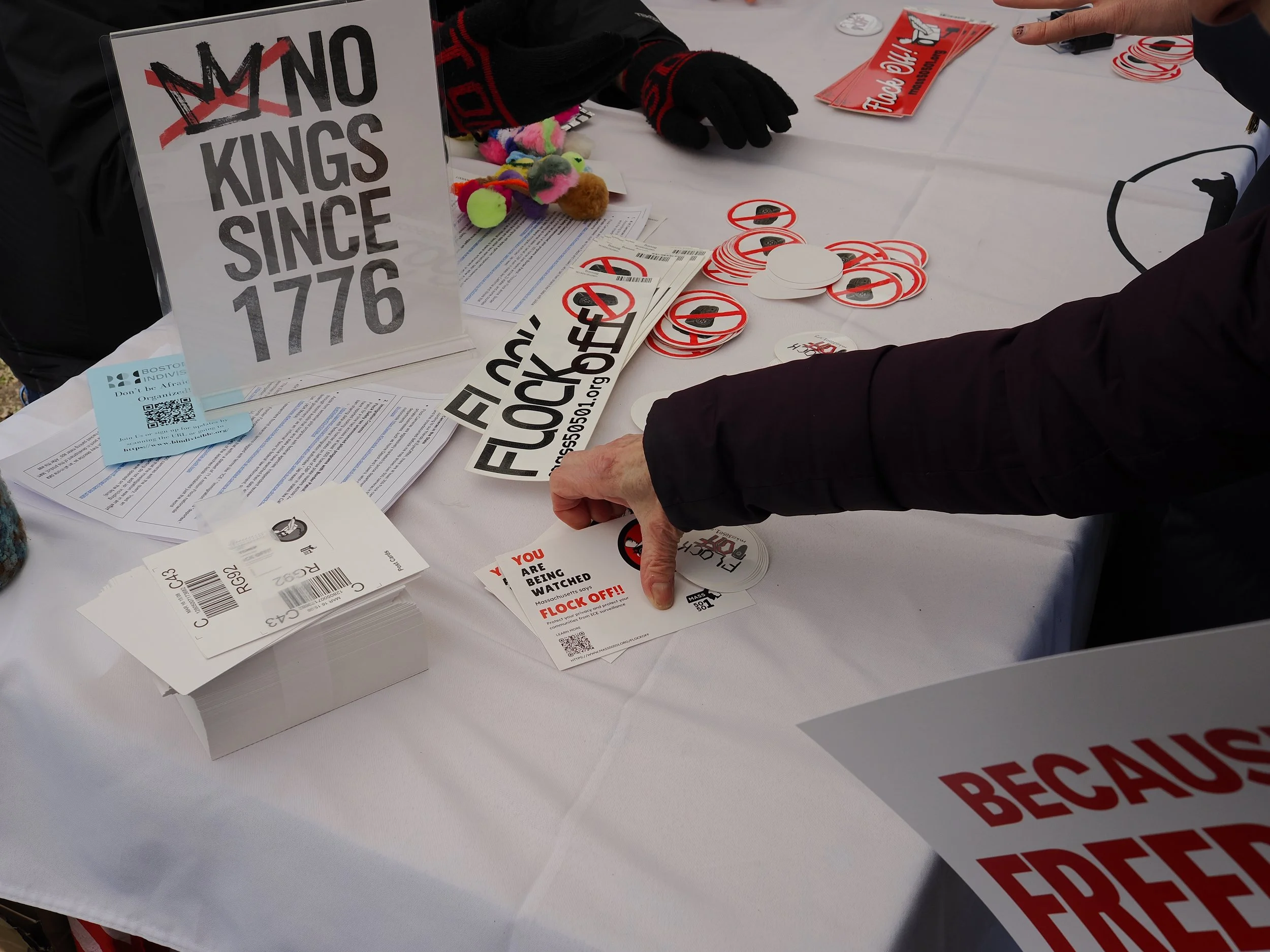
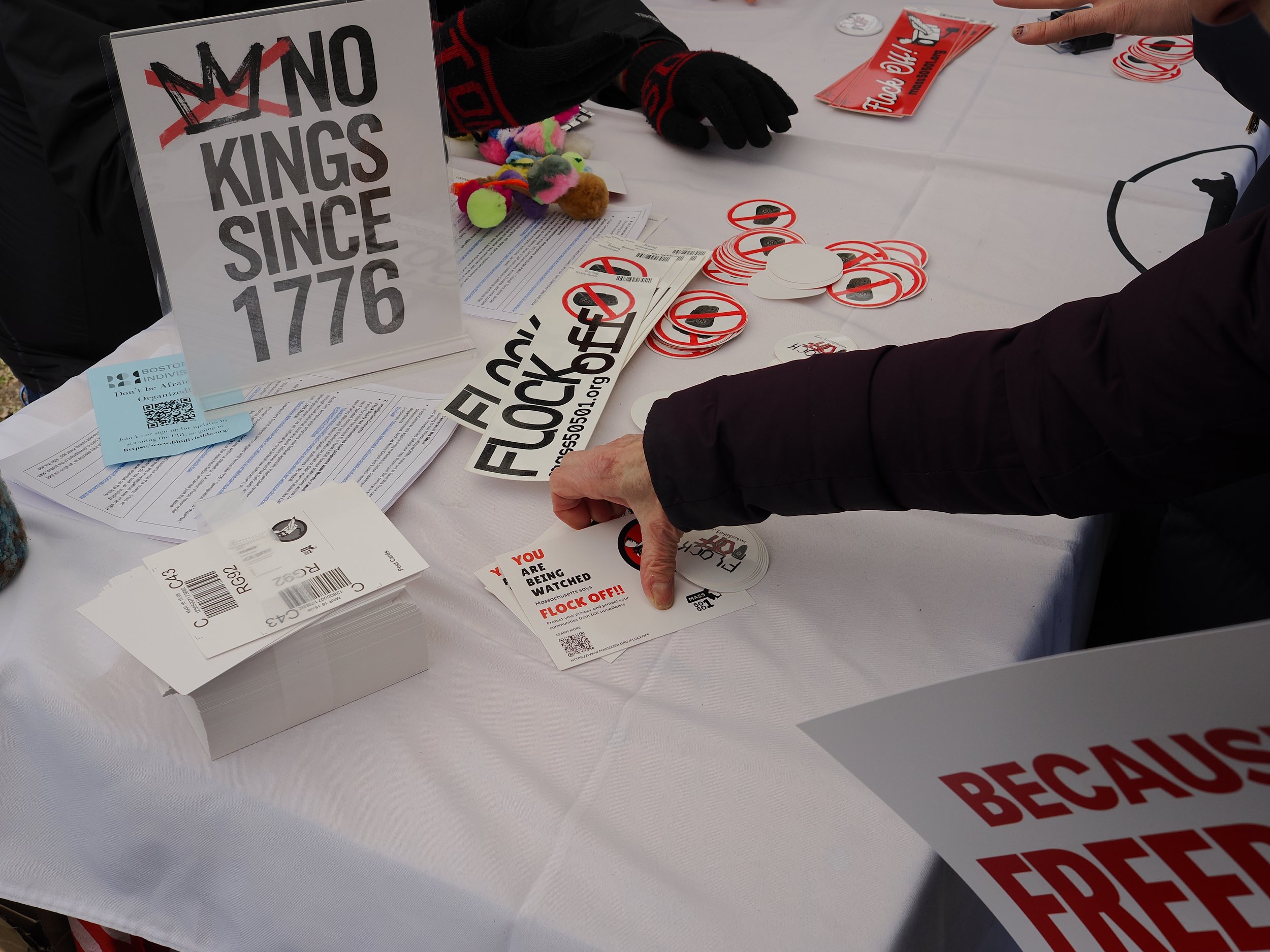
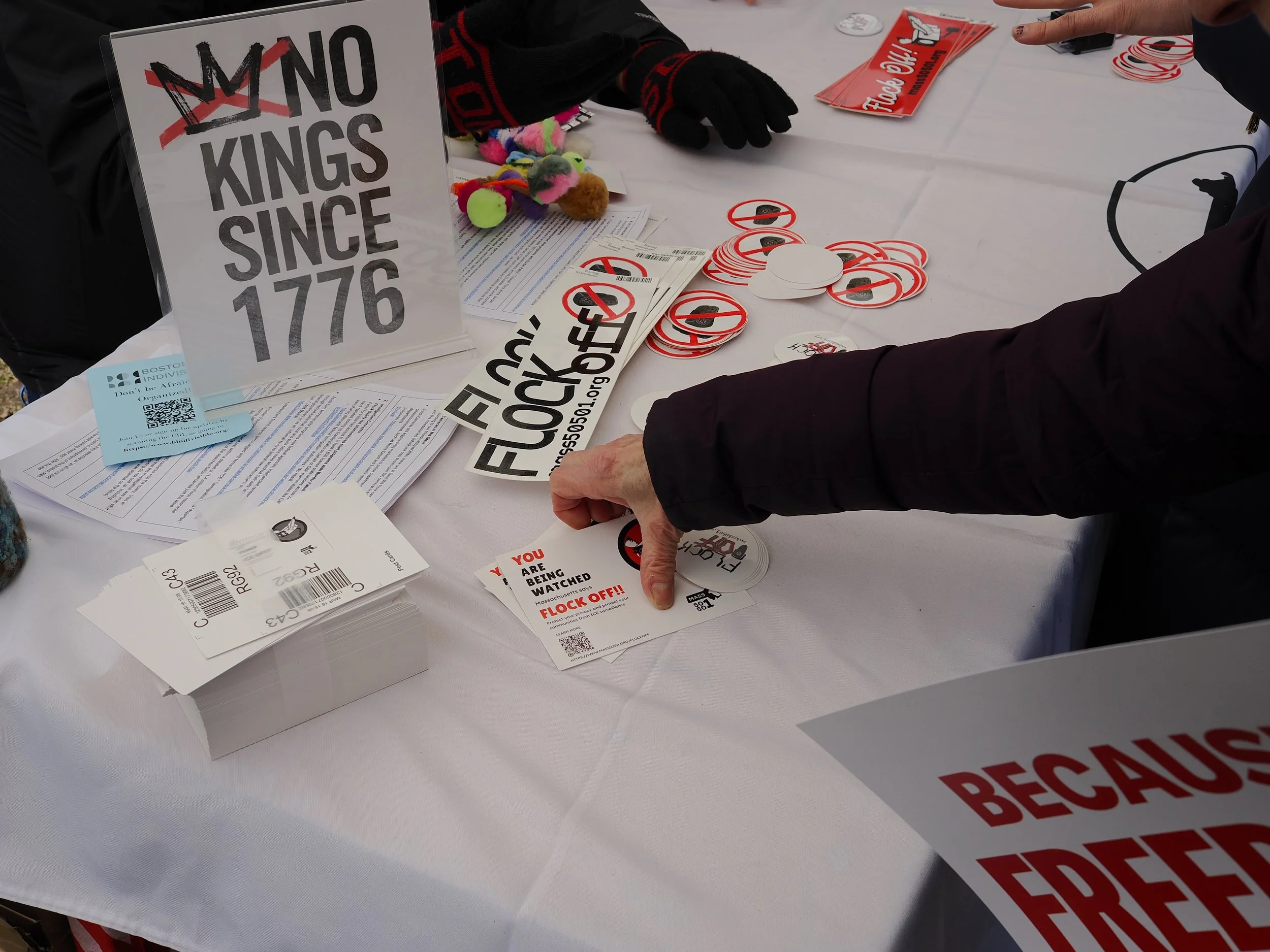
Mass 50501 continues our work at the municipal and state levels to remove Flock cameras from our communities and people are paying attention! If you are here, you’ve likely already learned a little bit about the dangers of these AI-powered mass surveillance tools. Things are changing fast and it can be tough to keep up with all the news. We’ll continue to post blogs about Flock (check our articles here). In this space, we’ll provide you with quick info from Flock news nationwide. This information could be helpful in removing cameras from your city or town! As always, if you’re interested in getting more involved, email us at flockoff@mass50501.org and join us in Discord!
Flock News and Updates
What the Flock?! September 11, 2026
A lot has happened in the world of surveillance since we last surveyed the ground of the warring efforts of Flock to put up cameras and citizens to get them taken right down again! We’ve got updates about Flock criticisms, misuse, contract cancellations, competing vendors, and legislation. If you need some background context about Flock Safety, the dangers of AI-powered license plate readers, and our fight against them, start at our website here. Otherwise, let’s review…
A lot has happened in the world of surveillance since we last surveyed the ground of the warring efforts of Flock to put up cameras and citizens to get them taken right down again! Let’s review:
Flock has remained under fire (sometimes friendly) about their shady business dealings and loose relationship with the truth while pitching their products. Comedians and satirists also smell the blood in the water, with The Onion reporting on Flock’s pros and cons, The Week rounding up some anti-Flock political cartoons, and Darth Vader joining San Diego’s city council meeting to profess his admiration.
Cases of police misuse of the tech have proliferated, from South Carolina to Georgia, and right here in Massachusetts, with police officers in Stow, Lynn, and New Bedford being disciplined.
And contract cancellations have proliferated in towns and cities across the nation. Cleveland’s city council declined to extend their $250,000 contract with Flock back in June, but then extended their contract a month later. The LAPD has chosen to allow their contract to expire until data security concerns have been answered, which prompted Flock CEO Garrett Langley to make a statement in support of Flock’s technology.
While Flock continues to downplay the invasive nature of their tech, their own training materials tell a different story. 404 Media reported that Flock trained officers on how their software platform FlockOS can be used to integrate information during surveillance of large-scale events, such as during a No Kings protest. (Audit logs have shown that Flock’s network has already been searched for terms such as “No Kings.”)
Massachusetts towns that have decided to cancel contracts so far include Cambridge, Salem, Littleton, Hopkinton, Wellesley, East Bridgewater, Grafton, Auburn, Douglas, Ayer, Abington, Southbridge, Barnstable, among many others—never mind all those that have merely paused their usage pending further review (such as in Methuen).
While this move away from Flock is a victory for the privacy-loving population (and we should celebrate it!), it’s not unmitigated: Some cities are simply moving to a less prominent competitor like Axon or Motorola. We should make sure to stay vigilant against all intrusions on our privacy, particularly by government contractors.
An interesting aspect of the growing anti-Flock movement is the way it crosses what we might consider typical ideological boundaries: no one likes these things. Of course privacy advocates like the ACLU and the Electronic Frontier Foundation have been on the case for quite a while, but Flock’s even drawing ire from unlikely sources like police unions. We’re seeing citizens reach across the aisle at the city level to defend their community’s right to privacy. And from Texas to Massachusetts, we’re seeing legislators of all stripes enter the fray. Rep. Massie (R-KY) has even introduced a bill at the federal level that would restrict federal funding on ALPR systems (which has some pretty notable carveouts, though, so make sure to read the full bill for yourself!). Get more information here.
These legislative moves could offer more robust protections than the town-by-town Flock cancellations. And we’re seeing success in the court too, with Suffolk Superior Court ruling that Massachusetts State Police must disclose ALPR camera locations, as requested in FOIA requests filed by the ACLU—a win for transparency!
Keep the pressure on!
Enjoyed this article? Get updates on the movement, volunteer opportunities, and more by clicking below.
What the Flock?! July 10, 2026
It’s been a while since our last installment of What the Flock?! Locally and nationwide, this issue is gaining more traction, so there’s a lot to report! We’ve got updates about problems with Flock, opposition efforts, and cancelled contracts, including in our very-own Framingham! If you need some background context about Flock Safety, the dangers of AI-powered license plate readers, and our fight against them, start at our website here. Otherwise, let’s dive in…

We begin with reports on the seemingly never-ending problems with Flock’s AI-powered surveillance tools: Check out this tik-tok to hear from a former RI police officer who ended up resigning after he spoke out against Flock cameras in 2023. Another headline from Rhode Island: a local businessman’s name is listed as the billing contact on Tiverton, RI’s Flock contract and residents want to know why, especially amid talks to expand Flock’s network in their city.
There are more reports about Flock data being misused. A police officer in FL looked up a woman’s license plate, added it to a Flock hotlist so he would be notified when she passed a camera, aggressively followed her, and then pulled her over for no reason other than because he wanted to and he could. Similarly, in Atlanta, GA, three officers were fired and arrested for unlawfully accessing the Flock database. Five more officers were arrested in Albany, GA. While some of these arrests were the result of audit log reviews, IPVM reported on a troubling trend that we’ve already been aware of: Flock’s audit logs are not a magic bullet to fix the problems inherent in their system. The audit logs are only helpful (and even still, sometimes only marginally so) if they are actually reviewed.
The San Francisco Police Department did review their audits of their Flock network and found nearly 300 searches over a year (0.005% of total searches) that were in violation of California law. The SFPD did not disclose the search reasons, only noting that they were not related to immigration or reproductive rights. Flock loves to repeat their reassurance that (currently) federal agencies do not have direct access to their data. In the San Francisco scenario, the SFPD shared their data with the Northern California Regional Intelligence Center, who then conducted searches on behalf of outside agencies. Sure, in theory, this data stream passing from agency to agency technically is a result of human error (or, possibly, misuse) so Flock can absolve themselves. However, the flowing data stream is the problem baked into Flock’s network. And Flock’s own CEO, Garrett Langley, recently stated that he’s aware that Flock’s AI-powered surveillance tools are used for immigration enforcement:
“I am like, guys, the company has no opinion on this. If the state of Texas wants to enforce immigration, they might use Flock, but they're gonna go enforce immigration no matter what Flock does."
California is not the only state in which Flock camera usage has run counter to state law. In Vermont, where 2013 legislation has significantly limited and regulated the use of license plate cameras, police officers have nevertheless searched out-of-state cameras. (Don’t forget: there is still no legislation on these surveillance tools in Massachusetts, but a bill is in the works! H.3755 is still in the Ways and Means committee. Check here for more info on how you can support this legislation in MA.)
In Syracuse, NY, Flock dragged their feet over removing their cameras after the city cancelled their contract. Additionally, residents were shocked to learn that their police department continued using the Flock cameras for about a month after the decision was made to cut ties with the company.
Back in California, police departments used Flock data to track anti-ICE protestors. The article quotes a chilling statement from Tracy Rosenberg, Advocacy Director at Oakland Privacy:
“In 2026, surveillance tech has become so highly automated and large in scope that this familiar pattern edges ever closer to dystopia-style authoritarianism where the government keeps records on every single person who dares to protest a government action… For a country that venerates an act of civil disobedience about tea in Boston, that’s a disturbing direction to go.”
Under a surveillance state, regular people just going about their lives suffer—like Joel Feder, journalist and director of The Drive who was tracked by Flock’s system for days and ultimately surrounded by police officers due to a data entry error that flagged him as driving a stolen vehicle (that wasn’t actually stolen afterall). Read his story for his play-by-play of how it all went down, as well as the compounding errors that led to what could have been a deadly confrontation.
Given the myriad of problems with Flock Safety’s AI-powered surveillance tools (and their less-than stellar record of trustworthiness), it's no surprise that debates about these cameras rage on across the country. In Caldwell, ID, a resident has filed a tort claim alleging that the city’s use of Flock’s ALPRs is against state law. They want the city “to either stop sharing license plate reader data with Flock Safety or end its agreement with the company altogether.”
Residents are also speaking up against the cameras in Tyler, TX; Springfield, OH; St. Paul, MN; Cleveland, OH; and in Tewksbury, MA, just to name a few. This news segment describes the debate taking place in Pasadena, CA. Residents’ concerns, for the most part, are being responded to. Sometimes concerns are met by a Flock representative presenting at a city council meeting, as was ultimately the case in Cleveland (who sadly extended their contract for another 6 months) and Lafayette, CO (where the debate continues). In Durango, CO, city councilors “requested monthly reports about Durango Police Department’s use of Flock cameras, including how many vehicles are logged, what offenses Flock searches have pertained to and what outcomes the technology has resulted in.” They reviewed their first report on June 16th. Check out the numbers in the article.
In Shaker Heights, OH, Flock was unfortunately not cancelled, but stricter guardrails were put in place via an amended contract. In Oakland County, MI, Board of Commissioners Chair Dave Woodward, D-Royal Oak, is facing a recall effort because he didn’t disclose a free trip he took to visit Flock’s headquarters.
These debates are leading to change. In Harrisburg, VA, a member of DeFlock Harrisburg reported several wins for the movement, including stronger public awareness and thousands of signatures on petitions. In Longmont, CO, (where Flock cameras were recently replaced by Axon cameras), Andrew Palmer, a resident-turned-activist explained how local residents do have the power to enact change:
“I have found that I’ve had a much greater impact than I thought I would…One visit with a city council member, one email, one time attending one of these meetings can be hugely impactful.”
For any new activists in this space (all of us?): The Electronic Frontier Foundation provided an explanation of some ways to determine if your local police department runs their data against the FBI's National Crime Information Center (NCIC) “Immigration Violator” hotlist, which is a hotlist populated exclusively by ICE. Follow the steps to check your town now! (And if you find something unsavory, reach out to your municipality about your concerns. See our tips to guide your conversation here.)
We saved the best for last: cancellations and/or removals! Let’s give a hearty round of applause to Edmonds, WA; Appleton, WI; Ashland, WI; Bandera, TX (this one happened a while ago, but we missed it!), and Framingham, MA!
👏👏👏👏
The progress we’ve seen in public awareness, regulatory efforts, and contract cancellations hasn’t let up. And while we are feeling optimistic, the job is certainly not done. Flock’s attempts to maintain and expand their customer base have not let up either. As we’ve reported, Flock reps have been attending local government meetings with their well-rehearsed (but somehow still lacking) sales pitches and bandaid fixes. Additionally, while contract cancellations are a great outcome, the next step that’s sorely needed is democratic oversight of these AI surveillance systems to prevent another company from setting up shop and doing the same thing. We hope this news helps you pay attention to the nationwide trends, so that if/when this issue comes up in your city or town, you will feel empowered to tackle it head-on!
Enjoyed this article? Get updates on the movement, volunteer opportunities, and more by clicking below.
What the Flock?! June 19, 2026
Buckle up, because this installment of What the Flock?! is a full one! We’ve got contract cancellations, mistakes, mis-use, more problems, conflicting statements, and some local news! Did you hear that last week Flock Safety allegedly leaked data via regular search engines?! If you need some background context about Flock Safety, the dangers of AI-powered license plate readers, and our fight against them, start at our website here. Otherwise, let’s dive in…
The good news: several municipalities have recently cancelled their Flock contracts, including Albany, OR; Columbia Heights, MN; and South Portland, ME. Reports from Maine indicate that opposition to these AI-powered surveillance tools is truly a bipartisan effort; we previously reported on the Republican state representative who introduced legislation to ban ALPR systems statewide. As with prior reports of contract cancellations, most cities and towns have made these decisions because of resident feedback. In South Portland, ME, public outcry against Flock was so consistent that the city hosted two workshops to allow citizens ample time to raise their concerns about the cameras. These meetings ultimately led to the contract being cancelled. In Columbia Heights, MN, Mayor Simula praised their local police department, and expressed concern with “other people that have had access.” In Albany, OR, City Councilor Steph Newton expressed that Flock Safety “has not earned residents trust with their data privacy." As public opposition to Flock heats up along with the weather, we expect to see even more cancellations. Keep the pressure on. It’s working.
And now, for some problems: Hugo Parra, a young man in San Diego, CA, was wrongly connected to an attempted carjacking at gunpoint due to Flock camera data. What’s most troubling is that the Flock data actually proved that Parra was five miles away at the time of the crime. How could officers make such a mistake? They didn’t attend to the timestamp of the data and used Flock’s vehicle fingerprint feature to find a similar car (make/model/color), rather than an exact license plate match. When Parra was brought into the police line-up, a witness identified him as the suspect because of his “jacket,” “beard,” and “skin color.” Parra, who is innocent, was wrongly jailed for a month among violent offenders due to these cascading mistakes. He plans to sue the city. ArsTechnica reports, “Parra’s case in San Diego is a powerful example of what can go wrong when cops build supposedly strong cases using less information” prompted by this technology.
A recent op-ed about problems with Flock cited research that cameras "create and reinforce racially biased policing" because they are often located based on the race and class of the area. The author discussed the many issues with this technology and Flock Safety in particular: fourth amendment violations, abuse, vulnerability, and Flock’s lack of transparency.
That same lack of transparency seems to once again be on display as part of—surpise, surprise!—ongoing litigation in California. Per footnote4a, “California requires every ALPR operator to publish a usage-and-privacy policy spelling out what it collects, why, how it keeps that data accurate, and how it secures it. (Cal. Civ. Code § 1798.90.51.)” The article further explains, "Flock’s published License Plate Reader Policy (last updated November 2025) lists eight kinds of data: a plate image, a vehicle image, vehicle characteristics like color and make, the plate number and state, and the date, time, and camera location. In court, Flock admits to more than 130 [data points]—and in its settlement proposal it agreed it ‘would not deny that it collects other information, such as bumper stickers and roof racks.’ Flock admits collecting this ALPR information that appears nowhere in its policy." Flock stated that this unspecified data is “wholly irrelevant” to the case in an effort to limit discovery.
Flock’s apparent attempts to obfuscate information continue. KWSO 7NEWS compared some of Flock Safety chief communications officer Josh Thomas’ statements with other Flock statements. For example, Thomas “disputed the characterization that the system tracks people,” instead he argued that “the system captures fixed points in time, not continuous tracking.” However, Flock’s own training materials repeatedly describe the action of “tracking” a vehicle or suspect’s movements. This semantic splitting of hairs is offensive and seems to be par for the course with Flock based on past “misunderstandings.”
How about a slightly different example of Flock’s behavior? IPVM reports that Flock’s “Strategic Relations manager David Clow published a LinkedIn post built around a graphic replicating the MythBusters brand… applied to Flock's legal talking points.” The problem? Flock didn’t have the rights to use any images associated with the MythBusters’ brand. Clow doubled-down and stated that the image was considered a form of parody. But, because he was using the branding to advertise a product, rather than provide a critique or commentary of MythBusters itself, the usage does not qualify as fair use. Clow then deleted his post. IPVM astutely notes that the mis-step “is a small example of a larger pattern: a company that markets itself on legal accountability while applying that standard selectively to itself."
Worryingly, we have more evidence of data misuse and abuse. 404 Media reported more about how Flock’s ALPR database has been abused to stalk people. The article details how Jarmarus Brown, a police officer in Florida, searched for his ex-girlfriend and her parents over several months as part of a broader pattern of abusive control in their relationship. At one point, another officer noticed him searching for his ex’s car in the Flock database and warned him to stop. Brown eventually admitted to his mis-use, stating that, “he would occasionally run her tag through Flock to track her whereabouts” in case she was lying to him. Apparently, this type of behavior was present in their relationship before Flock. While they were dating, he required his ex to remain on FaceTime with him throughout the day, and he once placed an AirTag in her wallet. This case highlights how unrestricted access to such a tool can be dangerous in the wrong hands and how departmental policies can be easily skirted. 404 Media states,
"It is definitely the case that Flock’s audit tools have proven useful in holding police accountable, because journalists, activists, and concerned citizens from around the country have pored through Flock audit logs that they have obtained through public records requests to document abuse. But it is also the case that Flock has strenuously fought against lawsuits and potential regulations that are seeking to require police to get a warrant to use the system. And many cases of abuse have not been detected by police departments themselves but by those private citizens, journalists, and stalking victims who have found patterns of abuse in public records files they have obtained from their local police departments.” (emphasis added)
404 Media also broke the story that Flock allegedly leaked “tons of law enforcement vehicle queries and possible user data,” including “license plate state and numbers, make, model, color, identifiers such as ‘window stickers’ and ‘top rack,’ case number, and more” through routine search engine results pages. But don’t worry. They’re fixing it… we think.
Given all these problems, it’s no wonder that—as ReasonTV put it in their recent YouTube short—people have reached their boiling point. The cracks are showing. Contracts are being cancelled. Residents’ voices are being heard! (Except when they’re not… ugh.) As the Idaho Mountain Express newspaper editorial board stated in their opinion piece,
“It’s not too late to put invasive technology on a short leash crafted of new laws and active public oversight before American freedoms evaporate in a cloud of algorithms.”
Massachusetts residents are attempting to do exactly that. (See: H.3755). In Agawam, MA, "concern about the license plate recognition cameras [had] grown so much that City Council President Anthony Russo… invited a member of the Police Department to the June 15 City Council meetingto answer the council’s questions about the equipment." See more about the meeting here. And in Framingham, MA, residents have been engaged in strong opposition to Flock cameras. Positively, their concerns are being taken seriously. Per a statement on the city’s Transparency and Accountabilitypage, "The Framingham Police Department continues to work collaboratively with the Mayor’s Office and a subcommittee of the City Council to address community concerns regarding the use of Flock Safety cameras. At this time we have not renewed the Flock Safety contract while those concerns are under review. The Framingham Police Department remains committed to balancing public safety needs with transparency, accountability, and the privacy concerns of the community it serves." Go Framingham!!
Enjoyed this article? Get updates on the movement, volunteer opportunities, and more by clicking below.
What the Flock?! June 5, 2026
This installment of What the Flock?! has updates on Home Depot’s Flock cameras, a fierce debate over the tech in Troy, NY; more examples of abuse, misuse, and mistakes; updates on various opposition efforts, and examples of Flock’s surveillance creep, including, worryingly, a recent FBI proposal seeking nationwide real-time access to the surveillance network. If you need some background context about Flock Safety, the dangers of AI-powered license plate readers, and our fight against them, start at our website here.
On May 21st, Home Depot shareholders unfortunately voted against the proposal seeking more information about how customers’ data was handled by third parties and the potential risks of Flock cameras in their parking lots. (For context, all shareholder proposals were voted against, so the proposal had a slim chance to begin with.) While this isn’t the outcome we were hoping for, it’s encouraging that the issue got media attention. The creep of AI-powered surveillance into retail locations has been a great hook to inform folks of the dangers of these unregulated surveillance tools, and we encourage you to continue to discuss this topic in your circles. Despite the proposal being voted down, the opposition against Home Depot’s use of Flock cameras hasn’t evaporated! Lawmakers in Connecticut wrote a letter to the CEOs of Home Depot and Lowe’s "demanding to know how they collect, store and share the data from these cameras." We’re glad to see this issue is not being dropped.
An intense debate has erupted in Troy, New York over their city’s Flock contract. In early May, the city council in Troy, NY introduced potential legislation to limit the amount of time license plate readers like Flock cameras can retain data, reducing the data storage from 30 days to 48 hours. The mayor and police department expressed that the restriction on data storage would undermine public safety. The debate raged on when the mayor wanted to renew the town's contract, but the city council paused payments in an effort to force review of privacy concerns associated with Flock cameras. The mayor then declared a public safety emergency to keep the cameras on. Troy's city council filed a lawsuit challenging the alleged executive overreach. The mayor and city council president have since reached a temporary compromise. Town officials established a 60 day working period to obtain more data about the town's usage of Flock cameras to inform policy and operational standards. As part of this compromise, they worked together on policy updates for the town's ALPR cameras which were implemented immediately. The updated policies include oversight via audits, nonparticipation in Flock's national lookup tool, prohibition of any immigrant-related enforcement activities or any monitoring of First Amendment protected activities, and strict limits on data sharing (including no sharing at all with federal agencies). The city council still plans to pursue legislation, stating, "A policy is not a law, and we will continue to work on our law." While the 60 day review and updated policies are steps in the right direction, some Troy residents have expressed frustration that the public were not given ample opportunity to voice their concerns. Additionally, they stated that the 60 day review is an additional 60 days in which their data is being captured without their consent. Following these updates, parts of town were vandalized with graffiti saying "Flock." No suspect has been named at this time. The co-leader of DeFlock Troy Bri Harrington, along with other activists, helped clean the local businesses that were tagged. This empathetic response shows the power of working together as a community and the importance of respecting one another in spite of differences. Let's keep an eye on how things unfold in Troy, NY.
Problems with Flock cameras abound. As we previously reported, a police officer in Wisconsin resigned after it was discovered that he had stalked an ex-girlfriend using Flock license plate data with a staggering 179 look-ups over a two-month period. This case is receiving more attention because it shows that safeguards and audits in the Flock platform are insufficient to protect citizens’ data from abuse. Yahoo News reports, “this was not a one-time misuse or an accidental search buried in a massive database. Investigators determined repeated lookups were taking place over weeks. Each search was reportedly logged as part of an investigation, despite the searches allegedly having no legitimate law enforcement purpose tied to criminal activity." The article goes on to state, “if internal oversight fails, abuse can continue for long periods before victims ever discover it.” As a reminder, most cases of misuse or abuse have only “[come] to light only after victims reported the officers’ behavior to the police,” which underscores the conclusion that others have come to before: Flock Safety’s purported safeguards are insufficient to truly protect us and our data.
This video recaps some of the recent news in a tight 2:22 with just a touch of humor. And if you’re itching to go down a rabbit hole, filmmaker Chris Parr's video presents the problem of Flock Safety through a discussion of the U.S.’s only “unmappable city,” North Oaks, MI. After he felt uncomfortable learning about Flock’s mass surveillance network, filmmaker Chris Parr actually decided to delete his drone images of North Oaks. Speaking about Flock cameras, he stated,
“Yeah, these things have been misused, but I actually think that’s not even as big of a problem as how they could be misused. I mean, who knows? Use your imagination. If they can do it, they probably will.”
In Florida, a 23-year-old woman who spent 13 days in jail after being wrongfully arrested in connection with a deadly crash finally had the charges against her dropped. Interestingly, the allegation was not originally the fault of a Flock camera. An observer provided an incorrect report (mistaking a maroon vehicle for a black vehicle) and partial plate number. This is where the Flock cameras came into play. The article states, “according to the arrest report, troopers cited a Flock license-plate reader camera that captured Isaacs' tag traveling… approximately 3 miles west of the crash scene.” The very-same data that was used to implicate Isaacs was also used to free her. Her attorneys were able to use the timestamps to prove that she was well past the accident scene at the time of the crash. She has stated that the 13 days she spent in jail were the worst days of her life.
The problems don’t stop there. Reports show that Flock’s network has been used for a variety of cases well beyond their stated purpose of “public safety.” The Electronic Frontier Foundation (EFF) analyzed Flock data audit logs and found that law enforcement agencies have “use[d] these surveillance networks for virtually any whim,” such as verifying student residence, employment background checks, investigating noise complaints, and minor traffic violations. For example, the city of Buford, Georgia, ran more than 375 searches to verify school residency over a three month period, which accounted for more than half of all ALPR searches in that period. EFF pointed out that "unchecked mission creep… has turned an alleged ‘crime-fighting’ tool into a universal tracker of everyone’s movements.”
While the previous report focused on tracking movements for mundane purposes, we all know how Flock data has been shared with federal agencies (either directly, or indirectly) for immigration enforcement purposes, often in violation of state laws. Case in point: a student group uncovered that the University of California shared ALPR data from its multiple campuses with U.S. Customs and Border Protection and other federal agencies, against California state law.
Dayton, OH (which we recently reported was pausing its cameras in order to review their usage), is the most recent city to cover their Flock cameras with garbage bags in order to prevent unauthorized data collection. Other cities that have covered the cameras after contract pauses or cancellations include Evanston, IL and Verona, WI.
On May 21, a bipartisan amendment banning ALPRs except for toll collection was proposed by Reps. Scott Perry and Chuy García for a federal highway bill. Many groups supported this amendment. Unfortunately, the amendment was voted down. For more information about the debate over this amendment, check out this article from The American Prospect.
Regulation is needed now more than ever, as the FBI has recently “announced plans to buy nationwide access to a network of license plate readers, saying it will award contracts to one or more vendors that can offer ‘near real time’ information from cameras across the US,” going on to state that the “system must cover 75 percent of locations” across the US and its territories. When discussing proposed regulation in Colorado, State Senator Zamora Wilson provided a remark that befits this situation. She said,
“Regardless of which party holds the reins, when the government can track your vehicle’s history back months or years through these databases, any reasonable expectation of privacy is effectively dead, and it’s not the role of the government to have a God’s eye view on its citizens.”
Luckily, there remains strong bipartisan opposition against these AI-powered surveillance tools, such as the Colorado bill, that, while not advancing at this time, is likely to return in another form. A State representative from Maine, David Boyer, introduced a bill to ban use of license plate readers except for toll collection. He stated that he was “just trying to slow down the impending surveillance state.” At the local level, check out the Flock opposition in Framingham, MA, where the police department has until June 30th to decide whether it will renew its contract with Flock Safety. Are Flock cameras in your town? If so, what are you going to do about it? Check out our suggestions for how to talk to your municipality about Flock, join us in Discord, or reach out to us at flockoff@mass50501.org.
Enjoyed this article? Get updates on the movement, volunteer opportunities, and more by clicking below.
What the Flock?! May 15, 2026
This installation of What the Flock?! touches on Flock’s drone programs, a questionable product demonstration policy, reports of Flock’s many problems (including a leaked memo from a city’s attorneys counseling against a Flock contract!), a class-action lawsuit, and multiple contract cancellations (yay!). If this sounds like gibberish to you and you need some background context about Flock Safety, the dangers of AI-powered license plate readers, and our fight against them, start at our website here.
Unsurprisingly (if you’ve been following along), there have been even more reports about the many problems with Flock Safety’s AI-powered license plate readers and other surveillance tools. (Do you know about Flock’s many drone programs? A Flock representative recently told a reporter that “a human operator is part of each step except one.” He goes on to explain that the drone “flies to the location by itself. But then once it's on scene the operator can manipulate the camera, zoom in on things to try and get more information.” Is it just us, or did that explanation not really make you feel any better?)
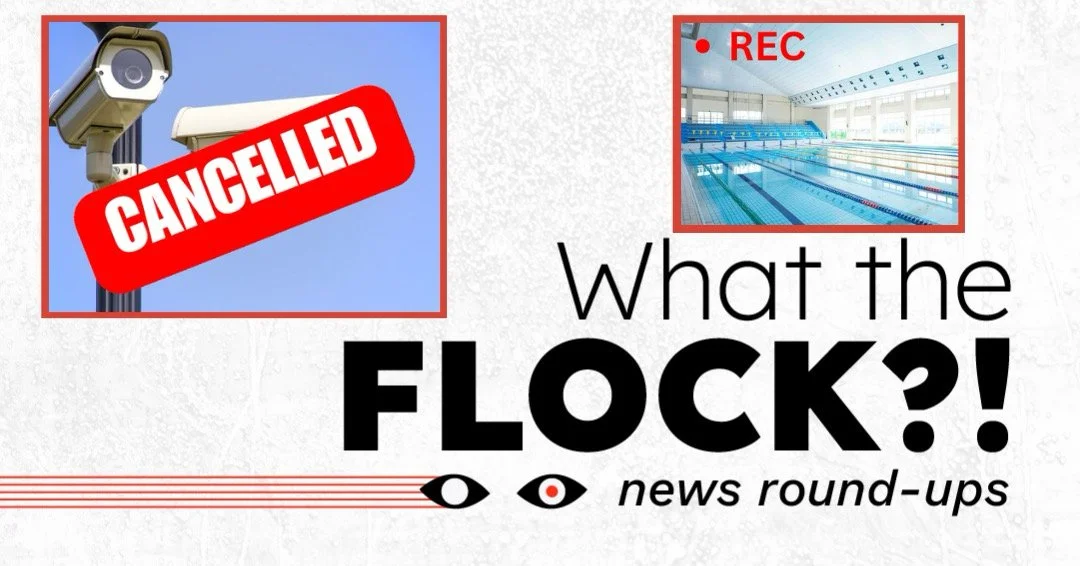
404 Media reported that Dunwoody, GA residents were alarmed to learn that Flock employees accessed sensitive areas of a local recreation center (pool, gym). Flock responded to the claims saying that the access in question was part of an authorized product demonstration program. Flock then adjusted their demonstration policy to prohibit viewing of sensitive areas. (If this seemingly hand-caught-in-the-cookie-jar style course correction feels familiar, that’s because it is. Flock has a history of providing transparency after their policies have been publicly identified as problematic. See here and here.)
This week, a Connecticut columnist wrote an article about Flock’s widespread surveillance network and the inherent dangers.
In Berkeley, CA, a confidential memo from city attorneys to Berkeley’s city council, police accountability board, city manager, police chief, and interim director of police accountability was leaked just before the city council was set to vote on renewing the town's contract, purchasing more surveillance tools, and expanding their network to plug into private cameras. (All told, the expansion would cost $2 million.) The city attorneys cited many concerns with Flock's AI-powered surveillance tools, ultimately concluding that the “technology carries inherent legal risks that cannot be entirely mitigated.” They stated, “we cannot ensure Flock will abide by its contractual obligations,” and indicated that Flock may not have the technical ability to implement some of the safeguards requested by the city, among other legal concerns.
Speaking of legal concerns, three residents in San Jose, CA have filed a class action lawsuit in federal court against the city, arguing that Flock cameras (474 cameras for only 178 square miles!) violate the Fourth Amendment with their warrantless tracking. The plaintiffs are asking for data to be deleted within 24 hours and for the AI-powered surveillance system in the city to be declared unconstitutional. In the suit, The Institute for Justice (who is representing the plaintiffs) reported that, in the second half of 2025, the cameras were searched an average of more than 15,000 times per day. The plaintiffs allege that abuse of Flock’s system "is unfortunately all too common.”
An example of such abuse is currently under investigation in Milwaukee, WI. The Milwaukee Police Department is investigating alleged employee misuse of the Flock database for the second time this calendar year. (Three months ago, a MPD employee was investigated for searching the Flock camera data over 170 times to track their ex.) Nevertheless, the Milwaukee Police Department still stated that the AI-powered license plate cameras are helpful for solving crimes when used correctly. Members of the community who oppose the cameras think that this event underscores the dangers of these tools. We’re inclined to agree.
Back at the end of March, Flock finally removed remaining cameras from Evanston, IL after months of dispute. (For context: The city cancelled their contract in August 2025. Flock challenged the termination and reinstalled the cameras unilaterally. The city responded by covering the remaining cameras in garbage bags because they could not confirm that the cameras were truly off.) The final update in this saga is an interesting read because it includes email chains between the city and Flock representatives which were obtained via Freedom of Information Act Inquiries.
Wonderfully, contract cancellations abound! Dayton, OH is indefinitely suspending its use of Flock cameras in order to perform an internal review. The Dayton Police Department found that "a network sharing feature had been enabled, allowing data to be accessed more broadly than intended," including 7,100 requests which cited immigration. This is not the first case of a city's sharing settings being different than intended. (See here and here).
The El Cerrito city council voted not to renew its contract with Flock Safety. While El Cerrito's mayor was pro-Flock, the Mayor Pro Tem Rebecca Saltzman (a city council member) expressed concerns about federal agencies accessing the data and about widespread AI-surveillance networks within the context of the Trump administration's attacks on democracy and human rights. Saltzman aptly noted, “The law has been changing constantly, we are losing more rights every week. Trump and the Supreme Court could change the law and require Flock turn over the data tomorrow.” The El Cerrito police department provided data endorsing positive effects of the license plate reader cameras, but, nevertheless, the council was split and ultimately voted 3-2 against renewing the contract.
Appleton, WI also announced that they were ending their contract with Flock. Mayor Jake Woodford’s statement is worth reading in full:
After careful consideration, taking into account the feedback from our community and our own concerns, we are beginning the process of ending our use of Flock Safety's system in the City of Appleton. Automated license plate reader (ALPR) technology has proven instrumental in solving cases, recovering stolen property, and locating missing people and we believe that if an alternative option is identified, it is an important capability to maintain for our community. That being said, concerns about the integrity of Flock's underlying system have eroded our trust.
The Appleton Police Department has long instituted strong internal controls over use of the product and data and has enhanced its policies to protect the public in recent months. However, such rigorous standards cannot be verified beyond the boundaries of our jurisdiction. Examples of illegitimate use of Flock data by personnel in other departments with access to the system reinforce accountability concerns that are not under the City of Appleton's control as a customer.
Recent events in a neighboring community have also raised questions about the accuracy of information Flock Safety provides to its customers. Regardless of the specific details, we hold ourselves to the highest standard in matters involving the public's personal data. [Links added for context]
This week also brought some regulation and education updates. Washington state just passed Senate Bill 6002, which provides safeguards for license plate cameras, such as limiting their uses (“police can only use the readers when investigating felonies or gross misdemeanors, looking for stolen vehicles or those registered to people with arrest warrants and searching for missing or endangered people, with some exceptions.”), data sharing (“the data can’t be shared except in court proceedings,”) and data retention (data “will need to be deleted after 21 days, unless it’s needed for police evidence”).
The ACLU of Massachusetts just published information differentiating between speed cameras and AI-powered license plate readers. This is a helpful one to reference when you’re discussing Flock with folks concerned about run-of-the-mill traffic safety!
Finally, there’s still time to boost the call for transparency regarding Home Depot’s use of Flock cameras in advance of their annual shareholder meeting on 5/21. If you missed this news in our prior What the Flock?! installment, full context and suggested actions to take can be found here.
Mass 50501 continues our work at the municipal and state levels to remove Flock cameras from our communities and people are paying attention! If you are here, you’ve likely already learned a little bit about the dangers of these AI-powered mass surveillance tools. Things are changing fast and it can be tough to keep up with all the news. We’ll continue to post blogs about Flock (check our articles here). In this space, you’ll find quick info from recent Flock news nationwide. This information could be helpful in removing cameras from your city or town! As always, if you’re interested in getting more involved, email us at flockoff@mass50501.org and join us in Discord!
Enjoyed this article? Get updates on the movement, volunteer opportunities, and more by clicking below.
What the Flock?! May 1, 2026
Recent Flock news for this week includes a contract cancellation, an article full of realistic optimism, suggestions that Flock’s transparency portal might not be all that transparent after all, a new place to find reports of Flock data abuse and misuse, examples of the ways that Flock cameras have made individuals less safe, and the introduction of the Surveillance Accountability Act (HR 8470) in the House of Representatives. If this sounds like gibberish to you and you need some background context about Flock Safety, the dangers of AI-powered license plate readers, and our fight against them, start at our website here.

This week, Oshkosh City Council in WI unanimously reversed their decision to renew their Flock contract only 24 hours after voting to renew it. Why this sudden change of heart? The police chief was given information about the cameras that directly contradicted a statement made by a Flock representative the day before.
The Nation reported on the proliferation of AI-powered surveillance cameras and nationwide attempts to remove them. The author likened Flock’s network to a modern panopticon. This article provides a balanced view of our surveillance situation. It celebrates the incredible progress that has been made against Flock by seasoned activists and regular people alike. (The author makes a point to call out the “parents and teachers and scientists and retirees” who have spoken up in their communities.) It also details the many obstacles that have yet to be tackled. Combatting AI-powered surveillance tools in our communities might at times feel like playing a frustrating game of Whack-a-Mole; this article is a nice infusion of realistic optimism.
Have I Been Flocked reported on Flock’s oft self-touted transparency portal and what appears to be—from Flock emails to police departments—intentional limitations or introduction of hoops people must jump through in order to access data via a Freedom of Information Act (FOIA) request.
Flock’s transparency portal and FOIA requests in general can be difficult for a layperson to navigate successfully. Thankfully, crowd-sourced records of Flock information continue to pop up. Kansas Watch has created an ALPR Abuse Library, which is “a publicly maintained, editorially reviewed index of news articles documenting abuses, misuses, and civil liberties concerns related to Automated License Plate Readers—with a focus on Flock Safety deployments.”
A Colorado man has ended up with his license plate incorrectly attached to a warrant he has no connection with due to a “data entry issue involving Colorado license plates, which use both the letter O and the numeral zero.” Because of this “issue,” Flock cameras create an alert every time Kyle Dausman’s truck passes by. He has been pulled over twice, and, although he is innocent, the problem has still not been corrected. His local police department has silenced their alerts, but other agencies could still act on the alert, leaving Dausman feeling unsafe driving his truck for fear of getting pulled over. He ominously stated,
"All I know is I'm in the system now. And there's really no easy way to get out of the system once you're in it."
Other examples of Flock cameras making people less safe are not hard to find. The Institute for Justice reviewed media reports and found that police officers have misused license plate reader data in order to stalk romantic interests. There have been at least 14 cases since 2021 (with most being more recent), but the article notes that this is likely an underrepresentation because not all police misconduct gets widely reported (or even detected). Horrifyingly, the review showed that most of the known incidents “came to light only after victims reported the officers’ behavior to the police,” which underscores the conclusion that others have come to before: Flock Safety’s purported safeguards are insufficient to truly protect us and our data.
The Surveillance Accountability Act (HR 8470) was introduced to the House of Representatives on April 23rd. The bill “would require government entities to obtain a warrant from a magistrate upon probable cause before conducting any search that significantly impinges on a person's privacy or security.” The bill specifically references “license plate images, vehicle metadata, or vehicle movement patterns obtained through automated license plate readers or similar systems” as needing a warrant “if the person associated with the collected identifiers did not express informed and voluntary consent.” This bill could eventually lead to regulation at the federal level, though—as many of us learned in grade school— it may take a while.
Mass 50501 continues our work at the municipal and state levels to remove Flock cameras from our communities and people are paying attention! If you are here, you’ve likely already learned a little bit about the dangers of these AI-powered mass surveillance tools. Things are changing fast and it can be tough to keep up with all the news. We’ll continue to post blogs about Flock (check our articles here). In this space, you’ll find quick info from recent Flock news nationwide. This information could be helpful in removing cameras from your city or town! As always, if you’re interested in getting more involved, email us at flockoff@mass50501.org and join us in Discord!
Enjoyed this article? Get updates on the movement, volunteer opportunities, and more by clicking below.
April 24, 2026
This installment of What the Flock?! contains another contract cancellation, a lawsuit over fourth amendment rights, hardships people are facing to get information about how Flock’s data is used, and a proposal to investigate Flock camera usage at Home Depot parking lots nationwide. Home Depot’s annual shareholders meeting is coming up on 5/21 and Flock is on the agenda! Read on to find out more…

Good news: the city of Bloomington, IL decided not to renew their contract with Flock after the public and city council members voiced concerns! The mayor cited issues with privacy, transparency, accountability, and public trust. Each cancellation reinforces the power of resident feedback to municipalities; this is working! For more information about how to talk to your local officials (including email and call scripts), check out our action page. Send it to a friend. There is clearly power in numbers at the local level!
And now, on to Virginia, where there are several recent happenings. For some background context, in October 2024, two residents in Norfolk, VA sued the city alleging that Flock’s ALPR cameras represented warrantless surveillance that infringed on residents’ fourth amendment rights. See another update on the case from September 2025. Unfortunately, in January 2026, a federal judge ruled that the cameras weren’t yet an invasion of privacy. Back to present time: the residents are appealing the judge’s decision. This week, several organizations filed amicus briefs in support of the appeal, including The Electronic Privacy Information Center, the Electronic Frontier Foundation, the American Civil Liberties Union, and the American Civil Liberties Union of Virginia. The amicus briefs state (among many arguments) that Flock’s systems expose the “privacies of life,” allow police departments and federal agencies to monitor people’s activities in real-time without a warrant, “perpetuate discriminatory and potentially unconstitutional predictive policing practices,” “provide the government with unprecedented powers of surveillance that upset traditional expectations of privacy,” and “undercut democracy.”
Also in Virginia, investigative journalists previously submitted Freedom of Information Act requests for Flock information from various police departments in the state. They found that the fees were inconsistent and sometimes excessive. While some departments provided the information for free, others charged thousands of dollars, with one quote coming in at just over $73K.They argue that the absence of a fee cap prevents ordinary people from understanding how the ALPR systems are actually used.
And finally, a nationwide chain has been called out for their partnership with Flock. Back in August 2025, 404 Media reported that Home Depot and Lowe's were sharing data from their parking lot Flock cameras with law enforcement. In advance of Home Depot’s annual shareholder’s meeting (coming upon May 21st), two Home Depot shareholders filed a proposal asking the company’s board of directors to produce a report “assessing risks to customers’ data privacy rights arising from the company’s sharing of sensitive customer data with third parties,” such as via the Flock cameras in their parking lots. The proposal goes on to explain possible financial and legal difficulties that may result from such data sharing, including data breaches and conflicts with evolving state privacy laws, as well as cites the company’s reputational risk from “frequent immigration enforcement raids” near stores. The proposal explicitly describes the problems inherent in a Flock contract, stating that “dependence on vendor-managed and provided surveillance networks and audit reports, without independent verification,” may “hinder detection of unauthorized access or misuse.” Basically, this boils down to: we can’t trust Flock to audit themselves nor protect customer data. (We previously reported on Flock’s abysmal track record with respect to cybersecurity.) The board of directors is recommending that shareholders vote against the proposal, alleging that sufficient oversight and auditing already take place. We wholeheartedly disagree with this assessment and urge stakeholders to vote for the proposal.
If you’re a shareholder, attend the meeting and make your voice heard! If you’re not, please spread the word! You can read the proposal and the board’s response here. Stay tuned for more on this topic!
Enjoyed this article? Get updates on the movement, volunteer opportunities, and more by clicking below.
April 10, 2026
This week’s What the Flock?! round-up includes a recap of data sharing concerns, proof that ICE has retained side-door access to Flock data, reporting on an incident in which Flock cameras were used to enforce a traffic violation, and city council remarks worth watching.
The Guardian recently provided a broad recap of data sharing and privacy concerns with Flock that have led some communities to reconsider or cancel their contracts. The Dutchtown Community Improvement District in St. Louis, MO recently cancelled their Flock contracts, citing concerns about data sharing with ICE. While Flock Safety continually reassures the public that they don’t share information with ICE, 404 Media found that the Florida Fish and Wildlife Conservation Commission police made dozens of searches with “immigration” as the stated search term (per a January audit), proving that ICE retains side-door access to Flock data from access points that many police departments likely wouldn’t ever consider as problematic. (Fish and Wildlife police?! Really?) 404 Media also reported that a motorcyclist in GA was issued a traffic ticket that read “CAPTURED ON FLOCK CAMERA 31 MM 1 HOLDING PHONE IN LEFT HAND.” This incident highlights two major problems: 1) Flock cameras capture more information beyond license plate images (as is often reported by Flock and municipalities to assuage concerns about privacy) and 2) the data captured by ALPRs can be used in any way with limited oversight.
If you want to learn more about Flock’s disastrous record, check out Benn Jordan’s comments at his city council meeting in February. See also a reddit post where a resident from Corona, CA shared how he is working to get rid of Flock in his community, including a link to his statements at a city council meeting. His statements are worth listening to. He mentions how Flock Safety’s data collection goes well beyond simple license plate surveillance. He also brought up the wider societal context: Flock Safety integrates with Palantir, whose CEO Alex Karp recently stated that AI technology “disrupts humanities-trained—largely Democratic—voters, and makes their economic power less. And increases the economic power of vocationally trained, working-class, often male, working-class voters.” Yikes.
Enjoyed this article? Get updates on the movement, volunteer opportunities, and more by clicking below.
Introducing What the Flock?!
Our first installation of What the Flock?! features a wider timeline of Flock news, including reports of Flock’s many problems, opposition efforts, resources to take action, and contract cancellations, including in our very own Attleboro, MA!
Photo by Mass 50501 Volunteer.
Mass 50501 continues our work at the municipal and state levels to remove Flock cameras from our communities and people are paying attention! Things are changing fast and it can be tough to keep up with all the news. We’ll continue to post blogs about Flock (check our previous articles here). In our new feature, What the Flock?!, we’ll provide you with quick info from Flock news nationwide. This information could be helpful in removing cameras from your city or town! As always, if you’re interested in getting more involved, email us at flockoff@mass50501.org and join us in Discord! Here’s our first news round-up:
In February, NPR gave a broad overview of Flock’s many problems, including data sharing across state lines and with federal agencies; Flock CEO Garrett Langley’s branding of opposition efforts as “coordinated attacks” from "the same activist groups who want to defund the police, weaken public safety, and normalize lawlessness;” and communities that have cancelled or are working to cancel their Flock contracts. A March TechSpot article similarly reported on the controversy surrounding Flock. Have I Been Flocked reported on troubling changes to Flock’s contract terms. If you want to hear about problems from some experts, the researchers at 404 Media did a Reddit AMA about Flock and the state of surveillance in the US. A family in Illinois was blocked from enrolling in their local school district (despite owning a home in the district) because an ALPR system tracked their vehicle as being parked out of district for a period of time over the summer. And for some local reporting: The Lowell Sun wrote negatively about Flock Safety due to cameras in Tewksbury, Lowell, and Billerica. If YouTube is more your thing, check out Louis Rossmann’s reporting (independent electronics technician, YouTuber, and consumer rights activist).
Now for the good news: a commissioner in Camden County, MO motioned to enforce an established ordinance banning ALPRs on the county’s roads. While he was outvoted 2-1, we applaud his efforts! Contracts have been paused or cancelled in Dunwoody, GA; San Jose, CA; Dane County, WI (after some shady practices by Flock); and our very own Attleboro, MA! Notice—most of these contracts were cancelled by City Council vote, which is why talking to your municipal leaders is extremely important. Louis Rossman has a video detailing a tool to alert you when AI-surveillance is on a meeting agenda in your community!
More specific good news for Massachusetts: MA House Bill H.3755, legislation that would impose meaningful statewide LPR guardrails (data retention and sharing limits), just advanced out of the Transportation Committee and now awaits action in the House Ways and Means Committee! Reach out to your House representative and let them know how important this legislation is. The next step is to make sure the Chair of the House Ways and Means Committee knows that MA voters care about passing this bill. See our Action page for how to contact your representative and for message templates.
And finally, here are two resources to help you learn more about this issue and take further action: Codeberg’s Deflock your City toolkit and Get the Flock Out of Here database.
Enjoyed this article? Get updates on the movement, volunteer opportunities, and more by clicking below.