On the “Right” Side of History
Holding Conservative Values In an Era of Right Wing Authoritarianism
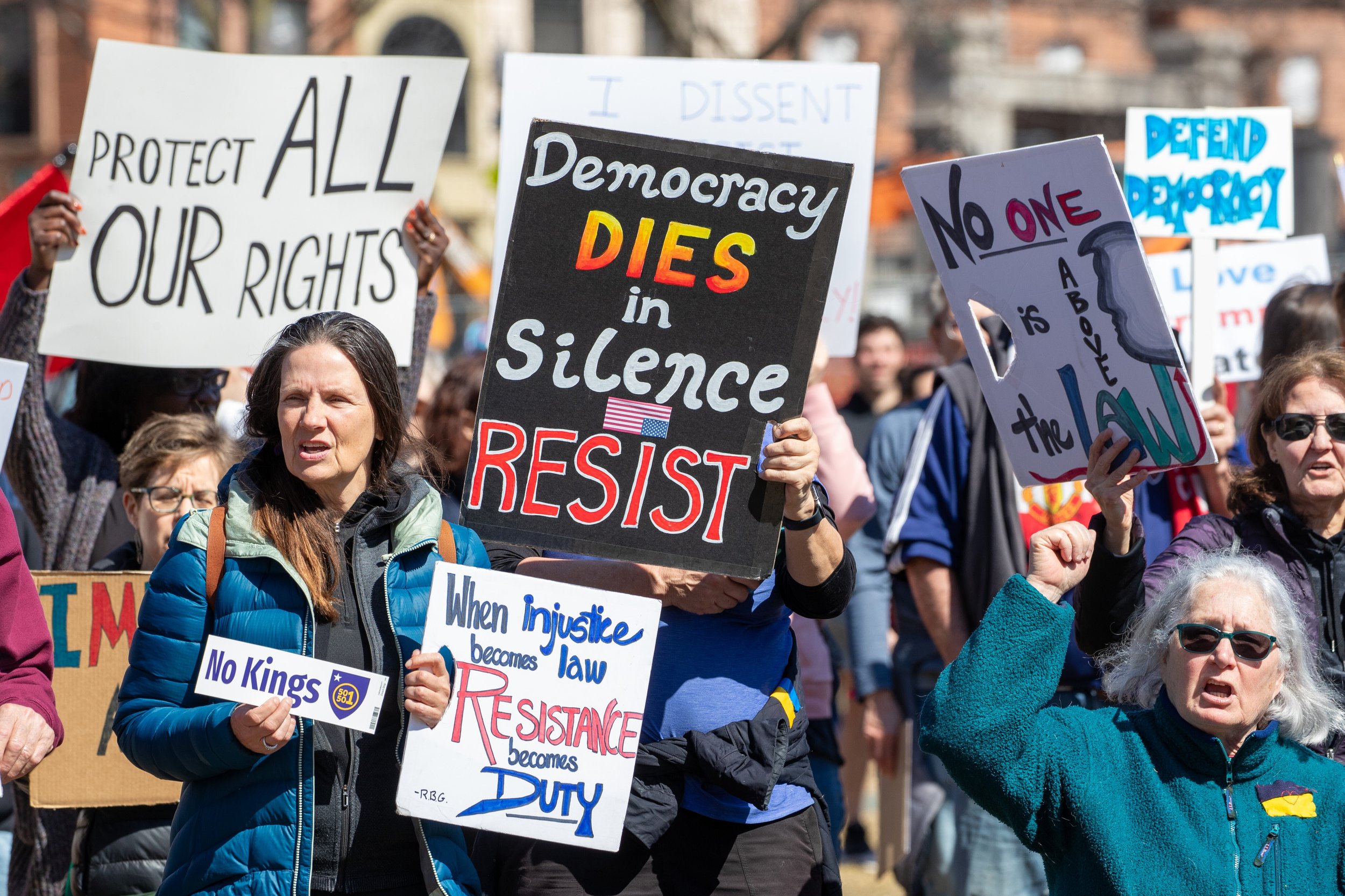
Activists demonstrating for democracy in Boston on March 15, 2025. Photo from a Mass 50501 volunteer.
The Overton window is a funny thing. In American discourse, we tend to imagine the Overton window as a range of politically acceptable ideas for the mainstream population sliding up and down a one-dimensional line stretching from the Left to the Right. There was a time when I was confident that I knew what “Left” and “Right” meant and where I sat on that line. I remember a time when I sat comfortably right of center, secure in the thought that my cohort held fast to what I thought of as quintessential American values: freedom of speech, a law-based society in which everyone was entitled to due process, patriotism as expressed through service and duty, civic engagement, responsible (and minimal) governance, and a full commitment to our constitution including every active amendment. I stood fiercely in defense of civil liberties for everyone, I waved the American flag with pride, and I believed that every American had the duty to try to correct any collective failure to live up to our ideals. I still do. I haven’t changed much.
Over the course of the last decade, many conservative communities where I used to enjoy participating in political debates have been overtaken by fear, greed, and hatred. The shift has been happening for a long time, but I will never forget the first time last year that I saw someone make the argument that we should support quota-based mass deportations because it might somehow decrease housing costs. I joined the conversation; surely, I thought, they didn’t realize that quota-based mass deportations would result in degradation of due process for everyone, widespread humanitarian crises, and potentially even the deaths of some of their own neighbors. Even if, somehow, they were comfortable with that, there was no clear path for that suffering to result in lower housing costs for those who escaped the violence and lawlessness that would result. When I joined the discussion, the response was a dog pile that involved no citations, no logic, and no thought. Those who were “in” supported mass deportation; anyone who questioned it was “out.”
More than a year into quota-based mass deportations, we have degradation of due process for every person in our country, humanitarian crises both inside and outside our detention centers as communities reel from the impacts of the racially-driven violence, and we have killings of nonviolent protesters by our own government in broad daylight in the streets. We also have higher housing costs.
Tyranny relies on hatred, paranoia, and cynicism. Democracy relies on respect, trust, and hope. Without mutual respect, civil discourse is not possible. Without trust, you cannot cooperate with others for your mutual benefit. Without hope, you cannot engage in efforts to make a better world. We have, unfortunately, seen a lot of behaviors that support tyranny over the last decade, and they have not all come from the top. Through millions of small acts, many average Americans have increasingly chosen fear. Cynicism. Hate. Greed. We often focus on the actions of top elected officials, or on the actions of some “other” distant group, but every descent into tyranny relies on the buy-in of at least a few too many regular people who respond to injustice with silence. At least a few too many who obey in advance. At least a few too many who assume the mantle of the tyrant.
When Trump won the first time, I spent a day in the library, sitting with a pile of books about democratic backsliding in countries around the world. This was by no means the first time I had read about many of these historical events, but they suddenly jumped off the page and into my reality in ways I had never experienced before. I recognized the same words, the same ideas, and the same actions somehow happening again in real time, enacted unwittingly by the people surrounding me in the present day. The eeriest examples were the comments about crimes committed by immigrants and other “undesirables.” Crimes committed by individual people were highlighted in gruesome detail as reasons to enact collective punishment against a group—usually a group that committed crimes at a much lower rate than the overall population. In these comments, the humanity of both the speaker and the subject was left behind in favor of an obscene celebration of cruelty. What used to be political discourse morphed into tribalistic clashes designed to shove people into categories of “friend” or “enemy.” As the foundation of political discourse shifted around me, the foundation of my political identity shifted out from under my feet as well.
When Trump won the second time, I made it my mission to find a place to plug in meaningfully and throw everything I possibly could at bolstering the pillars of democracy to protect our way of life and prevent the horrors of tyranny. I had felt politically homeless for a long time, and assumed that I would be jumping in entirely with people far to the left of me on the political spectrum. I worried that I would end up in a movement that supported many of the same dangers that Trump embodied, but from the other side of the Left-Right political spectrum. Trump’s actions and rhetoric felt very reminiscent of historical communist dictatorships to me; I didn’t want to swing the pendulum to replace communist witch hunts for capitalist witch hunts. While trying to find my place, I wandered despondently between conservative conversations dehumanizing hateful liberals to liberal conversations dehumanizing hateful conservatives. The prospect of replacing hate and prejudice with different hate and prejudice filled me with dread.
Early in 2025, I went to a protest organized by Mass 50501 and was entirely unsurprised to see some people who showed up to walk through the crowd handing out socialist pamphlets. I was, however, quite surprised that I also saw a conservative veteran speaking from the heart about his loyalty to the flag, the oath he took, and the duty he felt to uphold those values. The focus was on community, duty, loyalty, trust, and love. Hate did not enter the conversation. For the first time in a long time, I felt politically at home.
Since I joined Mass 50501, I’ve walked alongside people who have claimed just about every political label that existed before I learned the term “MAGA”. I met a retired former hippy who kindly pressed a resistance button into my hands. I met a laborer who swore like a sailor and fought for the right of workers on his line to listen to music in any damn language they please. I met very composed attorneys who failed to keep a straight face as people nearby twerked in inflatable costumes. I’ve organized with academics. Mechanics. Entrepreneurs. Construction workers. Engineers. Retirees. Students. Scientists. I’ve made countless new friends with people who I would never otherwise have met. We fall all over the classic Left-Right political spectrum, but we all share strong values: a sense of civic duty, a belief in civil liberties, and a tenacious refusal to dehumanize anyone.
In political discourse in the United States, I often see people fall into arguments grounded in the old Left-Right political spectrum. If an idea isn’t either “Left” or “Right” enough, arguments pop up that it’s filling a vaguely defined “centrist” space. If something doesn’t fit the mold of the old categories, someone will often argue that it somehow lacks conviction. I would argue, though, that if we absolutely must envision politics along a straight line between two extremes, the line that makes the most sense under the specter of the current administration isn’t “Left” vs “Right”; it’s “Tyranny” vs “Democracy.” There is no longer a stable “Right” or “Left” holding static positions in public discourse, especially as publicly acceptable ideas seesaw erratically at the pace of Trump’s middle-of-the-night social media posts.
As Americans rise in our millions to stand against authoritarianism, we find each other among those who choose democratic values. We hold these truths to be self-evident: that all people are created equal and are endowed with the inalienable right to life, liberty, and the pursuit of happiness. We pledge allegiance to the republic for which our flag stands: not to a person, not to a political party, and certainly not to a single political office. In a different time, many of us would have sat on opposite sides of an aisle that no longer holds meaning. Now, we stand together in our mutual stubbornness. We refuse to sacrifice respect for hatred. We refuse to sacrifice trust for paranoia. We refuse to sacrifice optimism for cynicism. We insist on building a stronger democracy. We insist that rights and liberties are for everyone. We insist on protecting the marginalized. We insist on fighting like hell to protect American democratic institutions. We insist on honor and responsibility.
Looking at things through the perspective of the old political spectrum, I have no idea how far “right” or “left” I am any more. There’s no meaningful center for me to define myself in relation to. Under a political spectrum stretching from tyranny to democracy, though, I know where the hell I stand. With ten toes down, with everything I have, with my entire soul, I stand for democracy.
Enjoyed this article? Get updates on the movement, volunteer opportunities, and more by clicking below.