Flock Safety and the Dangers of AI-powered License Plate Readers
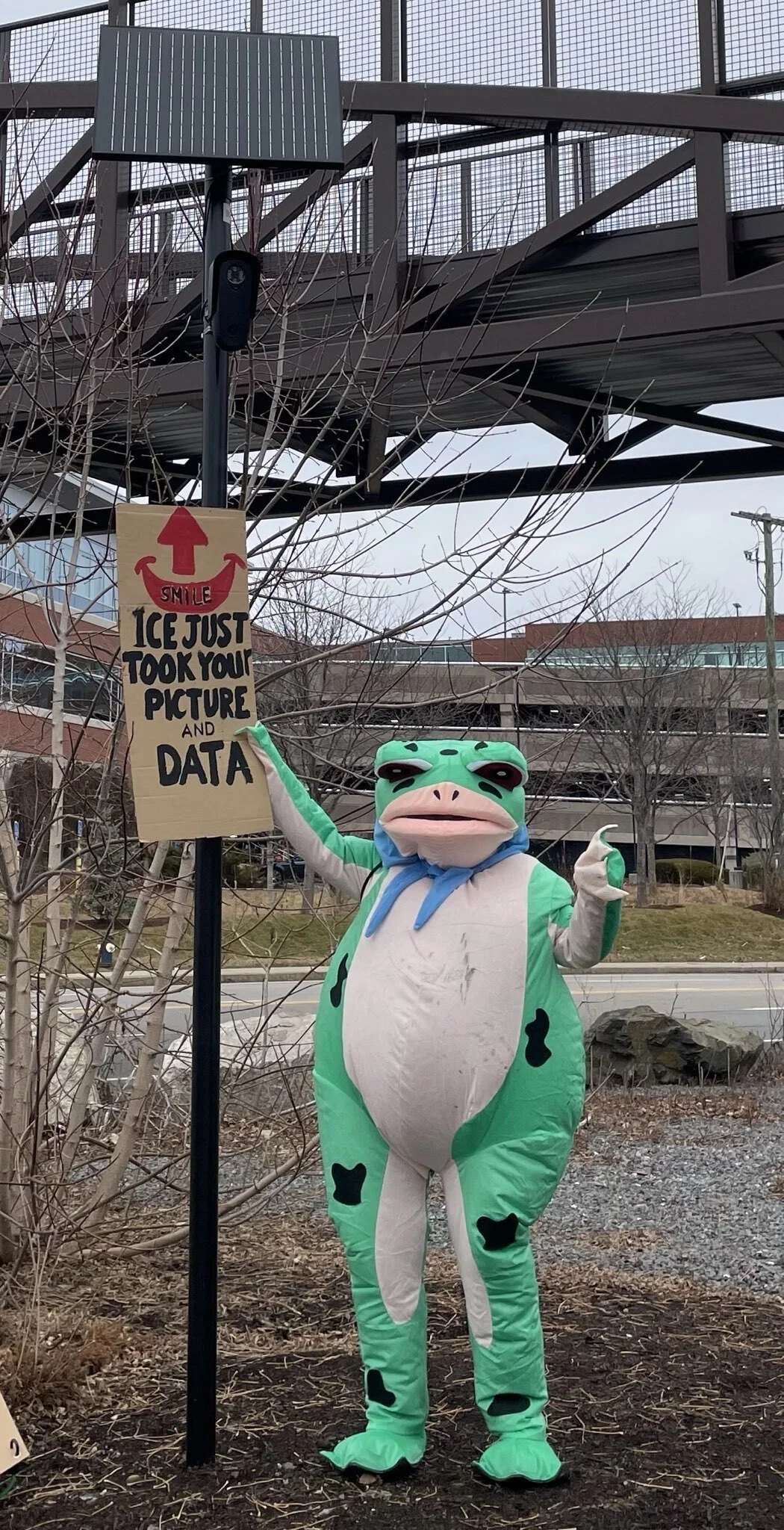
Photo via Kate, CreativeResisting.org
The Year the Cameras Came
Long gone are the days of “innocent until proven guilty” and personal privacy. There are fewer and fewer places that are free from our overlords’ constant gaze. Ugly black poles went up all over town. Slowly, at first, and without any fanfare; but their numbers increased steadily. Maybe they are solar panels for the utility company, people thought. Maybe they help the birds, a few climate-friendly optimists posited. They’re ugly!, a little kid commented. One lonely conspiracy theorist camped out by a pole closest to the center of town shortly after its appearance. They signal aliens! They’re watching us!, he declared. People averted their eyes and hurried past. They didn’t want any trouble.
Unfortunately, trouble was all the poles brought. No one knew who put them up, and town administrators and the police wouldn’t comment on them. We later learned that the police department paid for them with federal grant money, so the poles didn’t need to be approved as part of the town’s annual budget. But it probably wouldn’t have mattered. A neighboring community had its city council approve their budget, contract, and installation. Back then, no one knew how nefarious the company providing these black poles could be.
Of all the guesses as to what these poles could be, the conspiracy theorist was closest to the truth. Atop each pole sat an Automatic License Plate Reader (ALPR) camera. These cameras captured images of every single license plate that passed by them, and while they didn’t signal aliens, they did share the license plate data nationwide with hardly any restrictions. Anybody driving through our town was captured by the cameras. The climate-friendly activists were partially right—the camera did help the birds, but not the ones they were expecting. Most of these ALPR cameras were owned and operated by a company called Flock Safety. The little kid was the most correct. Everything about this tech was ugly.
When people started questioning the cameras more openly, we were quickly assured that—there’s nothing to fear! The cameras were merely collecting license plate numbers—nothing personal—nothing sensitive. But, when we asked to see the data captured by these ALPR cameras, we were told, Oh no! We can’t possibly share that information. Although the license plate data is the same as what could be captured by anyone’s eyeballs walking by on the street, it could *accidentally* contain private information. For everyone’s safety, we better not share it. Rest assured, they continued, we have the strongest possible protections on this data. No one views it without our authorization. And they believed that. And for a while, we did too. The ALPR cameras keep our community safe, they reminded us.
But then, the incidents started. People didn’t bat an eye when a man was held at gunpoint for 40 minutes because an ALPR identified his rental car vehicle as being on a hotlist. Human error, they said. We forgot to update our hotlist. Besides, the man won a settlement. Situation normal. People made excuses when, one afternoon, a 12 year old girl and her older sister were pulled over, held at gunpoint, and handcuffed before officers realized that the ALPR had misread their plate number. AI tools sometimes make mistakes, they said. A mother and family, including a 6 year old girl, were forced onto the hot pavement and held at gunpoint after an ALPR misread their plate. AI technology is improving everyday, they promised. Remember those videos of Will Smith eating spaghetti?
But unlike the Will Smith videos, things didn’t get any better for us. The ALPR cameras continued to make mistakes—and even worse, the officers that were fed the data stopped questioning it. As it turns out, none of us are immune to AI Brain drain. It became common practice to log our own movements and keep our own records of our whereabouts handy in case we were ever accused of something with “video evidence.” A third of our town had already been carrying their proof of citizenship in case of a chance encounter with the Secret Police anyway. Those of us who could, began downloading our cell phone and vehicle location data logs nightly, just in case.
And while it has been hard on all of us, it’s certainly been harder on some groups disproportionately, such as our immigrant neighbors and individuals seeking gender-affirming or reproductive health care. When the Secret Police started kidnapping immigrants in public spaces, many of our neighbors made the incredibly difficult choice to stay home from school, work, or places of worship. Once these ugly black poles showed up, things escalated. Many folks felt that any movement became unsafe, effectively making them prisoners in their own homes.
Remember when we were promised that our data was not being shared? Well, the ALPR sharing settings were accidentally unrestricted. Whoops! they said, We’ll get right on that. Now no one can see our data without a written request. Plus, our ALPR data is never used for immigration purposes, they reminded us. But we later found out that Flock Safety had piloted a program with Border Patrol without any notice to affected communities. How could we trust a company that only seemed to course correct or offer transparency after news of their wrongdoing had come to light? How could we ignore these big black poles, knowing that their use could directly influence the safety of people we loved and cared for?
As the awareness of what had really been happening with the big black poles in our town spread, even the pro-ALPR crowd and town administrators began to get concerned. After months of speculation and secrecy, we were finally united against this heinous AI-enhanced dragnet surveillance system. Ok, the town council and police department agreed, we’re deactivating these cameras until we have a clearer understanding of how the data sharing works. And that should have been the end of it. Except it wasn’t.
Flock came in under the cover of night and reinstalled several of the cameras against the town’s contract. We feared that we would never come out from under their watchful eye. And while our town has made progress against Flock, they continue to aggressively market to other unsuspecting communities. While their ALPR cameras have gotten the most attention lately, Flock also has cameras capable of zooming in to pedestrians at an alarming level. The company has plans to gather data from sources beyond law enforcement and big corporations (such as through doorbell cameras, essentially deputizing neighbors against each other). And most alarmingly, they announced a tool that will compile profiles of anyone captured by their cameras, even flirting with the idea of using data from breaches (though Flock quickly walked those plans back, without actually denying them).
A neighbor of mine, a retired college professor—a paper-and-pencil guy who never owned a cell phone and was still using a rolodex—was driven mad by the thought of constant surveillance. He began to hate leaving his house. He started making tallies in a little notebook anytime he passed a camera on his less- and less-frequent outings. After he passed, his family found his stash of notebooks. They were full of nothing but tally marks—526 tally marks over the course of only four months.
**The above narrative, while fictitious in its overall framing, pulled inspiration from real, documented problems with Flock Safety and ALPR technology. Check out the embedded links and read on to learn more about our current reality and—more importantly—our hopes for a better future.
What are ALPR Cameras? What is Flock Safety?
Automatic License Plate Reader (ALPR) cameras automatically capture all license plate numbers that come into view, along with the location, date, and time. They are often pole-mounted (single poles, street signs, traffic lights), but can also be mounted on police cars or mobile equipment (such as a temporary speed monitor).
Flock Safety is a company producing AI-powered ALPR technology, cameras, and drones, which advertises its technology as being able to eradicate all crime. They market their cameras to police departments, campuses, and private companies.
Why should I worry about this?
Between mistakes, poor oversight, the potential for intentional misuse, shady private companies, and the insidious creep of data collection from various, often effectively anonymous, sources, AI-powered mass surveillance endangers all of us.
AI-powered ALPR cameras and similar technology are different from regular ALPR cameras because of how they interpret, store, collate, and share data. Additionally, while customers of ALPR cameras in theory own their own data, the cameras themselves are owned by Flock (or similar companies) and only leased to the police departments. Unfortunately, we live in an age in which personal data is collected through everyday interactions and put up for sale to the highest bidder. We can leave our cell phones at home, we can deal in cash transactions, we can clip paper coupons instead of downloading a store’s shopping app, but we can’t avoid these systems of dragnet surveillance unless we never leave our homes.
We uphold our First Amendment right to record in public and are supportive of non-AI efforts that protect our communities, while still maintaining our reasonable rights to privacy and free action. Flock Safety and similar companies have not earned the public’s trust. This technology requires regulation and oversight to prevent encroachment on our civil liberties. There is, in fact, already proposed legislation in the MA state legislature to address this issue.
How can I find out where this is happening?
A crowd-sourced nationwide map of ALPR cameras can be found at deflock.me.
What can we do?
Watch this space for updated information, including a forthcoming FAQ and more specific guidance based on our teams’ experiences in local municipalities. More resources are available from the ACLU of Massachusetts. The first step toward change is spreading awareness.
Find out where cameras are located near you and spread the word. Talk up the cameras with your neighbors, who may have not even noticed or questioned them. Find out what information about them is publicly available from your police department. If ALPR cameras are already in use—do they have a publicly accessible ALPR policy? If not, request to see one! Does your municipality have any oversight on this type of technology? Check your city or town’s bylaws. (Bonus: you might learn something new about how your town works, in general!)
Learn more about your own digital footprint and how to secure things you may use daily, like a Ring doorbell camera or Amazon Alexa (or—if you’re feeling so inclined—keep up the Amazon boycott energy from November!)
Enjoyed this article? Get updates on the movement, volunteer opportunities, and more by clicking below.