The Patriots and The Nationalists
We are at a treacherous moment in our country’s history. Masked agents of the state are kidnapping citizens and noncitizens alike, in Minneapolis and elsewhere. These agents have gone so far as to kill citizens—those they have sworn to protect—with apparent contempt for their lives. In response, leaders of the government have lied about the circumstances surrounding the victims’ deaths, denied calls for accountability, and stood by their agents’ immoral actions.
This is a great national crisis because it is not only those killed who have been attacked; formerly cherished principles, such as the rule of law and the freedom to live without government interference, have also suffered, provoking anger and disheartenment in those who still hold these things dear. However, beyond constitutionalism and those who have bled, there is another, more subtle victim in this: our national identity. For those who, like me, were raised believing that this country stood for such virtues as fairness and equality, these actions demand us to answer the question: “How do we define ourselves?”
The answer, I believe, requires delineating between nationalism and patriotism. The storied American dictionary Meriam-Webster says of the two (italics theirs):
“Nationalism, while it refers to loyalty and devotion to a nation, tends to imply the placing of that nation above others, a tendency that is not necessarily implicit in patriotism.”
These sentiments were clearly written with an international context in mind, but I think we can, without too much stretching of the meanings, apply the terms to domestic politics as well.
The nationalists believe that certain racial, religious, or other groups are superior to some others, and America is made great only when the favored groups subjugate those they perceive as lower. Under this principle, liberties are more readily sacrificed when threats, real or imagined, are presented. By contrast, patriots believe that all the ideals expressed in our founding documents—among them freedom, liberty, and opportunity—belong to all Americans without exception, and believe that America can only be great when equal access to these ideals is ensured.
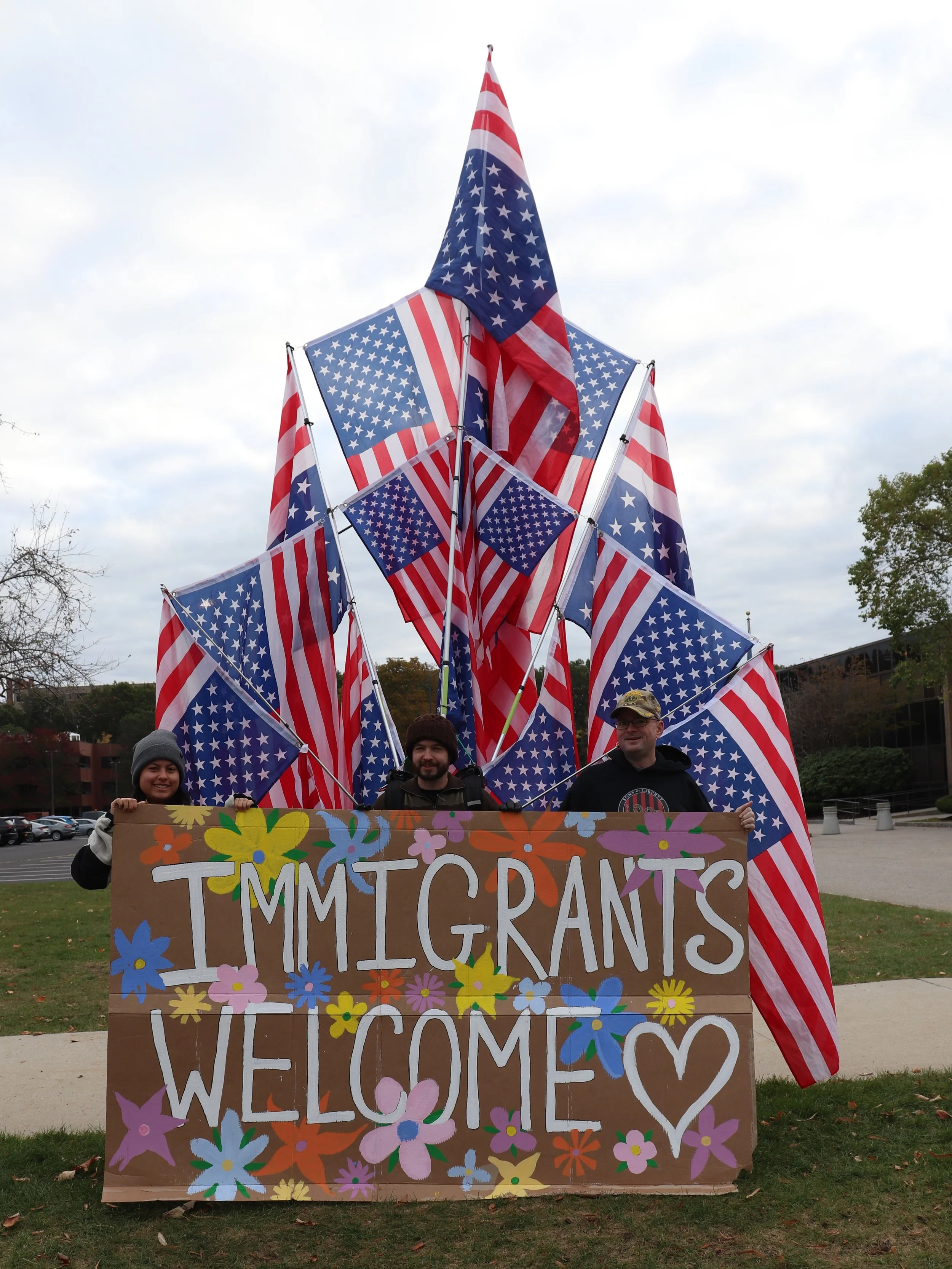
Both nationalists and patriots believe they are making America greater. However, their differences far outnumber their similarities. Where nationalists seek homogeneity, patriots seek pluralism. Where patriots see protest, nationalists see usurpation. When patriots pursue democracy, nationalists respond with authoritarianism, or at least selective disenfranchisement, which is but authoritarianism under a different name.
The trick to understanding America is that both camps have jostled for power since before its independence, the two ideological strands intertwining throughout our history like a double helix. Complicating things is that Americans are not clearly divided between the two camps. Individuals can express nationalistic ideas on some issues and patriotic ones on others, or change their views with time. The Puritans came to America for religious freedom then exiled members like Anne Hutchinson and Roger Williams for expressing beliefs they disapproved of. Infamously, the man who wrote
“all men are created equal, that they are endowed by their Creator with certain unalienable Rights, that among these are Life, Liberty and the pursuit of Happiness”
himself denied these rights to the people he enslaved. When these contradictions are considered, it seems that the arc of history in America bends not toward justice, but twists back and forth like a sine wave.
In recent years, an increasing number of works have addressed the historical failure of our country to live up to its patriotic ideals. These works include A People’s History of the United States by Howard Zinn and The 1619 Project, spearheaded by Nikole Hannah-Jones. These works are serious scholarship and deserve recognition. However, I think it is undeniable that, contrary to the authors’ intentions, they have contributed to a deepening cynicism of our national character. Nowadays, we hear often that America is a hypocritic nation that has never truly stood up for its beliefs; that it is, in effect, a nation with an ill conception and a hollow core. Some critics see the current administration as vindication of this pessimistic assessment. At worst, these critics may imply that this country is not worth fighting for.
This is a grave mistake. Let us begin at the top. The office of the presidency has to some become a symbol of the direction of the country, and a representation to the world of what we stand for. This thinking is understandable, especially coming from those outside the U.S. However, it is a mathematical absurdity that a nation, especially one of over 340 million individuals, can be represented by one man, even if that man was elected president by a majority, for single leaders mask political divisions. Simply put, nations are too complex, and polities too diverse, to be represented by any individual. This is true now, as it has been for previous governments.
Then what does represent America? The answer is simple: America’s character is set not by its government, but by its people; accepting otherwise would require us to sacrifice the spirit of individuality we have been known for for centuries. On this metric, we have far from a perfect record. We have had criminals, corrupt officials, abusers, and more than our fair share of slavers. But we have, at every point of our country’s history, had much more than that. When MLK marched to Washington, 250,000 followed to demand equal justice. A century earlier, soldiers enlisted by the government marched to battle singing “As he died to make men holy, let us die to make men free.” After nearly a century of protest in favor of women's suffrage, hundreds of politicians agreed to ratify the 19th amendment, granting the franchise to millions of American women. As this played out, millions more immigrants, many of them leaving places much less free than the U.S., came to our shores with hope of a better life, a promise which was eventually fulfilled with help from their neighbors, naturalized and newly arrived alike. Even on the world stage, Americans have done much for justice, with and without their government. To give but two examples: in World War II, Americans helped evacuate the Nazi concentration camps, and when the Canadian city of Halifax was devastated by an explosion in 1917, the people of Boston sent the equivalent of $16.9 million of aid in today’s dollars. Our charity has continued into this century, with the United States being the top global provider of humanitarian aid at least until last year, cumulatively preventing millions of deaths. When we forget that these valiant actions were conducted by Americans too, we neglect them at our own peril.
This is something critics of the United States often miss. To those working to make the nation more fair, but who still feel the United States is essentially corrupt, I say “Look in the mirror. This is your country too.” That our government has at times neglected these ideals, and the present administration is currently trying its best to stamp them out, does nothing to detract from this fact. What it does do, is require patriots to speak out more than ever, because despite our 250-year-long history, the patriotic fire is not self-sustaining. It requires each new generation of Americans to tend to it against the forces that seek to end it. Our flag will only stand for liberty, equality, and prosperity as long as we do.
Nowhere has this existential struggle for our identity been more visible the past few weeks than in the streets and homes of Minneapolis. The contrast cannot be more clear: On one side, armed and lawless agents trying to forcibly remove nonwhite people, and on the other, everyday Americans putting their lives in jeopardy to defend their immigrant neighbors. In the face of violence, oppression, and subzero temperatures, Minnesotans have shown us their vision of an America which is welcome to all.
Even several states away, with the comfort of a screen separating me from the violence, witnessing these events has not been easy. For every new video of someone getting killed, I am ashamed of my government and afraid of more unnecessary deaths. But when I see the people in Minnesota continuing to gather, continuing to resist, and refusing to submit their beliefs, I feel something more powerful stirring within me—patriotism.
Enjoyed this article? Get updates on the movement, volunteer opportunities, and more by clicking below.