What the Flock?! June 5, 2026
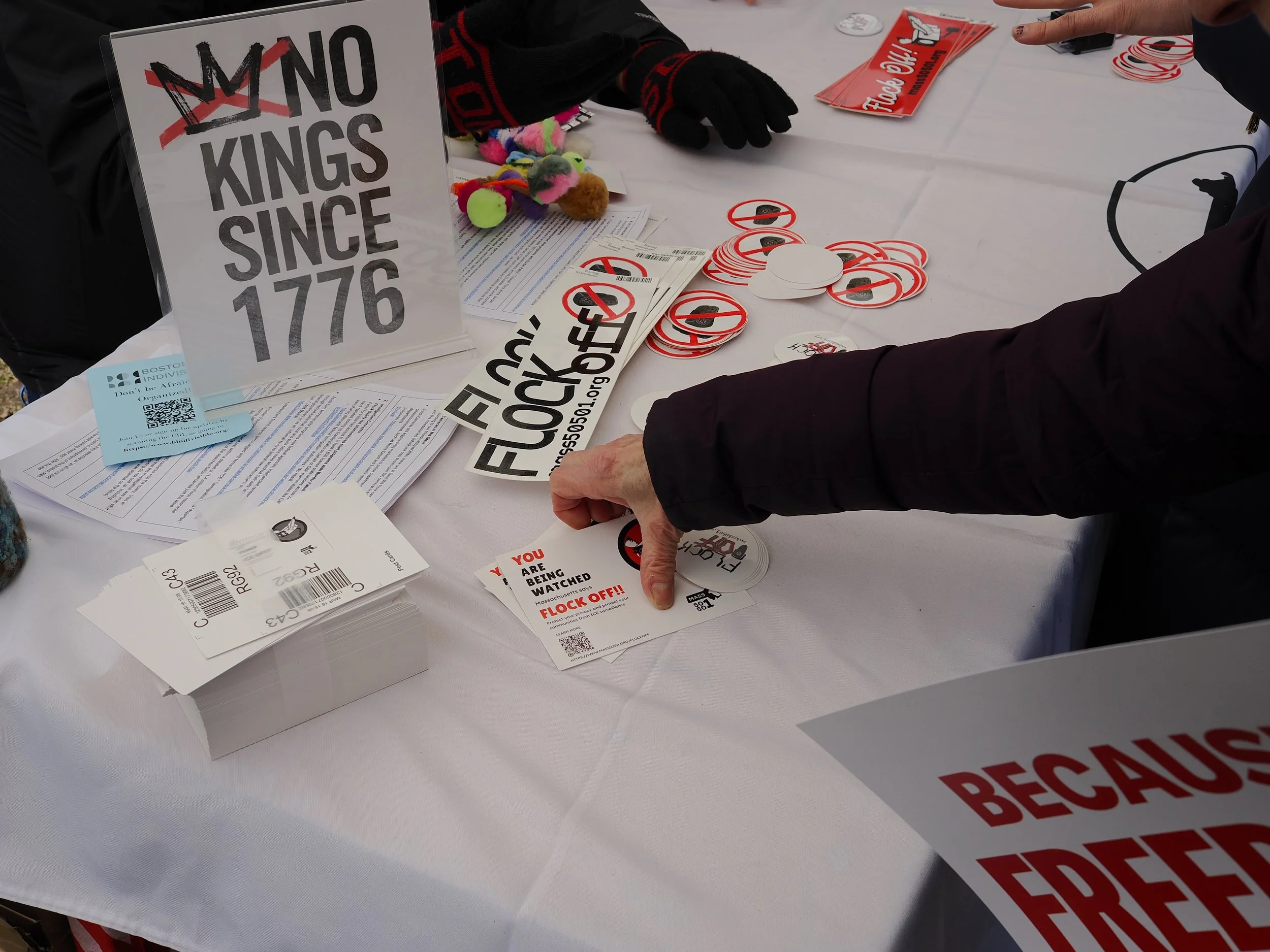
On May 21st, Home Depot shareholders unfortunately voted against the proposal seeking more information about how customers’ data was handled by third parties and the potential risks of Flock cameras in their parking lots. (For context, all shareholder proposals were voted against, so the proposal had a slim chance to begin with.) While this isn’t the outcome we were hoping for, it’s encouraging that the issue got media attention. The creep of AI-powered surveillance into retail locations has been a great hook to inform folks of the dangers of these unregulated surveillance tools, and we encourage you to continue to discuss this topic in your circles. Despite the proposal being voted down, the opposition against Home Depot’s use of Flock cameras hasn’t evaporated! Lawmakers in Connecticut wrote a letter to the CEOs of Home Depot and Lowe’s "demanding to know how they collect, store and share the data from these cameras." We’re glad to see this issue is not being dropped.
An intense debate has erupted in Troy, New York over their city’s Flock contract. In early May, the city council in Troy, NY introduced potential legislation to limit the amount of time license plate readers like Flock cameras can retain data, reducing the data storage from 30 days to 48 hours. The mayor and police department expressed that the restriction on data storage would undermine public safety. The debate raged on when the mayor wanted to renew the town's contract, but the city council paused payments in an effort to force review of privacy concerns associated with Flock cameras. The mayor then declared a public safety emergency to keep the cameras on. Troy's city council filed a lawsuit challenging the alleged executive overreach. The mayor and city council president have since reached a temporary compromise. Town officials established a 60 day working period to obtain more data about the town's usage of Flock cameras to inform policy and operational standards. As part of this compromise, they worked together on policy updates for the town's ALPR cameras which were implemented immediately. The updated policies include oversight via audits, nonparticipation in Flock's national lookup tool, prohibition of any immigrant-related enforcement activities or any monitoring of First Amendment protected activities, and strict limits on data sharing (including no sharing at all with federal agencies). The city council still plans to pursue legislation, stating, "A policy is not a law, and we will continue to work on our law." While the 60 day review and updated policies are steps in the right direction, some Troy residents have expressed frustration that the public were not given ample opportunity to voice their concerns. Additionally, they stated that the 60 day review is an additional 60 days in which their data is being captured without their consent. Following these updates, parts of town were vandalized with graffiti saying "Flock." No suspect has been named at this time. The co-leader of DeFlock Troy Bri Harrington, along with other activists, helped clean the local businesses that were tagged. This empathetic response shows the power of working together as a community and the importance of respecting one another in spite of differences. Let's keep an eye on how things unfold in Troy, NY.
Problems with Flock cameras abound. As we previously reported, a police officer in Wisconsin resigned after it was discovered that he had stalked an ex-girlfriend using Flock license plate data with a staggering 179 look-ups over a two-month period. This case is receiving more attention because it shows that safeguards and audits in the Flock platform are insufficient to protect citizens’ data from abuse. Yahoo News reports, “this was not a one-time misuse or an accidental search buried in a massive database. Investigators determined repeated lookups were taking place over weeks. Each search was reportedly logged as part of an investigation, despite the searches allegedly having no legitimate law enforcement purpose tied to criminal activity." The article goes on to state, “if internal oversight fails, abuse can continue for long periods before victims ever discover it.” As a reminder, most cases of misuse or abuse have only “[come] to light only after victims reported the officers’ behavior to the police,” which underscores the conclusion that others have come to before: Flock Safety’s purported safeguards are insufficient to truly protect us and our data.
This video recaps some of the recent news in a tight 2:22 with just a touch of humor. And if you’re itching to go down a rabbit hole, filmmaker Chris Parr's video presents the problem of Flock Safety through a discussion of the U.S.’s only “unmappable city,” North Oaks, MI. After he felt uncomfortable learning about Flock’s mass surveillance network, filmmaker Chris Parr actually decided to delete his drone images of North Oaks. Speaking about Flock cameras, he stated,
“Yeah, these things have been misused, but I actually think that’s not even as big of a problem as how they could be misused. I mean, who knows? Use your imagination. If they can do it, they probably will.”
In Florida, a 23-year-old woman who spent 13 days in jail after being wrongfully arrested in connection with a deadly crash finally had the charges against her dropped. Interestingly, the allegation was not originally the fault of a Flock camera. An observer provided an incorrect report (mistaking a maroon vehicle for a black vehicle) and partial plate number. This is where the Flock cameras came into play. The article states, “according to the arrest report, troopers cited a Flock license-plate reader camera that captured Isaacs' tag traveling… approximately 3 miles west of the crash scene.” The very-same data that was used to implicate Isaacs was also used to free her. Her attorneys were able to use the timestamps to prove that she was well past the accident scene at the time of the crash. She has stated that the 13 days she spent in jail were the worst days of her life.
The problems don’t stop there. Reports show that Flock’s network has been used for a variety of cases well beyond their stated purpose of “public safety.” The Electronic Frontier Foundation (EFF) analyzed Flock data audit logs and found that law enforcement agencies have “use[d] these surveillance networks for virtually any whim,” such as verifying student residence, employment background checks, investigating noise complaints, and minor traffic violations. For example, the city of Buford, Georgia, ran more than 375 searches to verify school residency over a three month period, which accounted for more than half of all ALPR searches in that period. EFF pointed out that "unchecked mission creep… has turned an alleged ‘crime-fighting’ tool into a universal tracker of everyone’s movements.”
While the previous report focused on tracking movements for mundane purposes, we all know how Flock data has been shared with federal agencies (either directly, or indirectly) for immigration enforcement purposes, often in violation of state laws. Case in point: a student group uncovered that the University of California shared ALPR data from its multiple campuses with U.S. Customs and Border Protection and other federal agencies, against California state law.
Dayton, OH (which we recently reported was pausing its cameras in order to review their usage), is the most recent city to cover their Flock cameras with garbage bags in order to prevent unauthorized data collection. Other cities that have covered the cameras after contract pauses or cancellations include Evanston, IL and Verona, WI.
On May 21, a bipartisan amendment banning ALPRs except for toll collection was proposed by Reps. Scott Perry and Chuy García for a federal highway bill. Many groups supported this amendment. Unfortunately, the amendment was voted down. For more information about the debate over this amendment, check out this article from The American Prospect.
Regulation is needed now more than ever, as the FBI has recently “announced plans to buy nationwide access to a network of license plate readers, saying it will award contracts to one or more vendors that can offer ‘near real time’ information from cameras across the US,” going on to state that the “system must cover 75 percent of locations” across the US and its territories. When discussing proposed regulation in Colorado, State Senator Zamora Wilson provided a remark that befits this situation. She said,
“Regardless of which party holds the reins, when the government can track your vehicle’s history back months or years through these databases, any reasonable expectation of privacy is effectively dead, and it’s not the role of the government to have a God’s eye view on its citizens.”
Luckily, there remains strong bipartisan opposition against these AI-powered surveillance tools, such as the Colorado bill, that, while not advancing at this time, is likely to return in another form. A State representative from Maine, David Boyer, introduced a bill to ban use of license plate readers except for toll collection. He stated that he was “just trying to slow down the impending surveillance state.” At the local level, check out the Flock opposition in Framingham, MA, where the police department has until June 30th to decide whether it will renew its contract with Flock Safety. Are Flock cameras in your town? If so, what are you going to do about it? Check out our suggestions for how to talk to your municipality about Flock, join us in Discord, or reach out to us at flockoff@mass50501.org.
Enjoyed this article? Get updates on the movement, volunteer opportunities, and more by clicking below.