Won’t You Be My Neighbor?
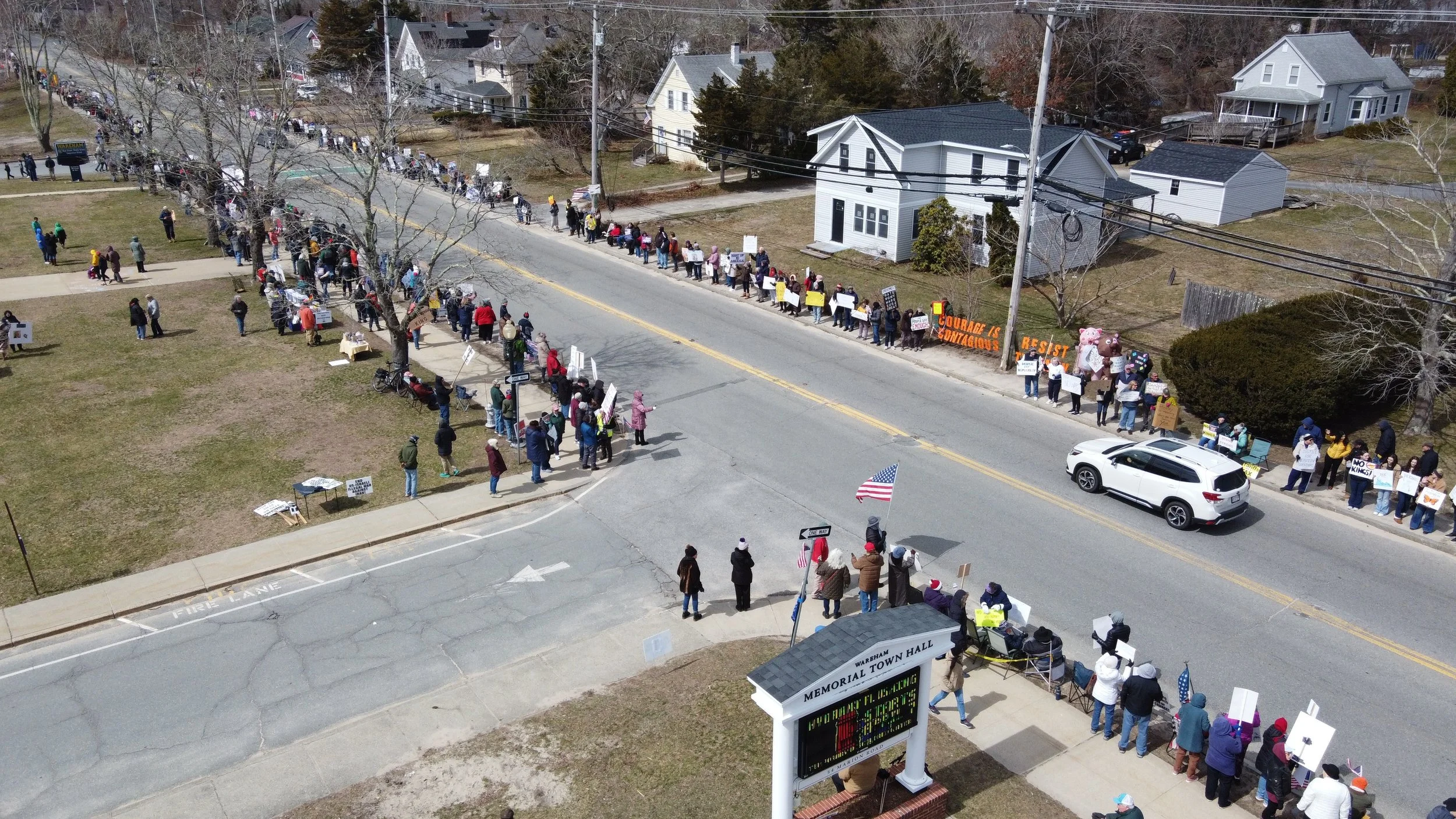
Aerial photo of No Kings III in Wareham. Photo via Mass 50501 volunteer.
With No Kings III behind us, the general malaise that comes with the frustration of incremental change and the constant bombardment of negative news makes people ask, “What can I concretely do next?”, “Does showing up matter?”, “How do I buy stock in inflatable costumes?” When I find myself asking these very questions, I turn to the old adage of “all politics is local.” And by that I mean going to a town committee meeting, seeing what’s going on at the community center, talking to your neighbors, and actually voting in local elections when they are the only offices on the ballot. (For other ideas on how to make a difference, check out the We Are Powerful Pledge highlighted in our No Kings III recap article last week.)
You see, I bumped into a couple of neighbors coming off the commuter rail from No Kings III, and in that few block walk together, the importance of being locally present came up. First, I learned that they hadn’t just gone to Boston No Kings, but also to a smaller rally a town or two over beforehand. In fact, the main reason they went to Boston, they explained, was because they wanted to be counted as part of the giant crowd since bigger gatherings are the media’s main focus. But they also felt that it was also important to be part of a local group so they can find like minded people and hear about smaller actions that are going on in our own backyard.
This had me thinking about the various federal cuts, mostly fallout from the “big beautiful bill,” and how the Massachusetts state government has been trying to fill in the gaps left by over $3.5 billion dollars in lost federal funding. In cases like the stalled Mass Pike improvement project, having $335 million pulled by Washington, we don’t have an answer yet. Though in other areas, such as Medicaid, recipients are now facing caps on benefit pay outs. How would this impact my community? An article last year pointed out that when the Department of Education cut half its personnel, it also cut funding to states, including $106 million to Massachusetts. According to Boston Public Radio, that money was being “used for capital investments like installing new HVAC systems, improving security, [and] emergency response systems…” What kind of cascading effects will that have on our kids, on the communities that already signed contracts to pay for this work, on the contractors who thought they had dependable work lined up? Even if none of these things will immediately impact my personal life, it has been brought to my attention that I live in society, not a silo, and we should all be concerned about the cascading effects of the hot potato of who gets paid and who doesn’t, of what gets prioritized, and of what gets regressively shelved with other “who’s going to pay for it” standards of living that we once had.
My neighbors also mentioned an upcoming town election in a few weeks. Nothing quite as horrifying as our national news would be voted on, just school committee, library board, that kind of thing, but here’s the real kicker—we had both received a reminder mailer with suggested candidates that referenced an expected turn out of only 20%. Two zero. One in five eligible voters. I found this information disheartening to say the least, though I suppose not surprising. I had to, of course, figure out how common this was and found a great report done in 2022 by MassVote. The summary is that it is indeed incredibly common in this day and age, but was not always the case.
More on that in a moment, but first I would like to address the question of, “But person talking to me on the Internet, why should I care? It’s not like my vote matters.” It does. And you’re giving away your power by disconnecting instead of letting your voice be heard. In Malden last week, the first override vote in a generation was voted down. “With a turnout of 15% of registered voters, the vote on the $5.4 million override failed by just 124 votes, or a margin of 2 percentage points.” (emphasis mine) Now I am not a Malden resident, and I am not weighing in on if this measure should have passed. I am just pointing out that the vote was decided by 124 people in a city of over 66,000 residents. Not voting is amplifying the voices of those who do. Keeping adequate city employees and infrastructure is dependent on voters caring that police, fire, school teachers, libraries, and roads exist. In Fiscal Year 2024 there were 46 such votes in Massachusetts, including 16 for schools, and 7 for public safety.
Returning to the report I mentioned by MassVote, “Reinvigorating Our Democracy Understanding Local Elections and How Massachusetts May Increase Municipal Voter Turnout” the following data tables and middle quotation are excerpts that show the change over time, and reflect on the importance of local elections.
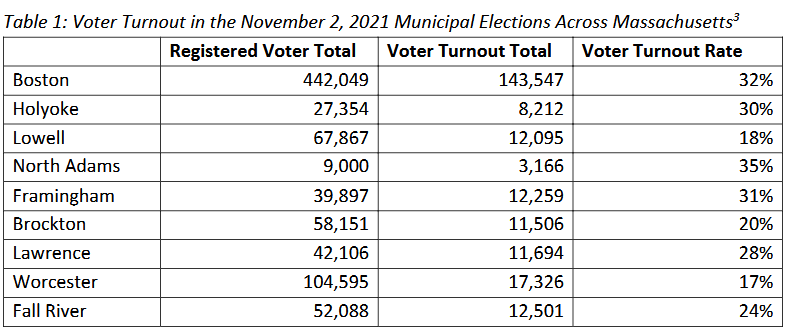
While voters may not believe that local elections matter all that much, the opposite is actually true. Of all elections, local [elections] have by far the greatest impact on the day-to-day lives of residents. Local officials, like mayors, city councilors, and school committee members, decide the types of policies that residents live with every day, such as policing, affordable housing, and education. These officials do not offer vague platitudes on these subjects, but make decisions that actually impact residents. They consider how much funding the police department should receive, how many public housing units should be built, and what direction schools should move in. These officials do more than fill potholes and repair streetlights. They shape the lives of each resident, from young students to retirees to everyone in between. (page 3 of report)
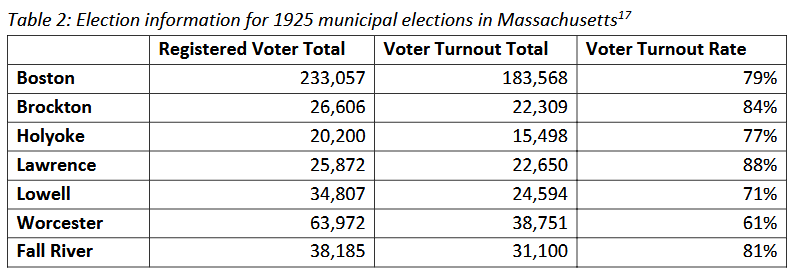
Note how much higher civic engagement was 100 years ago. Boston’s registered voters have almost doubled, but the raw turn out number is still lower, resulting in an abysmal turnout rate. How embarrassing it is that we call for governmental change but can’t even be counted on to care about our own neighborhoods? Showing up matters, and for myself, I pledge to keep talking to my neighbors, and to keep trying to be more engaged in protecting the local fabric of democracy.
I leave you with a quote from Fred Rogers, from Mr. Rogers Neighborhood.
“We live in a world in which we need to share responsibility. It’s easy to say ‘It’s not my child, not my community, not my world, not my problem.’ Then there are those who see the need and respond. I consider those people my heroes.”
Enjoyed this article? Get updates on the movement, volunteer opportunities, and more by clicking below.
