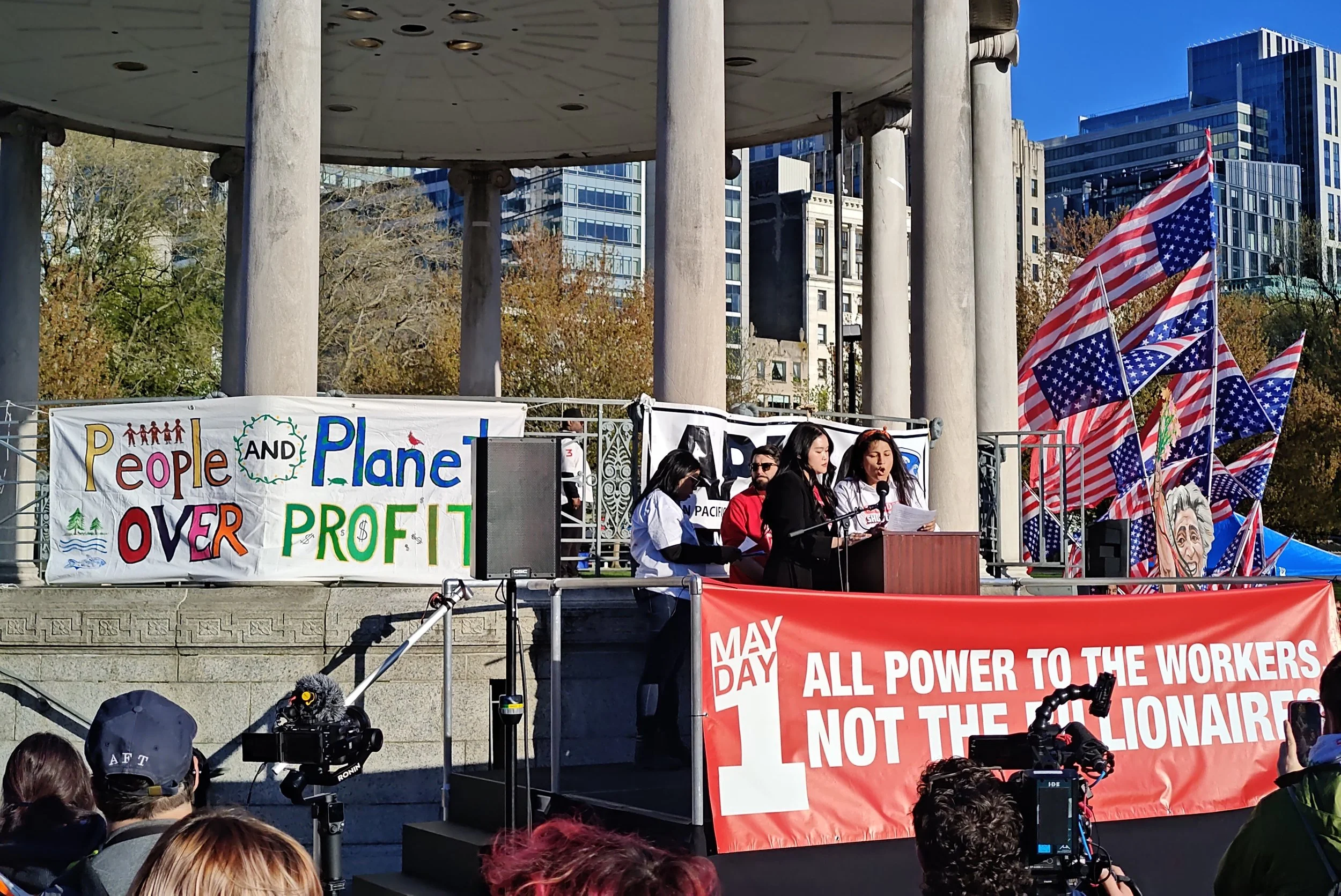
Boston’s 2026 May Day Rally. Photo from a Mass 50501 volunteer.
Ballot Question #5 “Change State Tax Revenue Limit” is one of the more confusing ballot questions. It is hard to read “method of calculating” and “Section 2BBBBBB of Chapter 29” and understand what this ballot question is fundamentally: an attempt to cut taxes. A no vote makes no changes to state taxes or revenue. A yes vote will cause more frequent occurrences of collected state revenue being given directly to taxpayers. I will break down the meaning of the question, the history behind it, and the likely effects.
What is the State Tax Revenue Limit?
The state tax in this question is the Massachusetts income tax. A revenue limit is a cap on how much tax the state can collect. Massachusetts also has a revenue limit for property taxes, commonly known as Proposition 2½.
In 1986, Massachusetts voters took to the polls and made a change to their personal income taxes. They repealed an additional 7.5% tax on income (a surtax) and also instituted a limit on how much tax revenue can grow year over year. That limit, also called Chapter 62F, is currently the previous year limit plus a percent increase equal to how much wages and salaries have grown on average over the past three years. For those who like equations, this is approximately

Every September, the state comptroller creates a report to say how much revenue the state had and the state auditor reports the limit and if it was exceeded. If the limit was exceeded, Massachusetts gives a rebate or tax credit to each taxpayer. The limit has been reached twice: once in 1987 (the first year it was implemented) and once in 2022 (when the stock market recovered from the pandemic faster than wages).
How to distribute the revenue in excess of the limit changed in 2023. In 2022, each taxpayer got back 14% of the taxes they paid in 2021. After that, the state legislature changed the rule from a distribution proportional to how much tax was paid, to an even distribution to each taxpayer as section 26 of a larger law. Now each individual taxpayer would get the same amount regardless of how much they paid. Married couples filing jointly would get twice as much as an individual, since they are two people. Corporations cannot receive a rebate under this law.
What does Question 5 change?
Ballot question 5 would make two changes to the limit.
First, it would replace the base limit with the actual taxes of the previous year rather than the previous limit. Here’s how this change looks in the equation.

Note, since the actual taxes can’t be higher than the previous limit, this will always result in an equal or lower limit. A lower limit is a tax cut. The people supporting question 5 are clear that this is intended to limit taxes and state spending.
Secondly, income from the Fair Share Amendment would be counted against this limit. This ballot measure from 2022 added an additional 4% tax on income beyond a million dollars per year, causing the tax to be called a “Millionaire’s tax.” The progressive taxation bracket is tied to inflation. For 2026, someone making $1,107,750 would still pay 5% of that in income taxes, but each $25 dollars beyond that $1.1 million would be an extra dollar of tax paid. This money is earmarked for education and transportation. Including this revenue in the calculation would lead to more often hitting the limit.
What’s the impact?
Tufts estimates that, if passed, the average refund per taxpayer would be about $225 per year, including both refund and non-refund years. The loss in state revenue would be about $1.2 billion dollars per year. A $1.2 billion dollar refund in 2026 would have been a 2% decrease in overall state revenue. This is less money for the state to spend, and will lead to cuts in funding.
The most likely funding cut would be to contributions to the Stabilization Fund (aka Rainy Day Fund). This fund accumulates money in years in which revenue exceeds expenses and is used to continue services during recessions. Other cuts would be determined by the legislature, but could include:
Layoffs, most likely in Health and Human Services or Education departments
Direct cuts to MassHealth
Cuts to aid to local school districts
Under the current calculation, each year’s limit is relatively predictable based on the past year’s limit. The proposed switch to basing the limit on the last year’s actual revenue makes the limit less predictable. This is especially challenging because the state budget is developed in January, and whether a rebate is needed isn’t determined until September, eight months later.
If revenue is low and revenue growth is strong, refunds are likely. This is the typical case when recovering from a recession. The new limit calculation would make it harder for the state budget to rebound from a recession.
Since the revenue calculation is changing to include the Fair Share tax, a refund is especially likely to be triggered in 2027. This would happen at a time when federal funding is also disappearing. For instance, federal support for SNAP administration and outreach is dropping by half in one of the time bombs of the 2025 Big Bad Bill.
Who is supporting each side?
Yes:
Ballot Question #5 was registered by Taxpayers for an Affordable Massachusetts. This committee also tried to put a reduction in state taxes from 5% to 4% on the ballot in 2026.
The top donor is Massachusetts Opportunity Alliance (MOA), a business association. MOA contributed $1.9 million in-kind, more than twice as much as all the opposition money combined.
The next highest donor is Massachusetts High Technology Council (MHTC), who started MOA. MHTC also opposed the Fair Share Amendment and supported Proposition 2½. Several colleges have left MHTC recently, and the organization no longer publicly lists its membership. Other top donors include CEO associations, corporate founders, and free-market think tanks. In short, CEOs and business executives support Question #5.
No:
The largest opposition committee is Protect Massachusetts Future. The top donor is the Service Employees International Union (SEIU) through the SEIU Mass State Council and 1199 SEIU MA PAC. This union represents 23,000 human services workers (509) and 80,000 Health Care workers (1199) in Massachusetts. The next largest donor is the Massachusetts Teachers Association, the largest union of public school teachers in the state. Other donors include more unions and equity advocacy groups. In short, teachers, childcare providers, nurses, psychologists, pharmacists, social workers, public employees, and those working for racial equity oppose Question #5.
Why might you want to vote yes?
You want a tax rebate.
You believe that lower taxes are good.
You believe that money in the hands of individuals is more important than money in the hands of the state government.
You believe in direct redistribution of wealth.
Why might you want to vote no?
You generally support state programs.
You want to stand with unions.
You approve of the Fair Share Amendment / Millionaire’s tax.
You want the state to have funds for local aid.
You would rather higher state revenue be invested in mass transit, social safety nets, education, and other public resources, rather than returned as tax rebates.
You don’t want any tax rebates for the rich, even if you receive the same dollar amount.
You are concerned about limiting state revenue while federal funding is also being cut.
You are concerned that limiting state spending during recession recovery could damage our ability to recover from recessions.
I, personally, will be voting no on #5. As I’ve been researching and writing this piece, I keep hearing the old folk song “Which side are you on?” in my head. Because for me, that’s the question: Are you on the “yes” side with billionaires and big company CEOs? Or are you on the “no” side with the workers and the vulnerable, whose jobs and services are on the line?
Mass 50501 is a nonviolent, nonpartisan nonprofit organization that focuses on community organizing to defend everyone’s rights and liberties and to resist tyrannical and unconstitutional actions. While Mass 50501 members affirm our mission and shared values, we welcome diverse viewpoints and we know that we are strengthened by the connections we make. If you’d like to add your voice to the mix, join us on Discord!