In Plymouth, there is a monument that is simultaneously huge and hard to notice. Known as the National Monument to the Forefathers, the statue is sort of paradoxical. At 81 feet tall, it is easily the tallest structure in town, not to mention one of the tallest monuments in the state. And yet, due to the surrounding trees, it is nearly invisible except when viewed from the harbor or from right beside it. Its location, in an otherwise residential neighborhood one mile away from the Rock, makes it even easier to miss; it is almost certain that there are lifelong Plymouth residents who don’t know of its existence.
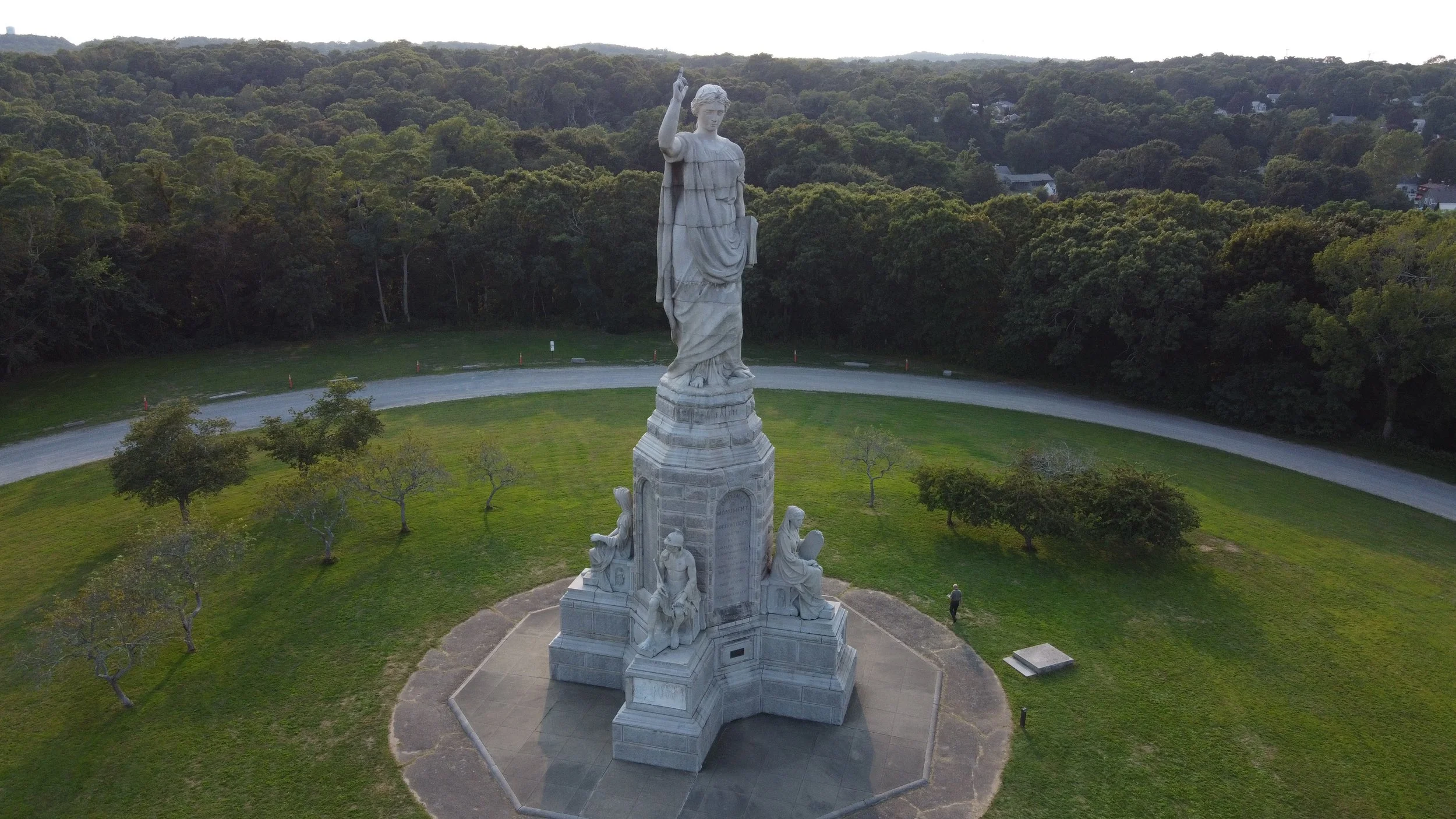
These contradictions make the monument both commanding and confounding. Even the first time I visited the monument, as a child, I was confused how such an imposing statue, carved of solid granite, could not draw a crowd. It is not only the size of the monument which is notable: the design differentiates itself from other large monuments by featuring larger-than-life humanoid subjects. The lower half of the monument has four such figures, representing the concepts law, morality, liberty, and education. These figures sit above four engravings depicting scenes from the Pilgrims’ journey to America, including the departure of the Pilgrims from the Netherlands, the signing of the Mayflower Compact, the arrival of the Pilgrims in Plymouth, and the signing of a treaty with the Wamponoag. Towering above these representations is the central figure, Faith, whose stature takes up just under half the height of the monument. Faith is represented by a woman with a star on her head, holding a book in one hand and pointing upwards with the other. Her head points slightly downwards, in the direction of the harbor, but over the head of somebody approaching the monument, forcing the observer to cast their eyes upwards to meet her gaze.
None of the above descriptions are the result of subjective interpretation; every figure in the monument is explicitly labelled. An inscription on the front of the monument even lays out the inspiration for the monument in plain text, reading, “National Monument to the Forefathers / Erected by a Grateful People In Remembrance Of Their Labors, Sacrifices, And Sufferings For Civil And Religious Liberty.”
At this point, you might be wondering, “This is a political newsletter. Why am I reading about an obscure monument in Plymouth?” My answer is that our monuments serve as expressions of our civic character. When these monuments express feelings not shared by the people, dismay and conflict can emerge in response. This has been most visible in the South, where in the past decade there has been much debate about the presence of Confederate memorials in public spaces. However, this debate has not been exclusive to that region; statues have stoked controversy here as well, as evidenced by the beheading of a statue of Christopher Columbus in Boston in 2020 (the statue was subsequently removed by authorities and not replaced). Conversely, our adulation of other, more popular monuments—the Lincoln Memorial comes to mind—demonstrates an affirmation of the subject. From this perspective, what reaction does the National Monument to the Forefathers provoke?
The first thing that is apparent is that the erectors had different historical ideas than we do, reflecting ideas that were popular at the time of the statue’s design in the 1850s. For example, the absence of an engraving of the first Thanksgiving, the episode most associated with the Pilgrims today, shows us that this event was not considered important when the statue was designed. (Thanksgiving was not made a recurring national holiday until 1863, during the Civil War; even then, the accompanying presidential proclamation made no mention of the Pilgrims.) Likewise, the claim that the Pilgrims came here primarily for “civil and religious liberty” shows a simpler narrative of the Pilgrims’ journey than the version widely accepted today, where concerns about their ability to make a living in the Netherlands and cultural concerns about their children becoming “too Dutch” were also central to their decision to journey across the Atlantic.
The element of the monument most likely to divide a diverse, modern audience is its explicit reliance on Christian iconography. This includes the first commandment etched into Morality’s tablet, a figure labelled “evangelist” beneath Morality, and the central placement of Faith, which its designers must have understood to represent Christian faith. From a historical perspective, the inclusion of these elements makes sense. The vast majority of early American colonists, including the Pilgrims, were Christians, and the Pilgrims’ faith certainly inspired their travel to America and motivated them as they weathered the disease and horrid conditions they encountered their first winter here, which killed nearly half of the Mayflower passengers. However, the inclusion of these aspects of the monument which emphasize this part of their identity, as well as the supposed “national” character of the monument, suggests that not only was this ideal important to the Pilgrims, but America as a country is derived primarily from this faith, with the other ideals represented by the monument playing supporting roles. A biographer of Hammatt Billings, the lead designer of the monument, has written this of the structure:
Its meaning spreads out from top to bottom, from the heaven-sent Faith which was then believed to have fueled the Pilgrims’ journey, to the social principles and civil institutions that were seen to have been established under her guidance, to the qualities these were either sustained by or fostered themselves, to the scene of human history that accounted for the transference of those ideals to the New World.
With this design, one could reasonably conclude upon viewing the monument that these principles, especially Christianity, should act as the scaffold of American society. This is essentially the conclusion espoused by actor and religious advocate, Kirk Cameron, whose 2012 film Monumental is apparently the most significant cultural legacy of the monument (“The seed that grew this nation was Faith in God,” says Cameron). Such a perspective raises a natural question, which is, what do those of us who are not Christian, or who are Christian but believe that the U.S. should not elevate the status of any particular religion, make of this monument?
One option is to look at the monument through the lenses of its creators for answers. The lead architect of the monument was a man named Hammat Billings (1818-1874). Billings was a man of many talents. He was an artist and architect who not only designed several prominent buildings in the Boston area, but also illustrated the first couple editions of Uncle Tom’s Cabin, among other accomplishments. Politically, he was associated with the Whig Party, a party which generally opposed slavery but “believed disunion would be worse than slavery.” James F. O’Gorman, author of the Billings biography quoted above, persuasively argues in his book that the inspiration for the monument was rooted in the political chaos of the 1850s and was primarily intended to unify the nation in a divided time—a mission that ultimately failed as the Civil War broke out.
But should we look at the monument in a purely historical context? I believe this monument, like any other, is worth evaluating at face value, without the assistance of historical textbooks. Reevaluating abstract monuments presents a challenge: unlike statues of real people, one cannot base their opinion on the legacy of the subject or the morality of the subject’s actions. Instead, the questions we are left with are, “Are the values presented important to us today?” and “Does this artistic representation of these ideals have merit?”
Looking beyond the labels etched into the granite, I believe the monument shows symbols which are worth celebrating independent of creed. I find the emphasis on law and self-governance (by the depiction of the signing of the Mayflower Compact, for instance) to be not only in accordance with the story of the Pilgrims, but admirable in their own right. I am impressed by the featuring of Education as, effectively, one of the five pillars of this nation, and its inclusion here inspires me to think about ways we might more greatly promote education on the national scale. The portrayal of Liberty, who wields a sword and wears broken shackles, reminds me that freedom is not self-sustaining. Overall, I think these values are important, and I believe most Americans would probably not protest their inclusion on such a monument (of course, it might be hard to find Americans who agree on the proper implementation of liberty, law, education, and morality in practice, but requiring viewers to be unanimous in their opinion while viewing asks too much of the monument).
Regarding Faith: the existing portrayal has non-religious elements which validate interpretations outside of a Christian-centered interpretation. Faith’s left foot, standing on an elevated rock, grounds the monument to the land in a possible nod to Plymouth Rock. Faith’s upturned right hand, resembling Plato’s in the School of Athens more than anything else, suggests that faith may have secular roots as well. It is worth mentioning that the monument is not as religiously explicit as it could be. A different design for another faith statue by Billings included in a scrapbook now owned by the Boston Public Library and dated June 30, 1870, during the construction of the monument, shows a figure similar to the one on the monument, except this one holds a large cross in one hand and a chalice in the other. The Faith statue of the Forefathers Monument could have shared these features, so their exclusion from the monument is notable. Additionally, the presence of the first commandment near Morality is nearly impossible to see from the ground (I first noticed it only after weeks of researching on the memorial.) Attributes like this suggest the faith on display is not purely Christian, but expresses faith in a more general higher power, or, perhaps, faith that the nation can build a better future through sacrifice, like what the Pilgrims suffered through. These alternative interpretations convince me that, while I may not share the Pilgrims’ religion, I might share their faith.
These constructive ideas make the monument valuable, even to nonreligious groups. At the very least, these ideas suggest that there are valid reactions to viewing the monument beyond destroying it, ignoring it, or using it to proselytize. A monument that elicits this reaction is worth paying attention to today, because it provides a creative way to consider what kind of country we are. This is best illustrated by a comparison. To my knowledge, the Forefathers Monument is the first attempt to physically erect a three-dimensional design explicitly laying out the ideals of the nation. However, today it is far overshadowed by the Statue of Liberty, designed after the Forefathers monument but completed three years before, which accomplishes the same effect through a different representation. Comparing the two monuments invites us to ask questions about the United States. Does liberty best exemplify our identity, or does faith? Which material better represents the United States, rigid granite, or gleaming copper? The inclusion of an interpretation of liberty on the Forefathers memorial invites additional comparison. Is liberty better represented as a sitting figure, or a standing one? A male figure, or female?
There is no need to answer these binary questions, because other representations of these ideals are possible. The Forefathers Monument was erected, in part, to unify the country around shared ideals in the face of social divisions. While our national debates have not yet reached the extremes of the 1850s and 1860s, our time is likewise marked by political violence and fractious politics. I think the glorification of shared ideals was not misplaced then, and it seems similar consideration could benefit our country now, in a way that building a national arch surely will not. If a monument representing our ideals was built today, which ideals would best represent us, and how would we represent them?
Enjoyed this article? Get updates on the movement, volunteer opportunities, and more by clicking below.