Music can’t change the world. But it can help people believe the world can be changed
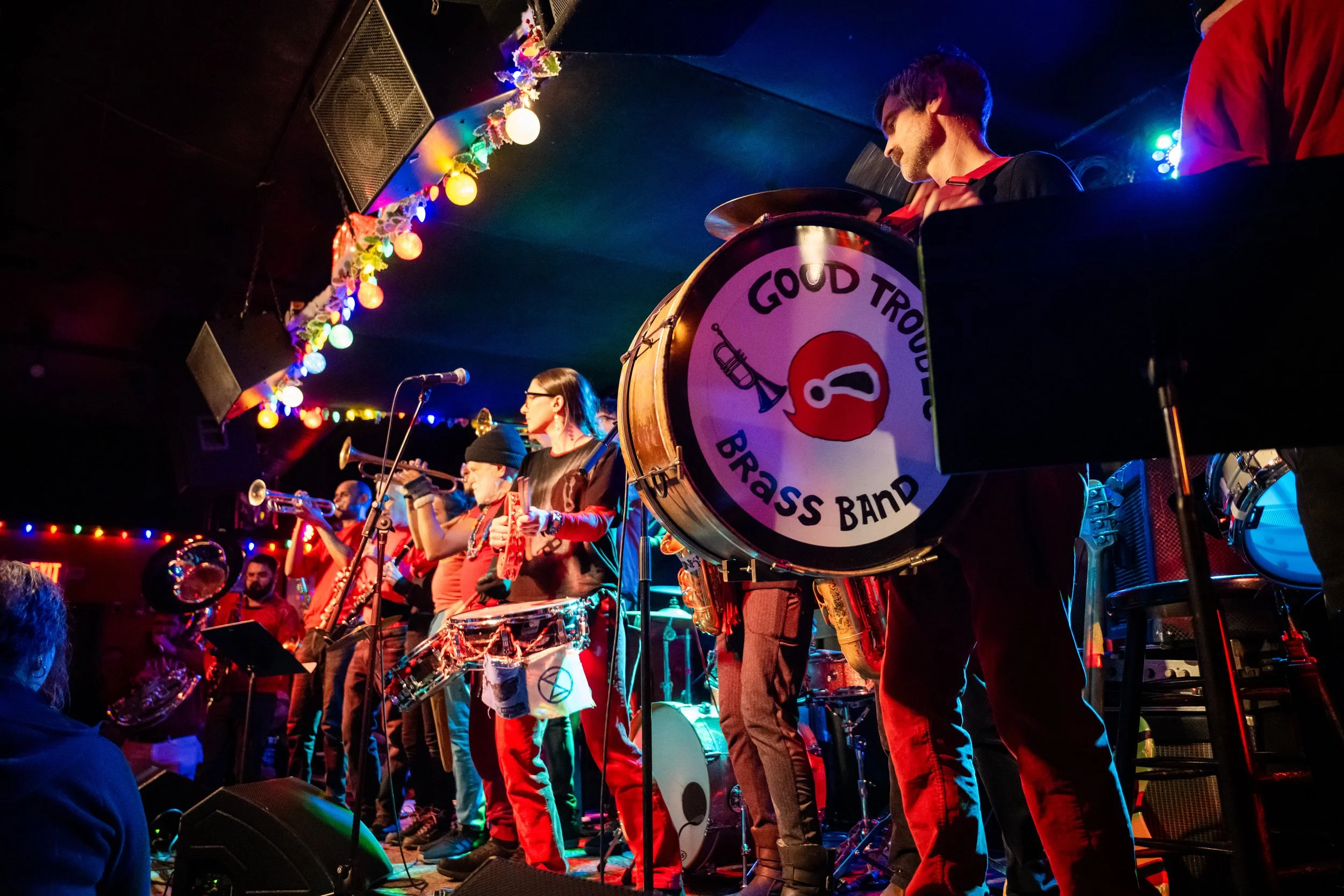
The Good Trouble Brass Band performing at the Burren (Somerville, MA) in December 2025 as part of the concert series Which Side?: A Protest Music Teach-Out. Photo by Mike Ritter.
Last weekend I had the good fortune to join a crowd of 8,000 or so for the first-ever, full-fledged performance of songs that Woody Guthrie didn’t complete during his abbreviated lifetime. The show, a collaborative performance by the musicians Billy Bragg and Wilco, took place at Mass MoCa, where Wilco have hosted their weekend-long Solid Sound festival biennially since 2010.
Woody Guthrie, of course, was the quintessentially American songwriter best known for writing “This Land Is Your Land” in response to his aversion to the overt jingoism of ”God Bless America.” Released in 1998, the album “Mermaid Avenue” (named for the Coney Island block where the Dust Bowl refugee lived about half of his life) uncovered a very human side of the legendary figure.
I’m an arts reporter for the Boston Globe, for which I wrote a recent piece about the overdue celebration of the making of the “Mermaid Avenue” album. I’m also a big fan of the First Amendment. My most recent book is an iconoclastic survey of sorts called “Which Side Are You On?: 20th Century American History in 100 Protest Songs.” In it I attempted to show—very much in contrast to the prevailing notion that protest music had its one shining moment during the 1960s—that there have in fact been songs of dissent, and idealism about our democratic experiment, in every era of popular music, of all styles.
Bragg, who made his name as an ani-Thatcherite during the post-punk years of the 1980s in England, continues to fight the good fight today. He released “City of Heroes,” his song about the bravery of the ICE protesters in Minneapolis, during the same 24-period when a somewhat better-known performer named Bruce Springsteen proved the point that protest songs are alive and well with his own new song, “Streets of Minneapolis."
Music can’t change the world, as Bragg likes to say. But it can help people believe the world can be changed.
That’s the idea behind the monthly concert series that I’ve been hosting for the past year. It’s called Which Side?: A Protest Music Teach-Out.
Like my book, the shows have expanded upon the ordinary concept of “protest” music. Each act does two songs—one a cover of a classic or lesser-known protest song, the other an original. The surprises have been plentiful.
We’ve showcased rock and punk music, sure, but also soul, gospel, hip-hop, reggae, a brass band, and folks singing in Spanish, French, and Ukrainian. We’ve had songs addressing the distressing attacks of the past decade on community, mutual aid, science, common sense, and common decency. One of our singers only recently became old enough to vote. On another night, we had the Kossoy Sisters, twin folksingers who brought us a direct line to Woody Guthrie himself: They met him and sang for him at a tribute show in 1956.
We’ve also had an honor roll of guest speakers—that’s the “teach-out” part—including progressive political actors, civil rights attorneys, music historians from Berklee, the emcee from Boston’s No Kings rallies, and many more.
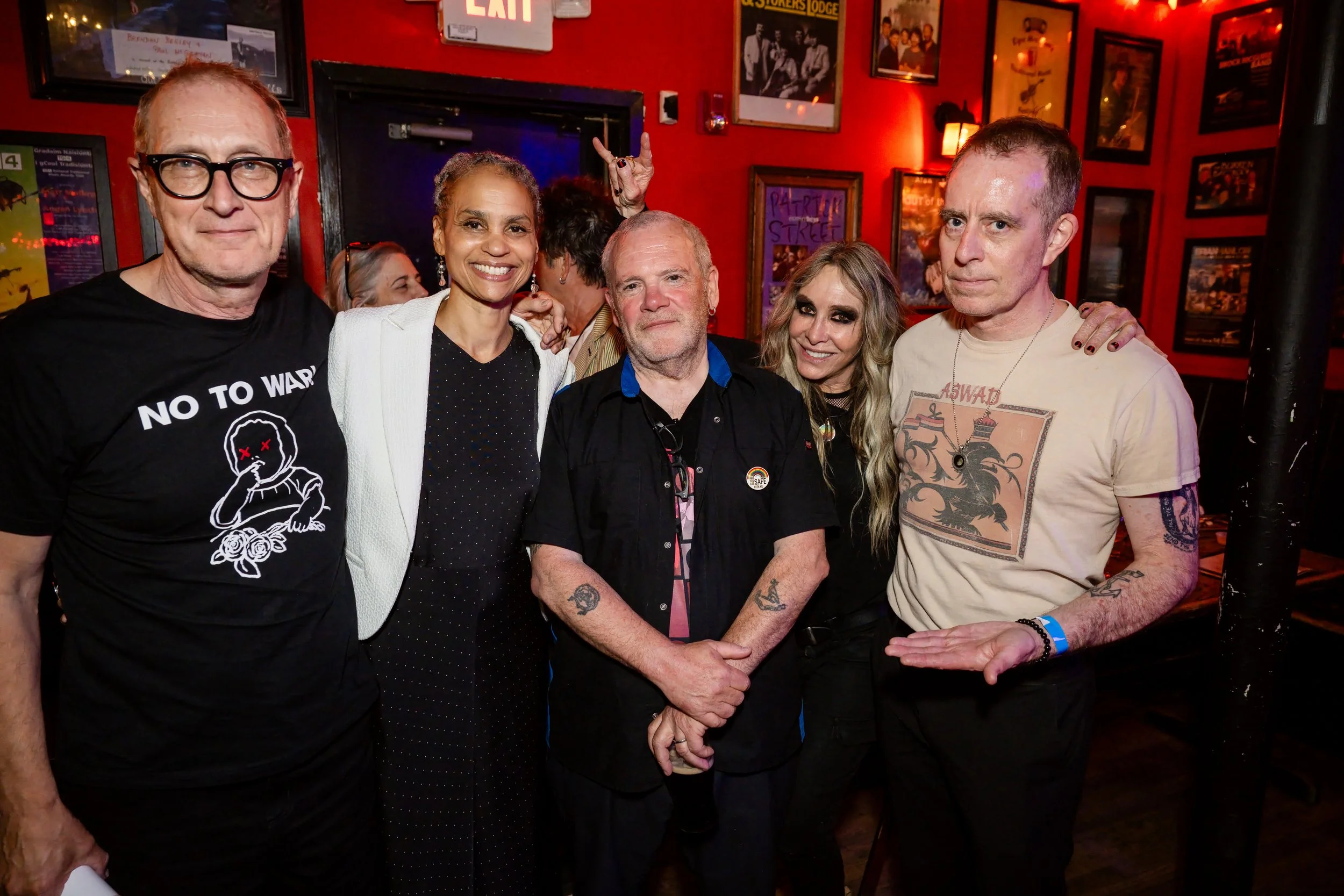
Maya Wiley (second from left), president of the Leadership Conference on Civil and Human Rights and 2021 New York City mayoral candidate, with Gang of Four at the Burren (Somerville, MA), June 2026 as part of the concert series Which Side?: A Protest Music Teach-Out. Photo by Mike Ritter.
All credit for the idea for the series goes to my friend Joyce Linehan, whom I first met in the 1990s, when she was managing some of Boston’s best (and most unmanageable) rock bands. She went on to become a prolific activist and community organizer, famously convincing a couple of upstarts named Elizabeth Warren and Marty Walsh to run for office, and eventually working for the latter as chief of policy in Boston’s City Hall.
It was Joyce who came up with our beloved house band’s name: They’re called the Paid Protesters. Our music director is the inimitable Ed Valauskas, studio manager at Q Division in Cambridge and longtime artist wrangler for the annual, all-star Hot Stove Cool Music benefit shows for youth education programs.
When we kicked off the Which Side? series last summer—the early shows were at the Lizard Lounge, and we’ve since made the Burren in Davis Square our home—we figured we’d do the show for a few months, then reassess. But we were immediately inspired to book more dates: “I don’t remember the last time I was moved by such a thing,” as Joyce wrote in her newsletter after the first show. “In this very dark and difficult moment, I crave the cathartic act of experiencing awe, and that happened here.”
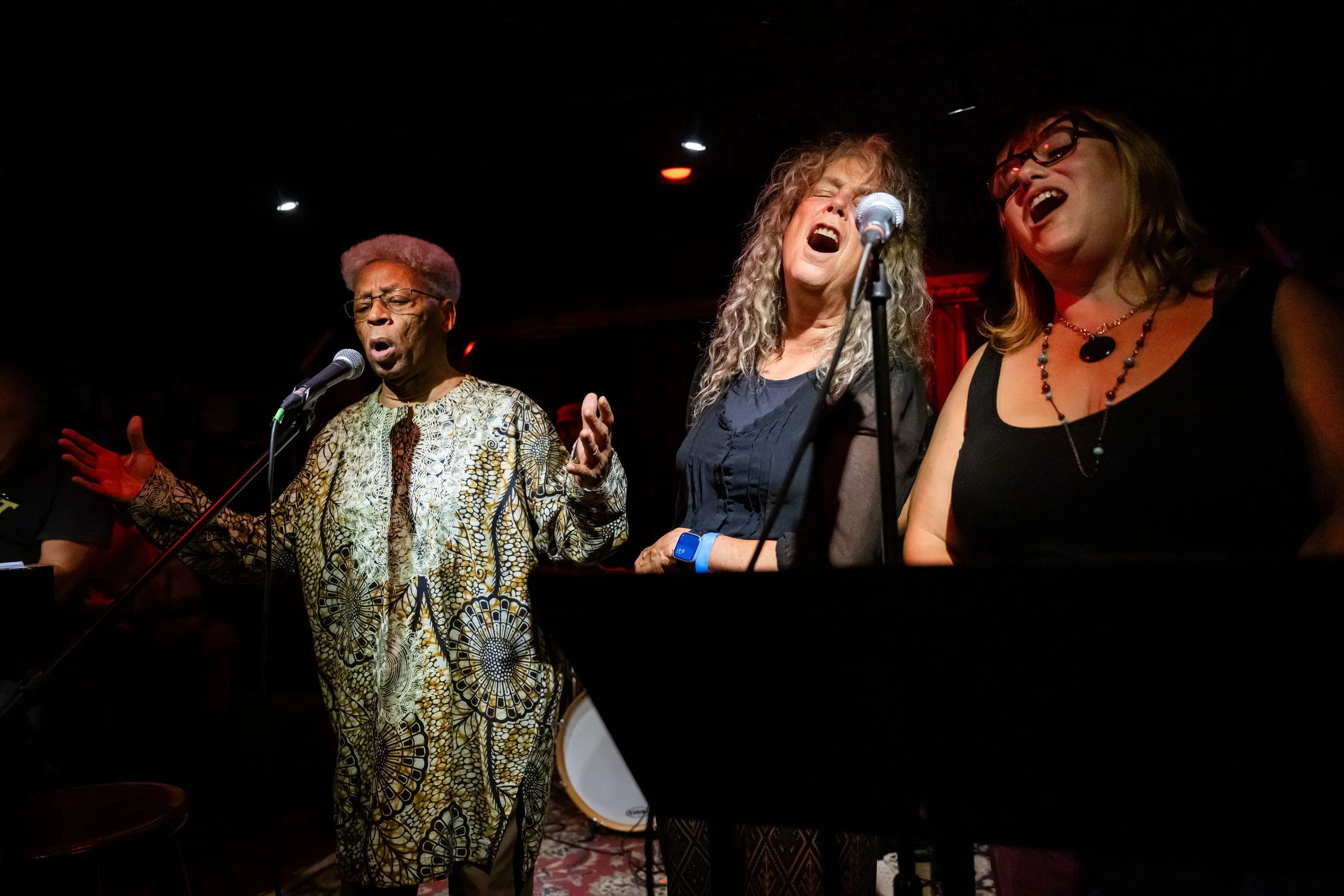
Milton Wright performing with Laurie Sargent and Erica Mantone, August 2025 at the Lizard Lounge (Cambridge, MA) as part of the concert series Which Side?: A Protest Music Teach-Out. Photo by Mike Ritter.
Perhaps needless to say, we’re still doing this thing, with no end in sight. In September, we’re planning to take the show on the road for the first time, to Nashville, and we’re hoping to bring it to other cities as well.
And on July 21st we will be celebrating our one-year anniversary with a special event at the Boston Lyric Opera’s beautiful, brand-new space in Fort Point. All of our shows at the Burren have been “sold out” (we actually use a pay-what-you-can model, with a $5 minimum; all proceeds go to the many musicians who have shared our stage). Our sole lament throughout this whole joyful project has been that we’ve not been able to introduce the show to more people. Now is your chance!
When the “Mermaid Avenue” show concluded at Mass MoCA, Billy Bragg and Wilco brought out dozens of guests, multiple generations of Woody’s descendants, to sing “This Land Is Your Land.” Afterward, Nora Guthrie took a moment to thank the musicians for making a dream of hers come true. Then she had a pointed message for the crowd, one that summed up the utility of all protest music.
“Now let’s get to work!” she said.
This is a guest article from our friend James Sullivan. To learn more about Which Side?: A Protest Music Teach-Out, check out whichside.boston.
Enjoyed this article? Get updates on the movement, volunteer opportunities, and more by clicking below.