Have You No Decency?
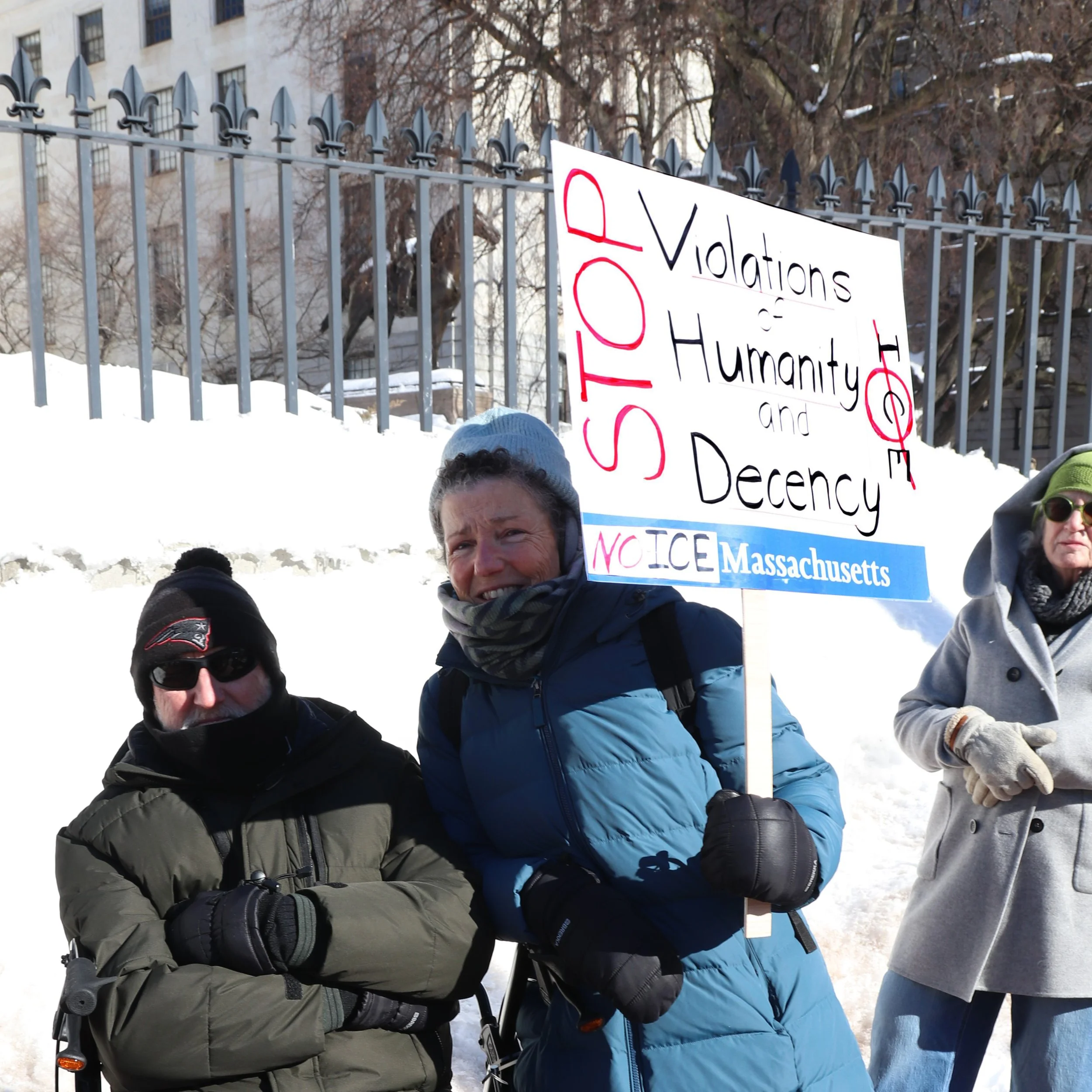
Protestors at ICE Out Everywhere. Photo from a Mass 50501 volunteer.
Much has been written on the direct, physical harms caused by the current administration, including herein this blog. In this article, I want to briefly shift our focus, and talk about the harmful language uttered by the president.
To recap, here is a brief list of some of the offensive things Trump has said since his political career began in 2015. During his first presidential campaign, he said of prisoner of war John McCain, “I like people who weren’t captured.” In his first term he described Haiti as a “shithole country.” Just last year, he called a female reporter “piggy,” and less than 24 hours after the murder of Rob Reiner, he said the acclaimed director was “deranged.” He said that Somalia “stinks and we don’t want [Somalis] in our country;” later in the same rant, he called Minnesota Governor Tim Walz a slur against intellectually disabled people in response to Walz welcoming Somali immigrants. After the October No Kings protest, he posted an AI-generated video of himself dumping excrement on protestors.
These statements provoke feelings of shock, outrage, disgust, and alienation. Past presidents have surely used indecent, dehumanizing language before, but to my knowledge no prior president has so ostentatiously degraded so many broad swaths of American society.
One might think that after so many years of hearing his disgusting commentary, people would tune it out. Some surely do; I wouldn’t be surprised if some of you skipped over the previous paragraph just to not deal with the discomfort of reading his words. However, a few recent comments of his have been so degrading to the public consciousness that they were all but impossible to ignore. First, after the killing of Renee Good at the hands of ICE agents, Trump all but blamed her for her own death, writing in a post on Truth Social, “The woman screaming was, obviously, a professional agitator, and the woman driving the car was very disorderly, obstructing and resisting, who then violently, willfully, and viciously ran over the ICE Officer, who seems to have shot her in self defense.” This statement was notable because it wasn’t just a lie, it was slander her loved ones were forced to hear from the loudest megaphone on the planet as they mourned.
Then, just over a month ago, Trump outdid himself yet again. Writing in the midst of conflict with Iran, Trump, the commander-in-chief of the world’s largest military posted, “A whole civilization will die tonight, never to be brought back again.” This statement was an apparent threat to commit genocide on a country of over 90 million souls. These words were directly harmful both to the self-perceived safety of Iranian civilians and to America’s global standing. That the members of the administration may never have had any real intention to execute on this abominable warning, as suggested by their recent record of backing away from their threats to Iran at the 11th hour, does not mean no damage was done. These escalating rhetorical transgressions show that in the fall of American discourse, we have not yet reached the bottom.
At this point, I can hear a reader asking “the administration has put people into camps and killed Americans in the streets, why do his words demand our attention?” My answer is that decency requires you to put aside your selfish desires and submit yourself to some standard of propriety. Fundamentally, it requires subscribing to a higher code; When you shake the hand of your worst enemy, you communicate that there are some things which transcend your own interests and rudest urges. In this sense, universal decency communicates respect for the basic equality of all people—that everybody is deserving of a certain level of respect.
When considered in this light, Trump’s indecency acts as a confession that he does not value anyone but himself. This rejection of a higher code is consistent with his willful ignorance of law and the Constitution itself. His contempt for others shows Trump to be the antithesis of a public servant, something everyone in government, especially the president, should try to be.
Trump’s electoral success, despite his indecency, reveals something else as well, this one about our civic culture. In theory, at least, it should be in politicians’ interest to be respectful to many, since offending potential voters (or constituencies voters care about) can cost votes. Apparently, this is not a powerful principle in our politics right now, but not too long ago professionalism and decency did matter to the American public, as best illustrated by the fall of Senator Joseph R. McCarthy. Senator McCarthy rose to fame in 1950 by fraudulently claiming knowledge of vast numbers of communists or communist sympathizers who had infiltrated the US government. While the untruthfulness of his accusations did not prevent him from becoming popular, at least initially, his treatment of some of his suspects ultimately did. In a hearing where Army lawyer Joseph Welch questioned McCarthy’s chief counsel (and future Trump mentor) Roy Cohn, McCarthy grew flustered and interrupted Welch to bring up the communist leanings of one of Welch’s staff members. To this, Welch famously replied “Let us not assassinate the lad further, Senator. You have done enough. Have you no sense of decency, sir? At long last, have you left no sense of decency?” (You can watch the exchange here.) This televised callout of McCarthy’s character accelerated his fall, and he swiftly became “[c]ensured by his Senate colleagues, ostracized by his party, and ignored by the press”.
It is outside the scope of this article to fully determine what has changed between then and now. However, it is hard to not point a finger at social media. Being online encourages bad behavior, and the provided exposure to the bad behavior further normalizes it. Additionally, the anonymity people can have while interacting online can lead them to perform and condone behavior they may reject in-person. Despite this, I have not seen evidence that people’s fundamental understanding of respect has changed since the 1950s. Some evidence for this is that prompting people to consider the impact of their statements can discourage future abuse. One study found that posters of racist content on Twitter decreased their use of racial slurs after being reminded by a bot to be empathetic, so long as the bot had a white profile picture.
Because some of the administration’s defenders already recoil from some of the mean things Trump says, it seems their support may diminish with similar calls to empathy. In this sense, Trump’s indecency is an opportunity to change public opinion if we can call this behavior out. One added benefit of this strategy could be that, in a world of misinformation, it may be easier to make common ground on the meaning of Trump’s derisive and caustic statements, compared to the actions of a complex government bureaucracy with many actors.
So, we should continue to protest the administration’s actions. Call for peace, protest the abuses of ICE, and stand for the Constitution. However, we should also remember the value in challenging the words of the administration. Most likely, nobody reading this is in a position to question the president directly, but to his allies, large and small, we should ask them “Have you no decency?”, and let them sit with the answer.
Enjoyed this article? Get updates on the movement, volunteer opportunities, and more by clicking below.