25 Reasons to Oppose Age-Based Social Media Bans
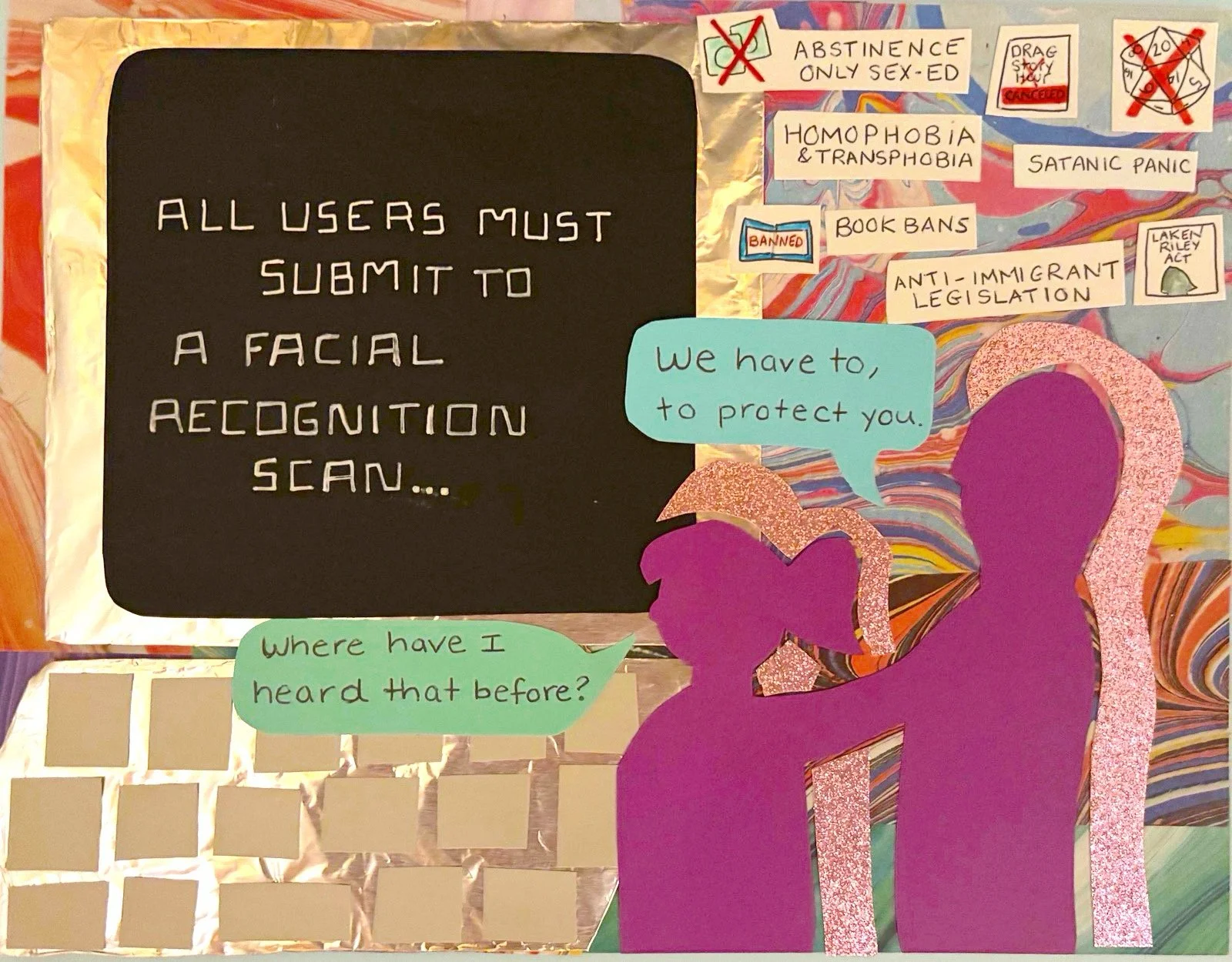
The Massachusetts House of Representatives recently passed Amendment H.5366, adding age-based restrictions on social media access to a Senate bill to ban cellphone use by students in public schools. Specifically, this amendment requires social media companies (broadly defined) to prevent people aged 13 and under from creating accounts on their sites. Additionally, 14 and 15 year-olds would need parental permission to create an account. The bill doesn’t say how companies should verify ages. For context, the current federal rule COPPA puts restrictions on companies to provide better privacy for people aged 12 and under. In response, most social media sites require people to say they are 13 or older to create an account. Governor Healey supports this bill and independently advocates for age-verification to adjust features for teens.
At first glance, this may seem like a good idea. If teens are struggling with mental health and spending a lot of time on social media, the idea that we can legislate them off of social media and solve their mental health struggles is deeply appealing. Unfortunately, life isn’t that simple.
A previous blog post raised many concerns with this bill already. As a queer software engineer who taught middle school computer science for a decade, I have some more to add. I’ve been talking to activists at Fight for the Future. I recently got to ask high school activists about their opinions about social media. They believe it is contributing to polarization and dehumanization and they also raise serious concerns about an age-based blanket ban. Here are my 25 good reasons to oppose this bill based on my life experience, scientific research, and conversations with activists.
The scientific consensus is that social media usage is neither inherently good nor bad for young people. Most of the studies that show a link between high social media use and mental health challenges are correlational, not causational. These could equally well be interpreted as depression causes social media use.
The argument that today’s teenagers have more mental health challenges than previous generations because of social media has a huge hole in it: The COVID-19 pandemic hit when today’s teens were elementary or middle school aged. They all suffered from a massive disruption to their social development.
Isolation is a mental health challenge. For teens who have limited transportation options and few places that they are welcome to hang out, the internet is a vital way to find community. This is especially true for LGBTQ+ teens, and also for neurodivergent and disabled youth. We’re already seeing negative effects on some of these young people from other age bans.
The features of social media that are bad for young people are generally bad for people of all ages. Maura Healey’s proposal even includes better ways to address social media’s problems. Disable infinite scroll. Disable video auto-play. Allow users to limit when apps can send notifications. Disable location tracking. Ability to turn off personalized feeds that invade privacy. Ability to limit the cumulative daily use. Have options for feeds that are “only who I follow” and “in chronological order”. But instead of demanding that social media companies give these options to all users, she proposes enforcing them only for teens. These should be available options for people of all ages. As a software developer, all of these features are easier to implement than age verification.
Enabling choice of such features for all social media users, including youth, encourages them to develop their own healthy relationship with social media.
This ban, like most legislation purportedly designed to protect teens, was created without talking to the youth it is supposed to be protecting. This leaves young people feeling ignored and unheard, which is not good for their mental health.
Age verification is hard technologically. The options are either verify age data with something like a driver’s license or birth certificate or use an AI estimation tool. AI estimation includes usage patterns, face scans, and hand movement scans. All of these have errors. AI learns what it is trained on. This is generally “the norm” of people working in tech and societal biases. Often AI estimators are more likely to guess wrong for people who are not white men. Some people over the age limit will be misidentified as underage and lose access that they should be allowed to have, and others will be read as older and gain access that the law says should be restricted.
Using identity documentation for age verification runs into the problem that not everyone has access to ID. Vulnerable people, including immigrants, poor people, and people in the process of a name change or who have changed their name are less likely to have easy access to ID. Undocumented immigrants and transgender folks are some of the least likely people to have access to documentation and the most targeted politically. Social media can be a lifeline for these people.
Regardless of how age verification is done, it involves providing personal information to the verifier. Social media companies make their money from advertisers and knowing the age of all their users would give them more information to sell.
Personal information, such a birthdate, face scan, or government id, are all valuable to scammers. Requiring these to access social media means that this data is more vulnerable to cyber-attacks and hackers.
With the Trump Regime going after ICE-watch social media accounts, adding more information to connect these social media accounts with the individuals running them puts activists in danger.
Social media companies may simply not actually implement a ban even if the law requires them too. Three months after Australia banned social media use by those under 16, a majority of Australian teens are still able to access social media, often without resorting to workarounds.
Many teens will find work-arounds for any age verification system: VPNs, using parent’s IDs, wearing makeup, trying verification multiple times, etc. Teaching people that breaking the rules is how to get what you want is bad for society.
Regulations to use the “best available” age verification add costs to doing business in the social media space. This discourages new companies from competing and further empowers existing Big Tech companies. If the current social media companies are causing harm, why would we give them more power? New companies might be less harmful and more helpful. Competition could lead to better and safer social media options.
Requiring parental approval for social media creation sounds reasonable, but runs up against technological limitations. How does a website know that one person is a parent or guardian of another? Getting a letter from a lawyer or unloading a birth certificate might be possible. The concerns about privacy and access apply here as well.
Takes away the ability for parents to decide when their children are ready for social media. Parents tend to know their children best, and are better decision makers than the state government.
Banning the creation of accounts limits the ability of parents to use more fine-tuned controls, like paying to get rid of ads, or blocking specific content.
More generally, anonymous viewing of social media may be worse than engagement with an account. Studies show that passive social media use is worse for mental health than active use.
People learn from experience. In some communities, 3-year-olds can comfortably and safely handle machetes because they have spent their entire lives observing adults using these tools. By separating youth from social media, we make it harder for them to learn to use it safely and responsibly.
A better option than a ban is to invest in media literacy and social media literacy. Teach all Massachusetts public school students about SIFTing for the truth.
A good digital literacy and online safety curriculum would include practical experience interacting with social media. A blanket ban prevents using these curricula.
Teens looking to be politically active often use social media for organizing. Many high school walkouts to support immigrants have been organized on Instagram. Young teens also organize to address local issues.
People, including youth, disengage when their voices aren’t heard. Telling young people that they can’t post on social media takes away their voice. This will lead to more political and social disengagement and worse mental health outcomes.
Taking away something is hurtful and a sign of disrespect. Teens, like all people, will be resentful of politicians and politics if their right to engage with social media is curtailed.
Legislation, like this, that is likely unconstitutional will be challenged in court. This could cost Massachusetts taxpayers money to defend such a law.
The good news is that this is not yet Massachusetts law. We can still change this bill! Call or email your state representative, your state senator, and the governor. You can find your representatives here. You can contact Governor Healey by email or call her office at (617) 725-4005. Tell your friends and family. Find out more at https://www.stoponlineidchecks.org/ma/
Enjoyed this article? Get updates on the movement, volunteer opportunities, and more by clicking below.