Rise Together
As the end of January approached, Boston found itself shivering in frigid temperatures and buried under multiple feet of snow. In the forecast? Thousands of protesters, ready to clear our streets of ICE.
The last two days of January saw strikes, rallies, and protests, all held in solidarity with those who are currently undergoing a hostile government takeover in Minnesota. On Friday, January 30, millions of people across all 50 states organized and participated in a nationwide strike. Students walked out of school, and adults refused to work or participated in an economic black out. Massachusetts was no exception. At 3 pm on Friday, a huge crowd gathered in Boston’s Copley Square, overflowing the space and spilling out into the surrounding streets. Protesters persevered through 17º temperatures and snowbanks piled higher than our heads to make our voices heard.
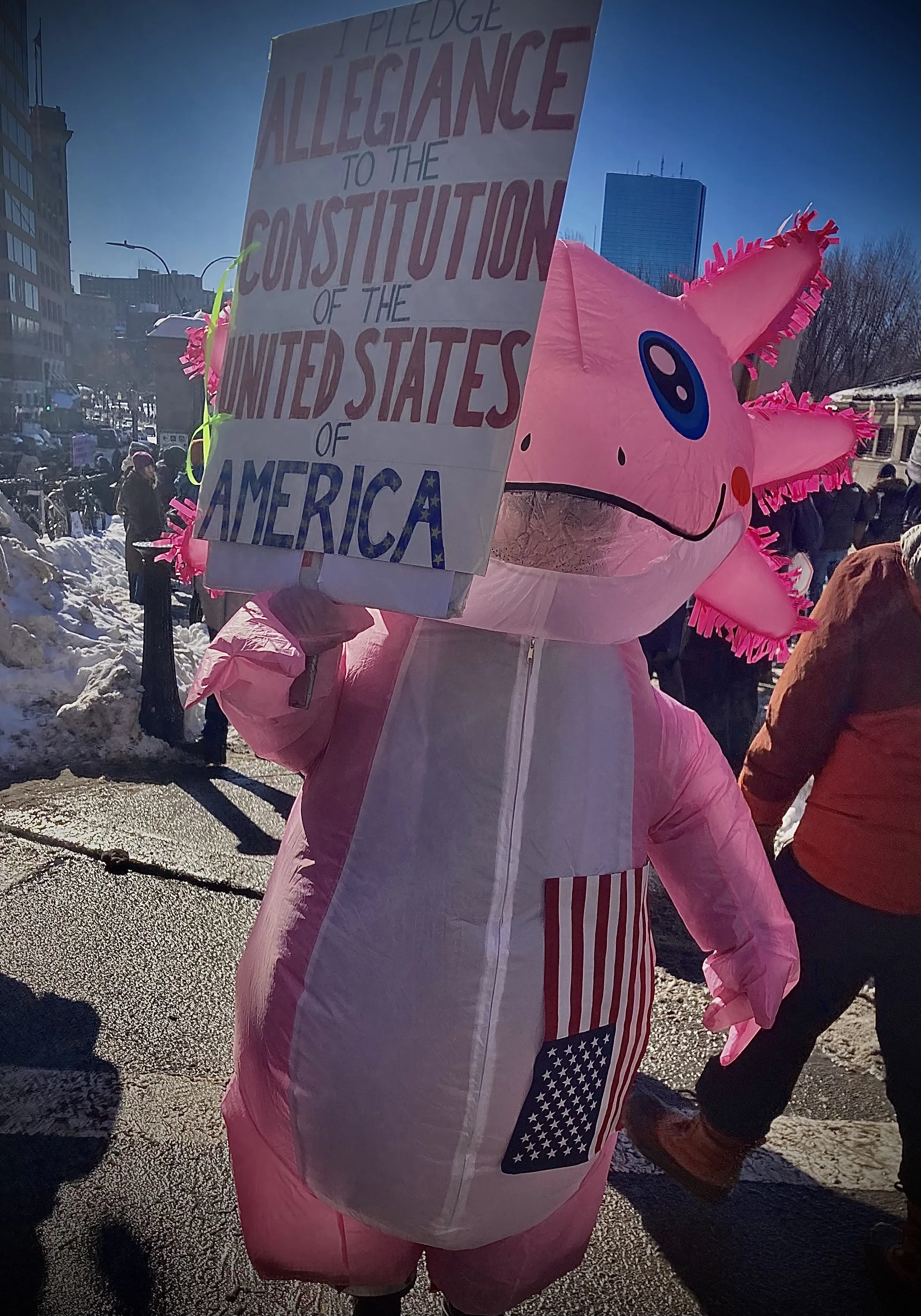
On the morning of Saturday, January 31, thousands poured into Boston Common, lining the steps, sidewalks, and streets leading to Liberty Hall. Several protesters were accompanied by their dogs, who were bedecked in yellow No Kings bandanas and signs reading, “Dogs united to deport Kristi Noem.”
Many of the demonstrators carried signs decrying ICE: “It’s f*cking cold, but I’ll stand out here until ICE melts,” “Keep the immigrants, deport the racists,” “I’m a salty b*tch. Melt ICE,” “I love illegal immigrants. Get in here!” Some attendees were even waving ice scrapers as they chanted, “No hate, no fear! Immigrants are welcome here!” and “El pueblo unido jamás será vencido” (the people united will never be defeated).
“It was never about being illegal or not,” said one protester. “They’re taking people despite whatever their status is, whether they were born here or not, just based on their skin color.”
Several protesters held signs with the names and photos of all those ICE has killed in 2026. These signs highlighted not just the violent and tragic losses of Renee Good and Alex Pretti, but also recognized that just in the past month, ICE has murdered six people. In fact, ICE has killed over 40 people since January of 2025, most of whom died while being held in custody. These devastating losses did not receive any news coverage, unlike the horrific shootings of Good and Pretti. This difference may be, at least in part, because of how blatant the murders of Good and Pretti were, but in the last year, ICE has intentionally and unabashedly executed at least five others on the street, including three deaths by gunshot and two vehicular homicides. These deaths were met with little to no backlash and were not publicized the way Good’s and Pretti’s were, thus making it undeniable that at least part of the reason why there is outcry only now is because both Good and Pretti were white.
“With Alex Pretti and Renee Good, I was shocked by the fact that their whiteness didn’t protect them,” a protester said. “When you align yourself with immigrants in your community, you’re seen as a race traitor to white people, and you become part of who they’re coming for. I think the slow loss of white privilege is a canary in the coal mine for what’s happening in general and that none of us are safe, even the people that historically have been the safest. We’re headed into a major inflection point and I hope that beyond that point, we’ll see justice.”
Dozens of protestors carried signs comparing ICE to the Gestapo and aligning the present-day US with 1939 Germany, including signs that said, “See you in Nuremberg, f*ckers,” and “Get Nazis the f*ck out of our government.” Others in the crowd recognized that much of the racism in this country is homegrown. From slave catchers to colonialism, violence against minorities in the US is baked into the roots of this country.
“Trump is a symptom, not a bug,” observed one protester, “I am educating myself about the history of this country so I can understand how to effectively protest against our government.”
For many, it’s about understanding how ICE is like both slave catchers and the Gestapo, realizing that tyranny has a playbook, and we can best defeat fascism by understanding and subverting it.
“I’m trying to stay educated,” stated one person.
“I’m learning about stuff that we’re not seeing in the news, because the media’s being very filtered and things aren’t being covered,” shared another. “I’ve talked with so many people who don’t know about the protests in Minnesota.”
For many people at the rallies last week, showing up to protests felt important, but it wasn’t enough in and of itself. Many people added that they’re boycotting companies like Amazon, Home Depot, Target, and Google.
“Boycotting is a big part of it,” said one striker in Copley Square. “I’m boycotting Amazon. I’m working to de-Google my whole situation, so I changed browsers and got a new email address. And, inspired by the National War Tax Committee, I am withholding my federal taxes.”
“I haven’t used Amazon in a year,” shared another.
Some are boycotting even when it directly affects their own bottom line. “My work contracts with some big companies that we’re trying to boycott,” said one protester. “I will refuse contracts with them. Even if it costs me parts of my employment, I’ve been really steadfast in that that’s important to me.”
People who aren’t able to strike have found numerous other ways to help. “I’m contacting representatives and donating to charities, especially immigration defense funds,” offered one protestor. “I’m signing petitions and being involved in mutual aid,” added another. Well-established organizations in Massachusetts that are working to protect and aid immigrants include MIRA and LUCE, both of which are always accepting volunteers and donations.
Some people are fighting the regime by making connections and raising awareness in their social circles. One demonstrator said, “I work in a place that’s pretty progressive, but people don’t really talk about politics, so I’m trying to bring up anti-capitalist talking points and what’s going on in the workplace a little more. I’m doing that with my friends, too. I have friends that just don’t talk about it, so that’s one way that I feel I can push through the uncomfortableness.”
Many are also finding comfort by connecting with their communities. Boston-based bookstores like Narrative and All She Wrote hosted events for people to make protest signs, and to find others they could then attend the protest with. “We’re here for our neighbors, and we’re here to make sure that our neighbors are safe,” said Christina Pasucci-Ciampa, the owner of All She Wrote, who donated all of Friday’s profits to LUCE.
Protesters shared how they’re finding community, too. “I’m going through my hobbies to meet people with similar interests,” said one Boston University student. “I’m a dancer, and I specifically make it my effort to join a company that’s very left-wing. I’m surrounding myself with people that have the same values as me.”
Others, like an MIT staff member who came out to support the MIT union that helped organize Saturday’s protest, shared that she’s finding community through her church. “We’ve been leading it together so that we can then go out and do things like this,” she said.
For some, the protests themselves are a way to connect. “Showing up here today,” was how one protester said she was finding community. “This is my first protest. It was good. Cold but good, and especially with everyone else showing up in the cold, all commiserating about f*cked up stuff.”
“The information coming out is painful to hear and not do anything. I would feel wrong not being here,” said another protester. “We need people to come together.”
Through two days of sub-freezing temperatures, frigid winds, and deep drifts of snow, one thing was clear: Boston stands united against ICE. We stand in solidarity with Minnesota, and with all those besieged by the terrors Trump has unleashed. We are ready to defend our own. We are rising up to take back our country from this fascist regime, and we are rising up together.
This article is written in memory of all those ICE has killed since Trump’s second inauguration, most recently including: Keith Porter, Victor Manuel Diaz, Heber Sanchaz Domínguez, Parady La, Luis Gustavo Nunez Caceres, Luis Beltran Yanez-Cruz, Geraldo Lunas Campos, Renee Good, and Alex Pretti.
Enjoyed this article? Get updates on the movement, volunteer opportunities, and more by clicking below.