Get to Know Your Candidates: The Race for the Senate
This November, Massachusetts voters will elect a U.S. Senator to serve alongside Elizabeth Warren and represent us at the federal level. The incumbent and frontrunner of the race is Ed Markey, who has served in this role since 2013. Markey’s primary challenger for the Democrat primary is Seth Moulton, the current House Representative for Massachusetts’s 6th District; formerly running in the primary were Alex Rikleen, a history teacher, and William Gates, a union leader. John Deaton, a lawyer, is running on the Republican ticket, and Joe Tache, a teacher and activist, is the nominee for the Party for Socialism and Liberation. Nathan Bech, who began the race as a candidate for the GOP primary, is now running as an independent.
With the primaries in just a few short months on September 1, we at Mass 50501 decided to reach out to each of these seven candidates with questions to help voters decide who to support. Exercising our right to vote is one of the most fundamental tenets of democracy, and now is an excellent time to make sure your voter registration is up to date!
The questions we sent and the answers we received are below. Please note that if a candidate’s answers are not included, it’s because they did not respond. All answers were limited to a 200-word max, and anything over that was edited to fit, with the intent to preserve as much of the original meaning as possible. Since the writing of this article, Alex Rikleen has withdrawn from the race and endorsed Ed Markey. (Some online sources now report additional candidates that were not listed at the time of this article’s research and outreach.)
Edited and Compiled by Via Luino
Question 1
If passed, the Safeguard American Voter Eligibility (SAVE) Act and similar legislation, which are currently under consideration by the Senate, would require voters to provide documentary proof of citizenship, such as a passport or a birth certificate, at the time of registration and voting. As about 50% of Americans do not have a passport, this act threatens to create financial and logistical barriers to voting. About 80% of women in heterosexual marriages took their husbands’ last names, and these women are particularly likely to have their voting access challenged. These proposed acts will also limit mail-in voting, enable voter roll purges, and mandate states send sensitive voter information to the federal administration. As a U.S. Senator, how would you vote on this bill, and why would you vote that way?
Markey
I already have voted no and will continue to do so. The SAVE Act isn’t a safeguard for democracy; it’s sabotaging it. Federal law already bars noncitizens from voting in federal elections, and states use safeguards to verify eligibility. This bill wouldn’t solve a real crisis; it manufactures one by forcing eligible Americans to overcome unnecessary red tape to exercise their most fundamental right.
Requiring documentary proof of citizenship at registration and voting would fall hardest on the very people our democracy must protect: seniors, students, rural voters, disabled voters, Native voters, military families, working parents, Black and brown communities, and both members of the trans community and women whose legal names no longer match their birth certificates. For millions without passports, ready access to documents, flexible work schedules, or transportation to election offices, this bill says: prove it again, pay again, wait again, or lose your vote.
The right to vote shouldn’t depend on paperwork, wealth, or location. We should be making voting more accessible, not more burdensome. I strongly oppose the SAVE Act because it is anti-democratic, unworkable, and deliberately designed to suppress participation, not protect elections. Democracy is strengthened when every eligible voter can be heard.
Rikleen
Protecting voting rights is one of the three main pillars of my platform (along with Supreme Court reform and campaign finance reform). This law would be one of the greatest setbacks to voting rights in American history, and I strongly oppose it.
In order to have a representative democracy, all citizens must have their voting rights protected. The SAVE Act (and the “SAVE America Act,” a near-identical law) moves in the exact opposite direction, preventing millions from accessing their legal right to vote.
We must pass the John Lewis Voting Rights Act and the Freedom to Vote Act (or, better yet, its stronger predecessor, the For the People Act). Those laws would actually protect citizens’ access to vote, allow same-day voter registration, expand early voting, make election day a holiday, end partisan gerrymandering, and restore the enforceability of the Voting Rights Act.
Tache
I would vote no on the SAVE Act without hesitation. It is part of a coordinated right-wing assault on the democratic rights working people have won through struggle, and another step towards Donald Trump’s goal of rolling back the gains of the Civil Rights Movement.
When half of Americans (who are disproportionally Black or Latin American) don’t own a passport, when millions of married women’s IDs don’t match their birth certificates, when there is a concerted attack on trans people who are just trying to live their lives, it becomes clear which populations the right wing wants to disenfranchise.
As U.S. Senator, I would not only vote against the SAVE Act, but support mass political education initiatives across Massachusetts to educate residents about the Act and why we should stand against it, along with the historical context of how voting rights were won and should be expanded through struggle.
Question 2
Since January 2025, ICE agents have been deployed in American communities, where they have detained immigrants in record numbers. They have also been involved in increasingly violent episodes, including the high profile murders of Renee Good and Alex Pretti, the detention of five-year-old Liam Conejo Ramos, and the reported deaths of 46 people who were being held in custody. As Senator, what do you view as the appropriate scope of ICE activities and how would you ensure that ICE agents do not violate the Constitutional rights of anyone in the U.S.?
Markey
I was the first U.S. Senator to call for the abolition of ICE. And I will continue to oppose any package that gives even a nickel to an agency that has terrorized immigrant communities, trampled constitutional rights, and operated without the accountability our democracy demands.
After the tragic killing of Renee Nicole Good by ICE, I expanded my longstanding effort to end qualified immunity for federal law enforcement by reintroducing the Qualified Immunity Abolition Act of 2026 with Congresswoman Ayanna Pressley. This legislation would allow victims and families to hold federal officers, including ICE agents, accountable in court for misconduct and civil rights violations.
I also introduced the Naturalization and Oath Ceremony Protection Act to defend the final step on the pathway to citizenship after the Trump Administration arbitrarily canceled ceremonies for immigrants already approved to naturalize. This bill would guarantee eligible individuals the right to take the oath, prohibit nationality-based exclusions, and require due process.
I have consistently fought to defend immigrant and refugee communities, protect Temporary Protected Status recipients, support a pathway to citizenship for Dreamers and millions of immigrants, and restore America’s leadership in refugee protection through the GRACE Act.
Rikleen
ICE must be completely abolished. Immigration processing and civil enforcement should be handled by a new agency built around legality, transparency, due process, and humane treatment—not by ICE, which is broken beyond repair. ICE’s actions are frequently illegal and unconstitutional, and it regularly demonstrates an institutional disregard for basic American values. Even its 47-day training course appears designed more around symbolic loyalty to Trump than around serious job preparation.
Our laws clearly declare that immigration violations are a civil offense, not a criminal one. When an immigrant commits a crime, they should be subject to the American criminal justice system. Otherwise, we should have a civil enforcement bureau focused on safe, transparent, and humane immigration processes.
Finally, we will not be able to move forward without accountability: there must be investigations and prosecutions for ICE (and CBP, etc.) officials who abused their positions and violated our laws. We must establish the precedent that lawlessness from government officials will have consequences.
Tache
Forty-six people have died in ICE custody. A five-year-old was detained. At least two people have been murdered. There is no reform that fixes an agency built for this—ICE should be fully abolished, and the taxpayer money funding it should be reappropriated to actually meet people’s needs. Furthermore, the ICE agents who have murdered community members like Renee Good, Alex Pretti, and Silverio Villegas Gonzalez should be arrested and prosecuted to the fullest extent of the law.
There has been an obvious demonization campaign against our immigrant brothers and sisters, orchestrated by the right. Trump and his billionaire friends have no solutions to offer those of us who are struggling to make ends meet, and continue to make life worse by gutting food assistance, Medicaid, and other programs that alleviate some of the suffering of working people. They benefit from deepening divisions between us along differences in race, gender, sexuality, immigration status, and more. My campaign is rooted in a working class movement that seeks to unite us and fight for our collective liberation. Not only do I seek to abolish ICE, but my campaign also calls for full amnesty and a path to citizenship for all immigrants.
Question 3
Massachusetts consistently ranks as one of the most expensive states to live in, with housing costs making up the lion’s share of those expenses. As senator, how will you address the issue of high housing costs?
Markey
The federal government has a fundamental responsibility to ensure everyone has access to safe, affordable, sustainable housing. Housing is not just a commodity; it is the foundation for health, stability, dignity, and opportunity. Washington cannot sit on the sidelines while rent rises, homelessness grows, and working families are pushed out of their communities.
I’ve helped secure hundreds of millions of dollars for Massachusetts to go towards affordable housing, homelessness prevention, rental assistance, and supportive housing. I was an original co-sponsor on the Housing ACCESS Act with Senator Alex Padilla, which aligns Medicaid housing-related services with federal housing resources for people experiencing chronic homelessness. We must expand vouchers, invest in public and social housing, strengthen tenant protections, and ensure federal dollars benefit residents, not corporate landlords.
That is why I reintroduced the Green New Deal for Public Housing Act with Senator Bernie Sanders and Congresswoman Alexandria Ocasio-Cortez. This bill would invest up to $234 billion over ten years to modernize public housing into zero-carbon, energy-efficient homes, improve conditions for nearly two million residents, create good-paying union jobs, repeal the Faircloth Amendment, and give residents a real voice. Housing is a human right and bold federal leadership can make that right real.
Rikleen
At a fundamental level, the core problem driving up housing costs is that we aren’t building enough housing. The biggest obstacles to building more housing are municipal and state-level regulations. Therefore, what the federal government should do is incentivize municipal and state governments to open their doors to building more housing.
This can be done with either a proverbial “carrot” or “stick.” Congress can offer grants to complying governments (“build more homes and we’ll give you a pot of money to renovate your school!”), or it can withhold planned funding (“if you don’t build more homes, we won’t cover your planned road renovations”). My strong preference is to try the “carrot” approach first, and only move to the “stick” approach if that is proving unsuccessful.
There are other things that the federal government can and should do—such as federal regulations around short-term rentals, and limiting private equity companies driving up costs—but those levers are tiny compared to the impact of just building a lot more housing.
Tache
Housing costs are crushing working people in Massachusetts because housing is run for profit, not for people. Boston alone has significantly more vacant units than homeless residents; corporate landlords hold them empty to inflate asset values while families sleep in cars. This is a crisis manufactured by capitalism.
The federal government must directly provide housing as a public good. I would fight to repeal the Faircloth Amendment, which bans the construction of new public housing, and pass a nationwide eviction ban. We can convert vacant corporate-owned housing stock into public housing, and cancel mortgage and medical debt that traps families.
Through a People’s Housing Corps, modeled on the WPA, we would create millions of union jobs building and maintaining high-quality public housing. Decades of deliberate disinvestment created the stigma around public housing—a federal mobilization can prove that public housing can be safe, dignified, and desirable.
Question 4
In the 2022 case Dobbs v. Jackson Women’s Health Organization, the Supreme Court overturned the right to an abortion established in Roe v. Wade. There is also a concerted effort to revive the Comstock Act, originally from 1873, to prevent mailing abortion medication across state lines. How would you support Americans’ reproductive rights, including for those who are seeking to terminate their pregnancies?
Markey
I will always defend abortion rights as fundamental human rights and am proud to have both a 100% rating from and the endorsement of Planned Parenthood. The Supreme Court’s decision in Dobbs was a radical attack on freedom, privacy, equality, and the right of every person to make decisions about their own body, future, and family.
I support codifying Roe v. Wade into federal law, protecting access to medication abortion, defending the right to travel for care, safeguarding providers from political prosecution, and ensuring that no extremist administration can weaponize the Comstock Act to ban abortion by mail nationwide. We cannot allow an 1873 law to become a backdoor for a national abortion ban.
I’ve consistently fought to protect reproductive freedom, including supporting the Women’s Health Protection Act, opposing anti-abortion judicial nominees, and standing with patients, providers, and advocates against MAGA efforts to criminalize care. I also support repealing the Hyde Amendment, because reproductive freedom mustn’t depend on income, ZIP code, race, immigration status, or insurance coverage.
The right to abortion is the right to dignity. To autonomy. To control your own life. I will vote, legislate, and organize to restore and expand reproductive freedom for every American.
Rikleen
The Dobbs decision was an abomination—it created a nationwide health crisis, and its so-called reasoning is an insult to the fields of law and history alike. However, we should also be clear about the status of women’s health in America before Dobbs, while Roe v. Wade was still the law of the land: millions of women—especially low-income women, especially minority women, and especially women from specific geographic regions—were de facto denied access to reproductive health care. Dobbs was a disaster, but the solution is not to return to a pre-Dobbs landscape.
What we need now is to move forward. We need new, broad, nationwide legislation that guarantees bodily autonomy and reproductive freedom for all. That means codifying abortion access, protecting medication abortion and interstate travel, repealing the Comstock Act as a threat to reproductive care, and guaranteeing access regardless of income or ZIP code.
And we need Supreme Court reform, including expansion, to end the far-right partisan Roberts Court’s ongoing assault on the rights of women and minorities. If we do not address the crisis on the Supreme Court, then it will immediately nullify any candidate’s answer to this question.
Tache
Reproductive freedom is not negotiable. Abortion is healthcare, and healthcare is a human right. I will fight to codify the right to abortion in federal law, repeal the Hyde Amendment so federal funds can pay for abortion care, and block any attempt to revive the Comstock Act to criminalize mailing mifepristone. I will vote against every spending bill, judicial nominee, and executive appointment that advances the right wing’s war on bodily autonomy.
But protecting Roe-era access is the bare minimum. Even before Dobbs, abortion was inaccessible for poor and rural patients, especially Black and Brown women. Our platform calls for free, publicly funded reproductive healthcare, including abortion, contraception, and prenatal care—through a publicly-owned health care system, expanded provider training, and protections against disinformation in advertising. The same billionaires funding attacks on abortion also fund attacks on unions, immigrants, and trans people. Defeating them requires a movement, and I will use my position as Senator to help build that movement.
Question 5
From Kansas’s recent and sudden decision to revoke driver’s licenses from trans people with little warning and no grace period to the SCOTUS ruling that conversion therapy is free speech, LGBTQ+ people are under threat, with the trans community facing particularly vicious attacks. As senator, what will you do to ensure that all LGBTQ+ people, and especially the trans community, are safe?
Markey
I have been a leading voice for LGBTQ+ equality at home and abroad, fighting not only for civil rights protections, but for the government infrastructure needed to make those protections real.
Internationally, I introduced the International Human Rights Defense Act and the GLOBE Act to restore U.S. leadership in defending LGBTQ+ people worldwide, including by reinstating a State Department Special Envoy and coordinating strategies to combat criminalization, violence, and discrimination.
Domestically, I have fought to ensure our laws reject anti-LGBTQ+ bias and violence. I reintroduced the LGBTQ+ Panic Defense Prohibition Act to end the use of “panic” defenses in federal courts, and the Elder Pride Act to ensure LGBTQ+ older adults, including those in rural communities and those living with HIV, are not erased from federal aging and health policy.
I have also been one of the Senate’s strongest voices for transgender rights. I introduced the Transgender Health Care Access Act, the CARE Act, and authored the Transgender Bill of Rights to ensure trans and nonbinary people can live with safety, dignity, healthcare access, and economic security. I will continue using every tool available to defend LGBTQ+ freedom.
Rikleen
First of all, we have to pass the Equality Act. This is yet another example of the failure of our existing Democratic establishment—the Equality Act was before Congress in 2021, when Democrats controlled the presidency, the House, and the Senate, but they failed to get it done.
We also need to pass a Trans Bill of Rights—actual legislation, not just the non-binding resolution that my primary opponents are currently co-sponsoring.
Lastly, our advocacy cannot waver based on polling or election trends. We must defend all communities, all the time—that is the job of a legislator. After the last election, many perceived attacking certain communities as politically expedient. In addition to passing legislation, we need a Senator who will stand boldly and lead on these issues, no matter the political climate.
Tache
What Kansas did—stripping 1,700 trans residents of their driver’s licenses overnight—is not merely a paperwork issue. It strips people of the ID they need to work, drive, vote, and exist in public. I will fight at the federal level to protect trans people’s right to accurate identification and to live their lives without state harassment. The SCOTUS conversion therapy ruling is equally dangerous; “free speech” does not cover state-licensed professionals abusing minors, and Congress can and should ban the practice outright.
More broadly, I will fight to codify federal nondiscrimination protections in employment, housing, healthcare, and public accommodations, and to guarantee gender-affirming care as a federally protected right.
These attacks are a deliberate strategy to divide working people while billionaires loot the country. Trans liberation is working-class liberation, and we need an organized movement to win it.
Question 6
Our nation’s freedom to read is constantly being pulled into question, from the continued rise in book bans to the recent firing of a Tennessee librarian over her refusal to move children’s books with LGBTQ+ themes to the adult section. Now Congress is facing opposing legislation on a similar matter. H.R.7661 would limit students from accessing certain books by forbidding Congress from funding programs designed to “provide or promote literature… [involving] gender dysphoria or transgenderism,” and this bill has been denounced by the American Library Association as a federal book ban. Conversely, H.R.6440 would expand literacy efforts and outline Constitutional rights for school libraries. Meanwhile, despite efforts to push through legislation like An Act Regarding Free Expression, Massachusetts has fallen behind states like Rhode Island in terms of protecting our own right to read. What is your stance on the opposing legislation regarding book bans, and how strongly will you prioritize this stance?
Markey
I strongly oppose H.R. 7661 and any effort to turn Congress into a national book-banning board. This bill is not about protecting children. It is about censoring LGBTQ+ stories, erasing transgender young people, and threatening schools and libraries with the loss of federal funds if they refuse to comply. That is wrong, unconstitutional, and un-American.
I support legislation like the Right to Read Act, H.R. 6440, which expands literacy, strengthens school libraries, protects students’ constitutional rights, and ensures young people can see the full American story on the shelves. The freedom to read is the freedom to learn. The freedom to learn is the freedom to think.
My record is clear. I introduced theInternational Human Rights Defense Act and the GLOBE Act to defend LGBTQ+ people worldwide, the LGBTQ+ Panic Defense Prohibition Act to reject anti-LGBTQ+ violence and bias, the Elder Pride Act, the Transgender Health Care Access Act, the CARE Act, and authored the Transgender Bill of Rights.
I will prioritize this fight with everything I have. We do not defeat hate by hiding books. We defeat hate by telling the truth, protecting students, and defending freedom.
Rikleen
I oppose H.R.7661 (the book ban) and support H.R.6440 (the pro-literacy legislation).
Banning books is a classic tool of authoritarian governments, and therefore contrary to the very core of what America strives to be. I oppose any attempt to ban books.
Authoritarians frequently find cultural wedges and use them—usually alongside a purported claim that they are “protecting children”—to enact restrictions on basic freedoms. The modern assault on access to books throughout the United States is a textbook example of this practice.
As we have already seen in states and municipalities where these book bans have been enacted, what began with a cultural wedge quickly morphs into an all-out ban on books that include minority or non-heterosexual characters.
We cannot allow book banning.
Tache
I will vote no on H.R.7661; it is a federal book ban dressed up as funding policy, and the American Library Association is right to call it out. I will vote yes on H.R.6440 and push to go further by classifying discriminatory book bans as violations of federal civil rights law.
This will be a high priority for me. Book bans are part of Project 2025’s coordinated attempt to erase the real history of this country: the history of slavery and the movement to defeat it, of labor struggle, of LGBTQ+ people and their struggle for liberation, of working-class movements that won every right we have. The Trump Administration is already stripping monuments and museums about slavery; restricting what kids can read is the same project.
The right to read is foundational. As Senator, I will use the platform to defend librarians and teachers being fired or threatened, fund public libraries, and demand a curriculum that teaches our true history.
Question 7
Do you currently support or oppose impeachment and removal of Donald Trump or other members of his administration? If not, under what circumstances would you support impeachment and removal of the president or administration members?
Markey
I support the immediate impeachment and removal of this corrupt, illegal, and unconstitutional president. When our leader violates the Constitution, abuses power, betrays the public trust, and threatens the safety and democracy of the United States, there is no option but to remove them from office. No president is above the law. No Cabinet official is above accountability. And no one who uses public office to attack our democracy should be allowed to hide behind the title they hold.
My record is clear. I was the first United States Senator to call for Donald Trump’s impeachment and removal after the January 6th attack on the Capitol. I was also the first Senator to call on Vice President Vance and the Cabinet to invoke the 25th Amendment following Donald Trump’s threats of genocide on the nation of Iran. I continue to believe Congress must use every Constitutional tool available to hold this administration accountable. Accountability is not optional. It is the foundation of democracy. When a president attacks the Constitution, Congress must defend it.
Rikleen
Yes, I support impeachment and removal. I am the only candidate in this race endorsed by Citizens Impeachment, a national organization pursuing impeachment that has partnered with 50501 toward that same goal.
We must establish that violating the law and violating the Constitution has consequences. Congress must assert itself as a co-equal branch of the government, and members of Congress must adhere to their oaths. When a member of Congress declares that Trump should be impeached, but refuses to act on that for political considerations—as one of my opponents did in January—they are prioritizing politics over the law.
Furthermore, when impeachable officials are fired rather than impeached—as happened with Kristi Noem and Pam Bondi—the message to remaining officials is that the only way to lose their job is to get on Trump’s bad side. Had Congress begun impeachment proceedings first, then Congress would have demonstrated that illegal actions have consequences.
Tache
Yes. Donald Trump should be impeached and removed, and so should the officials carrying out his agenda, including Stephen Miller, Pete Hegseth, and others. The grounds are overwhelming: unauthorized military strikes against Venezuela and Iran, the kidnapping of a head of state, the disappearing of immigrants without due process, and the most flagrant pay-to-play corruption in modern history.
Removal requires a Senate supermajority that does not exist while the ruling class parties run our government. Impeachment alone won’t save us. It will require a mass movement bigger than anything we have seen before to ultimately hold this administration accountable. As Senator, I will help build that movement.
The Democrats will tell you the answer is to hand them another majority and trust the institutions. But they impeached Trump twice during his first term and removed him zero times. Today, they confirm his nominees, vote for his spending bills, fund ICE’s expansion, and ship weapons to Israel. Their misleadership has helped get us to this point, because ultimately they are funded by the same billionaires as the Republicans. This is why my campaign is rooted in a movement completely independent of the two-party system.
Question 8
Since the beginning of 2026, the Trump administration has initiated military action without Congressional approval, including the kidnapping of Venezuelan president Nicolas Maduro as well as the bombing of civilian targets in Iran and a threat that their “civilization will die tonight.” What is the appropriate role of Congressional approval in military action, and how will you ensure that Congress performs this level of oversight before future military actions?
Markey
Congress has the Constitutional power to declare war, and the president has no authority to launch wars of choice, bomb civilian targets, kidnap foreign leaders, or threaten annihilation without Congressional authorization. I would continue to oppose any unauthorized military action by Donald Trump or any president, and I will use every tool available to force accountability before another reckless escalation.
I have voted repeatedly for War Powers Resolutions to stop Trump’s unauthorized war in Iran and to require Congressional approval before further military action. I have called his Iran war illegal, Unconstitutional, and dangerous, because Congress was never asked, the American people were never given a justification, and our servicemembers and families are paying the price.
Oversight cannot be optional. I would demand immediate hearings, public testimony from senior national security officials, classified briefings where necessary, and votes before funds are used for unauthorized hostilities. I would support legislation cutting off funding for military action that has not been authorized by Congress, and I would back subpoenas when officials refuse to answer. The Constitution gives Congress the war power. I will fight to make sure Congress uses it. No president gets a blank check to wage illegal war.
Rikleen
The Constitution leaves no ambiguity: the power to declare war belongs to Congress, not the president. Congress has extended some limited use-of-force authority to the president through legislation.
That said, the Trump Administration’s actions in Venezuela and Iran are beyond the scope of those permissions. Those engagements are Unconstitutional abuses of power. In extreme cases like this, where the president has violated the letter and intent of the Constitution, the necessary Congressional response is impeachment. Anything less is an invitation to Trump and future presidents to ignore the Constitutional requirement that only Congress can declare war.
Tache
These wars kill civilians and devastate whole countries. They use U.S. tax dollars to serve weapons profiteers, oil companies, and the U.S. empire’s drive for domination—they are wrong whether or not Congress signs off. The bombings in Iran, the strikes on fishing boats in the Caribbean, the kidnapping of President Maduro, and the U.S.-backed genocide in Gaza are part and parcel of an imperialist system built to dominate working people around the world for the profit of the few.
We should use Congressional approval against this war machine. For decades, both parties have rubber-stamped the 2001 and 2002 Authorizations for Use of Military Force (AUMFs) and a $1 trillion Pentagon budget. I will fight to repeal the AUMFs and force War Powers Resolution votes. I will vote to end all U.S. military aid and weapons transfers to Israel, introduce legislation to cut the Pentagon budget by 90%, and close all 800 military bases operating around the world.
This ambitious anti-war push will be based in the movement I will help grow as Senator. It is the duty of those who claim to represent us to stand against death and destruction at home and abroad.
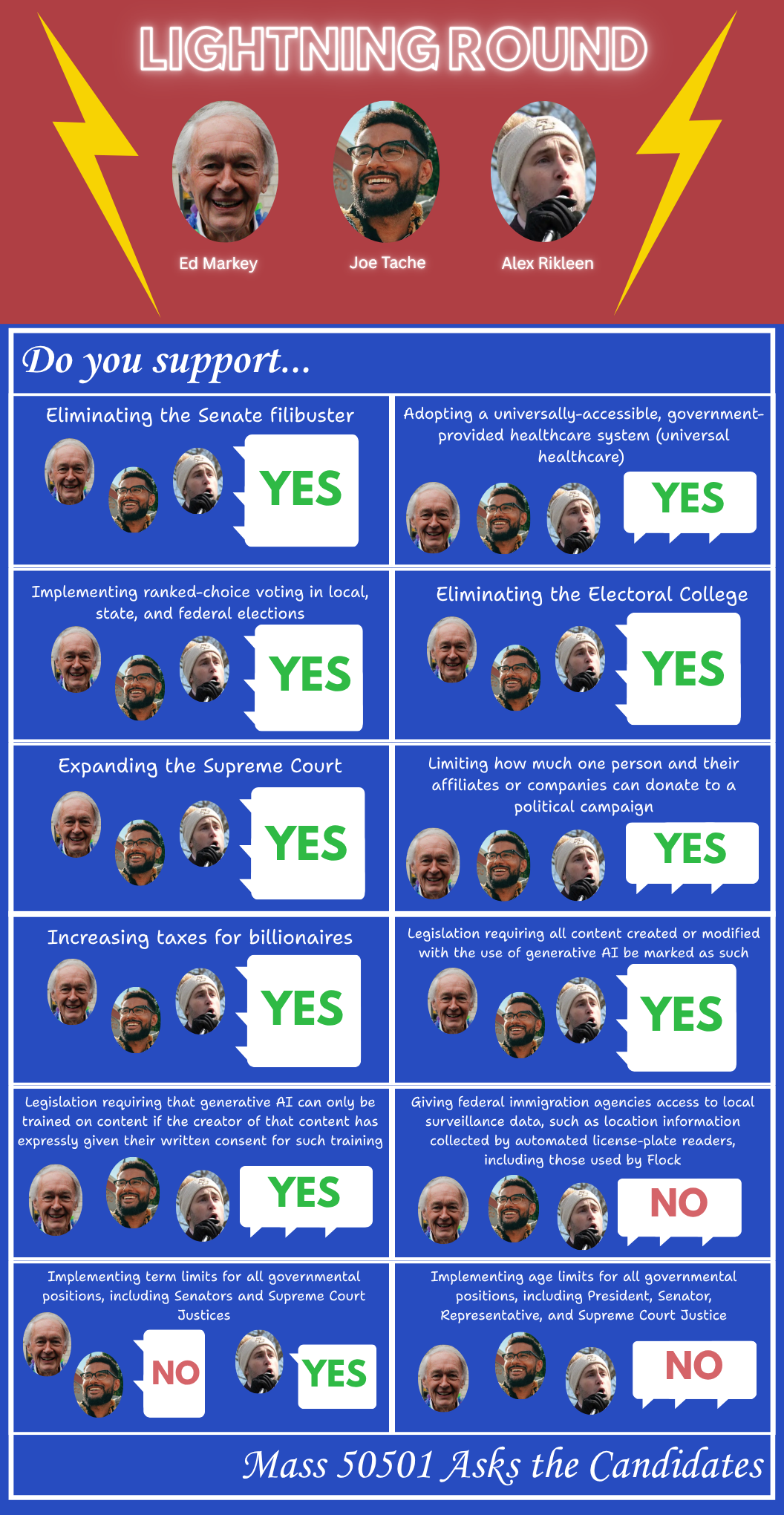
Candidate positions on eliminating the senate filibuster, universal healthcare, ranked-choice voting, eliminating the electoral college, expanding the supreme court, capping political donations, increasing taxes for billionaires, labeling of generative AI content, requiring creator consent for generative AI training, giving federal immigration authorities access to local surveillance data, term limits, and politician age limits.
Election day will be here before we know it! Double-check your registration status and make a plan to hit the polls with a friend. If you are intending to vote early or via an absentee ballot, you can find relevant information here. You can register to vote in Massachusetts up to ten days before the election. Your voice matters. Your vote matters. Use it!
Enjoyed this article? Get updates on the movement, volunteer opportunities, and more by clicking below.