Equal Constitutional protections for all Commonwealth Inhabitants—YES, WE CAN—with training and shared nonviolent strategy
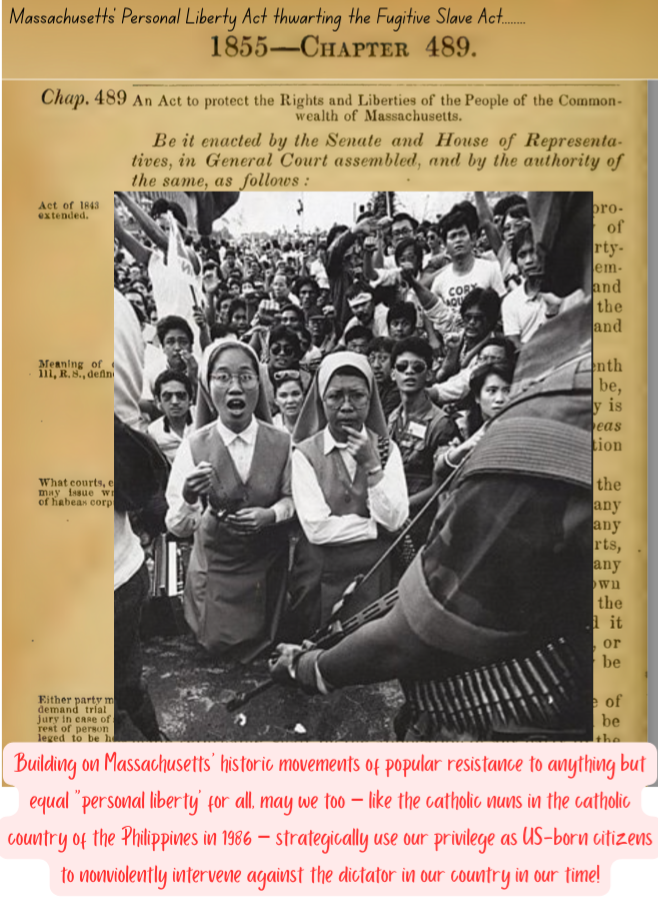
We, at the People’s Pledge of Solidarity, want to share our Commonwealth’s history which is powerfully committed to true equal justice; this informs our work and we invite you to join our nonviolent training and strategies, including on how to utilize our state’s habeas corpus. Please email us at peoplespledgeofsolidarity at gmail.com to sign our pledge of solidarity and join our network. Our state Constitution and history also could inform acting from the power of the people for true equal justice. So I am also available and would love to think with others on how state-rights could inform additional strategic efforts as we claim our power for justice.
In 1855, the Massachusetts Legislature, exercising its state constitutional authority, enacted the Personal Liberty Act to protect the Black inhabitants of Massachusetts from the very beefed up Fugitive Slave Act. It was passed in response to a growing and incredibly strong abolitionist movement and exercised the coequal constitutional state’s rights. While the U.S. Supreme Court was firmly behind the Fugitive Slave Act at the time, it acknowledged (Ableman v. Booth, 62 U.S. 506 (1859)) that we live under two coequal constitutions, both state and federal. It also affirmed that the most core value of a “free society,” in protecting personal liberty, that the states continue, even in regard to federal agents, to have the authority to exercise habeas corpus; it preserved that a U.S. agent must prove in court at least their authority as an agent and the warrant under which they take someone’s liberty.
Quite simply, we have our own complete set of rights under the Constitution of the Commonwealth of Massachusetts, that equally protects all inhabitants as to their unalienable rights to life, liberty and [real] property. BUT, unlike the U.S. Constitution, these rights are explicitly not to be “abridged or denied on the basis of sex, race, color, creed, or nation of origin.” [emphasis added]
This is far stronger equal protection language than exists in the federal Constitution by enumerating the categories protected. Most importantly, nation of origin does not exist in the federal Constitution, as such, at all. In our Commonwealth, that means that, if a U.S. born citizen cannot lose their liberty based upon a particular set of facts, then neither can anyone else from any other nation. Nor can those from certain nations be provided different rights than those from other nations originally outside of the U.S. Further, the abolitionist history of Massachusetts provides us with already constitutionally recognized moral obligations and authority as to all “Inhabitants”!
Most importantly, the originally ratified Massachusetts Constitution, under which we live, was the second one presented to the then-voters (white male property owners) for ratification. The first one included legalized slavery and was voted down. The present Constitution, in contrast, purposefully highlighted liberty which abolitionists were purposefully using to recognize that “liberty” included liberty of those who had been previously legally enslaved (Commonwealth v. Aves, 35 Mass. 193 (1836)). But, thanks to the organizing and bravery of those presently considered enslaved when it passed, within three years, in 1783, in the third of the Quock Walker cases, known as Commonwealth v. Jennison (1783), Walker proved that he had been criminally beaten. The Chief Justice of our Supreme Judicial Court (SJC) provided final interpretation of the new Constitution to the jury; he instructed that your equal right to liberty could not be denied on the basis of African descent, nor for color, complexion, or feature (which we would now call race). The amendment adding the above abridgement language was not until 1976, but had been upheld in SJC decisions inbetween.The 1780 Constitution also enfranchised male property-owners as voters regardless of what we would call race—making them all fully recognized equals in the eyes of our Commonwealth’s Constitution. In short, they were all “naturalized” in contradiction of later U.S. white-only naturalization laws.
Our Constitution’s guarantees to “inhabitants” has applied to all Massachusetts residents who chose our Commonwealth as their primary residence (now known as “domicile”) since its ratification. “Inhabitant” status is now clearly and explicitly defined in our laws as having been here and paid taxes for 183 days; remember, even buying a cup of coffee out is taxed, gas for your car is taxed, so the 183 days is likely to begin almost immediately from when somebody moved here to live in our state.
In Commonwealth v. Aves (1836), the SJC codified what had already become practice, to some extent, and became prevailing law at that point, that, if someone brought an enslaved person into our state knowingly, they were immediately manumitted. When the beefed up Fugitive Slave Act was enacted in 1850, the Chief Judge of the Massachusetts SJC reversed his general position and held that, if the bounty hunter/U.S. agent that came into the state to take someone could prove that they had, in fact, escaped from legalized slavery in the South, in that one instance, they could be returned to a slave state.
The abolitionist movement massively ridiculed the Chief Justice for this decision and protested. However, he had left the door open to the right to personal liberty reversing the power of the Fugitive Slave Act. Hence, they organized the passage of the 1855 Personal Liberty statute. Stronger than anything even proposed to the Massachusetts Legislature in the present crisis, it provided that: a judge would lose their bench if they ruled for a bounty hunter; a lawyer would be disbarred if they represented a bounty hunter; no one in Massachusetts could hold a commission of any kind from both the state and the federal government at the same time.
On top of the laws that already exist in Massachusetts, no one who is an officer of the peace may use nation of origin as a basis for their actions. Nor can they watch another officer of the peace do so. (We are seeking promulgation of regulations now that enforce the preexisting law clearly and thoroughly codified into the 2020 Police Reform Act; it was passed to ensure that no George Floyd type murder occurs in Massachusetts.)
This clear statement of our state’s authority and the state rights of all Massachusetts inhabitants in 1855 serves as a clear assertion of our state constitutional authority. The Personal Liberty Act was never repealed. It doesn’t appear in our laws now, because of the outcome of the Civil War. But, elements of it still do: most importantly, the right of any of us to act under habeas corpus. While no one should do this without the right legal materials and some training (which you can access by emailing us at peoplespledgeofsolidarity at gmail.com), habeas corpus provides the right to emergency enter any court, demand a stop to whatever proceedings are under way (including even a murder trial), and request a writ for someone being held by someone else against their will; that writ requires the identified captor to come to court with that person and prove the legal basis of their detaining that person against their will. Limited by the U.S. Supreme Court ruling in Ableman, if the person holding somebody can prove that they are a federal agent and so under the more limited habeas corpus, then they need only come and prove up their credentials as a federal agent and then, prove up their warrant.
Should they fail to prove either of those two, of course, then they would fall under the general habeas corpus and would have to produce the person they are holding. Because there is no such thing in our laws as a right without a remedy, until they have proved up their credentials, at least, they could not legally remove somebody from our state.
Further, under the Peace Officer Standard and Training Commission authority, every Massachusetts officer of the peace has not only the right, but the obligation, to insist that, were a federal agent to even temporarily attempt to detain someone, they would have to show their credentials and warrant to our local police, constables, or sheriffs. Also, school officers and campus police already have the Peace Officers Standard and Training Commission certification and to not violate it, they cannot allow anybody else presenting themselves as an officer of the peace to put their hands on somebody without proof that they have the legal authority to do so. (We are trying to get in to make sure that our Commonwealth’s officers of the peace know this and are provided with uniform guidance.)
Given all of this, our Tea Party demands should include no taxation without representation. That means that all Massachusetts inhabitants have and need to assert our equal, uniform rights, as we are all taxed, and, therefore, qualify as inhabitants for the constitutional guarantees and protections of the Commonwealth’s Constitution.
It should be noted that the Massachusetts Constitution’s Preamble provides for “citizens,” by which the writers meant members of a civic society, to ensure for each other the experience of our laws, without “fraud, violence, or surprise,” if our government institutions fail to so provide. The Tenth Amendment of the U.S. Constitution not only reserves to the states those areas of law not explicitly provided to the federal government, but also preserves to the people their rights and obligations that are not explicitly reserved to the federal government.
We, at the People’s Pledge of Solidarity, want to train especially U.S.-born Mass. residents in how to exercise these rights and responsibilities to each other nonviolently, but assertively, to clearly establish the already preexisting moral and constitutional rights to protect our Commonwealth and all of our inhabitants equally, without discrimination or prejudice, and certainly, “without fraud, violence, or surprise.” Luckily, we stand on hundreds of years of effective nonviolent interventionary actions to accomplish this, if we work together.
Please contact us at peoplespledgeofsolidarity at gmail.com. Imagine when: we have thousands trained, buddies for anyone who might be targeted, can slow them down, derail or stop any “grab”; then, we can force them to produce credentials, a warrant in court if needed, and not let them immediately remove anyone from the Commonwealth, and we can raise the greater defenses explicit as to non-discrimination in our state Constitution—and much, much more as our collective creativity builds off of these long standing legal rights and tradition of refusing the removal of our people especially our inhabitants of color who are integral to the best Commonwealth we can be!
Grace C Ross