Background Resistance: Impacts of Dissent Beyond the Front Lines
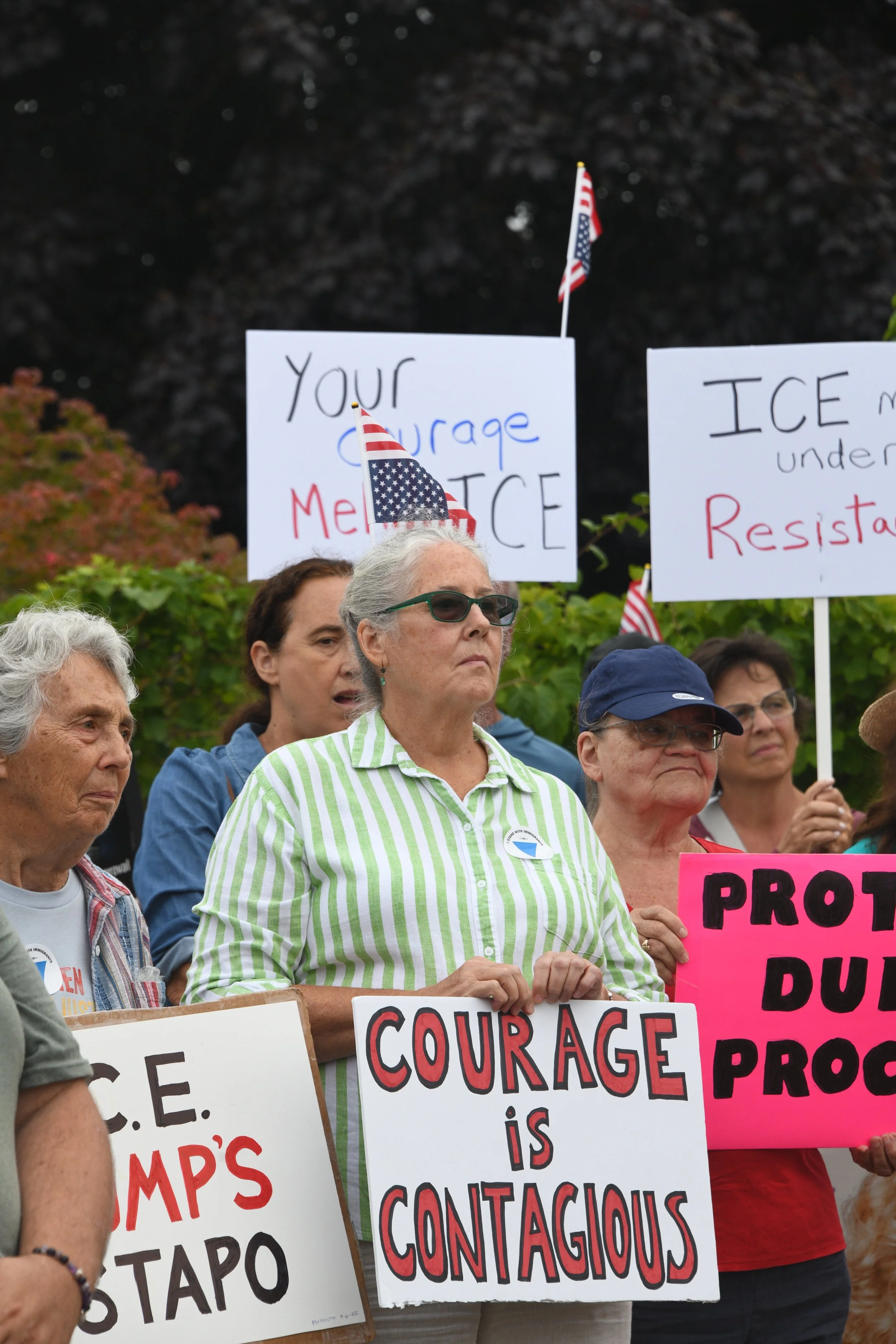
Activists in Plymouth, August 2025. Photo from a Mass 50501 volunteer.
Last spring, when the second Trump administration was still new, I shuffled nervously into a friend’s home late at night. My arms were full of snacks intended to share with strangers, and I was unsure what to expect. People from the neighborhood showed up one by one, all bearing copious amounts of food, none seemingly hungry. As the trays and boxes loaded with a variety of treats became ever more precariously placed on shrinking table space, we sat in a circle and, one by one, explained who we were and why we were there. Our neighborhood at the time was plastered with Trump’s name, Trump’s face, and the paranoia-fueled hatred of the “Other.” Venezuelans. Federal employees. “Trans ideology.” “DEI.” Fictional stories of “Criminal Illegal Aliens” raping and murdering innocents en masse weighed heavily in the air outside.
We met in the basement like it was the Prohibition Era and engaged in our illicit activity: asking questions out loud about how to care for a child whose father has been violently abducted by people in masks claiming to be from our government, what to do when your patients with Hispanic last names stop showing up for their medical appointments or show up suddenly in a panic on their way to self-deport, whether your trans family members will survive escalating violent harassment, whether secret police will come to violently detain someone because their accent betrays them as an immigrant, and whether that speaker’s legal immigration status even matters anymore. This was a time when the administration was floating the prospect of deploying military and national security assets on American streets to “prevent crime,” and we had no idea what that would mean. This was a time when a wave of immigrants were being torn away from their daily lives for having expressed pro-Palestinian sentiments long before Trump’s “Additional Measures to Combat Anti-Semitism” Executive Order apparently retroactively made those sentiments worthy of detention and deportation. This was a time when, amidst the uproar over the treatment of Kilmar Abrego Garcia, the Senior Director for Counterterrorism suggested that opposition to the Trump administration’s deportation efforts was “technically aiding and abetting criminals and terrorists”, and could be considered a federal crime. It was unclear to many of us whether even asking these questions aloud would bring violence and oppression into our own lives.
We openly discussed—some of us for the first time—the ways the rising wave of fascism in our country impacted us personally, what help we needed, and what help we desperately wanted to offer to others. In that circle, we were predominantly mothers, most with young children. We talked about how to answer questions about hatred and racism from the children who were old enough to ask them. We talked about how to handle the emotional load of processing horrors in one moment and turning around and caring for our own children the next. We talked about our fears for our children’s future. We talked about how to help. Always how to help.
With every question, with each person who broke into tears, with every gesture of support, we rejected the oppressive air of violent paranoia around us and built community. We informally built out mutual aid systems, with some people volunteering to help with childcare, some offering to give rides to those who couldn’t drive, some offering emotional support, some offering to help with connections to legal resources. The food on the table between us served as a physical manifestation of our desire to care for and support each other, even though things were scary, and even though we didn’t know each other before we walked through the door.
The Trump Administration has made use of a playbook that has been used for centuries: 1) isolate an ethnic or cultural minority (or two, or three), 2) highlight some real or imagined crime committed by an individual or a small percentage of people as a danger posed by all members of the group, regardless of how statistically likely members of that group actually are to commit that crime, and 3) justify centralization of your own power as the only way to protect the “good people” from the “bad people.” Leaning into violent spectacles of cruelty often serves as a good force multiplier, especially when paired with threats to criminalize dissent. People who are scared are more likely to remain silent when they see that someone else has become the scapegoat of the day. They might even join the scapegoating in their efforts to be seen as one of the “good people” who “definitely won’t ever be next” in the list of villainized groups.
It has been well over a year since that first basement meeting, and in that time millions of Americans have risen to resist. Through record-breaking protests, boycotts, countless flyers, resistance clothing, groups holding signs on bridges, and everyday citizens doing things like showing up to city council meetings, huge numbers of normal people have served as a meaningful check on the worst impulses of members of our government. Countless judges and attorneys heroically held their ground in support of due process and rule of law despite direct, personal threats. Veterans—and even an active-duty Air Force officer—have stepped forward to voice their opposition. Universities have defied intimidation. Officials have resigned rather than enact orders that are anathema to American values.
As everyday citizens demonstrate courage, demand integrity, and build out networks to support each other, these meetings are working their way out of basements and into the fresh air. This type of resistance is completely decentralized, so it doesn’t have the same visual impact as something like a large No Kings protest, but it has real impacts all the same. It makes space for more people to participate than could ever show up to a single event. It lends solidarity and support to those under pressure to comply with orders that defy our laws and insult our humanity. It means that, if someone might consider enacting violence against dissenters in the name of the administration, it is increasingly likely that they would face someone they know on the other end of it. It is harder to dehumanize and delegitimize a group of people when your neighbor, your cousin, or your business partner is among them. An even smaller percentage of people could potentially enact violence against dissenters with confidence that they won’t face condemnation from someone they know personally in the aftermath.
The violence continues. The danger is not gone. The democratic backsliding that we have experienced in the last two years could take decades to recover from, assuming that we are given the opportunity to recover.
The difference matters, though, between the whispers and tears in that basement meeting over a year ago, and what I see now, after several of the largest protests in American history and the community building that happens in the background of those events. Courage is contagious. When we saw institution after institution fall in line or simply fall in the early days of the second Trump administration, it was difficult to tell where the boundaries of real resistance would meet the blitzkrieg of tactics barreling past normal democratic process to enact a dizzying percentage of the goals of Project 2025. In the last year and a half, those boundaries have been tested and many have held strong. Untold numbers of brave Americans have defied threats, pressure, and danger to support our democratic institutions. Many of those brave Americans have never been to a protest or made a sign. They are there nonetheless, quietly and defiantly doing their jobs with the same integrity they have always had, sending emails to their elected officials, wearing symbols of resistance, feeding people, providing emotional support, and taking thousands of other small actions that, together, build up to a movement with the ability to check the power of an administration run amok.
As we head into the midterms and I see our own president leading his followers in a pledge to “cheat like hell” in the elections, I feel the gravity of the threat to our democracy in my bones. I also understand that the impact of that pledge will be determined not just by the fact of our president demanding it, but also by the number of Americans who are actually willing to step into that traitorous role. It will be determined by the number of Americans willing to look away quietly rather than speak out. It will be determined by countless instances of honor wrestling with fear in homes across the country.
I am reassured by the number of Americans who have responded to threats to our democracy not with silence but with defiance. I am reassured by the number of Americans who are leaning into those networks of support that have formed in the wake of cruelty by mobilizing those networks to get to the polls and vote. I am reassured by the number of Americans who are still, despite exhaustion, constantly reaching out to offer each other help.
We have come a long way since those harrowing early months. We have stepped into the power of our voices, and found that there are limits to the power of the voices of others. The integrity of our elections will be determined not just by the whirlwind pace of rule changes, redistricting efforts, and messaging designed to make people cede the power of their vote out of cynicism or fear; the integrity of our elections will also be determined by the wave of Americans who have been resisting, quietly or loudly, in the open or behind the scenes, for hours every week or in small pockets of time squeezed between schedule blocks in a busy life. Efforts to promote cynicism, fear, and hatred don’t have the same impact they used to. We aren’t going back into basements. We dissent, we plan, and we will see you at the polls.
Check your voter registration status in Massachusetts here:
https://www.sec.state.ma.us/VoterRegistrationSearch/MyVoterRegStatus.aspx
Learn about voting options here:
https://www.sec.state.ma.us/divisions/elections/elections-and-voting.htm
Check out Mass 50501’s Protect Our Vote campaign and take our public pledge to protect election integrity. You can also find up-to-date voting and volunteer resources. Add your voice to the opposition and learn ways you can take action as we head into the midterms.
Enjoyed this article? Get updates on the movement, volunteer opportunities, and more by clicking below.